

Summary
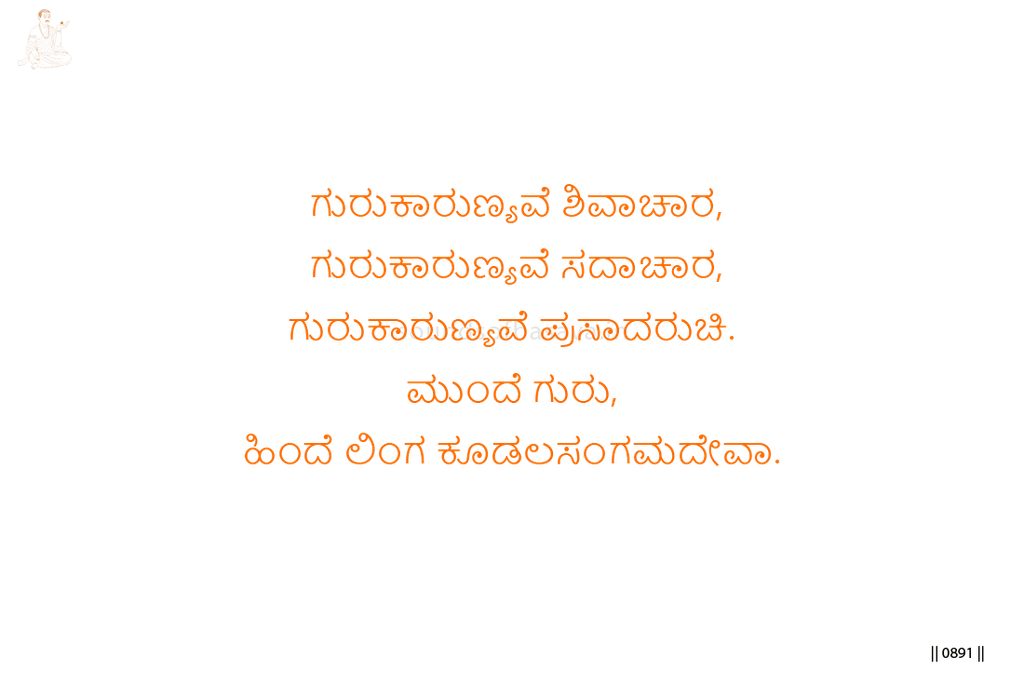
Basavanna gathers Shivachara, Sadachara, and the taste of Prasada into one source: Guru-karuṇya. Right conduct, Shiva-centered conduct, and the inward relish of grace do not arise as separate achievements held by the seeker. They unfold through the compassion of the true Guru.
The vachana is brief, but its structure is complete. Guru’s grace becomes conduct. Guru’s grace becomes rightness. Guru’s grace becomes the ability to receive Prasada as living experience rather than mere sacred substance.
The final image gives the seeker’s orientation: before me, Guru; behind me, Linga. The Guru stands before as revealer, guide, and awakener. The Linga stands behind as the abiding Divine ground from which the whole path is sustained.
Thus Basavanna does not present the path as self-made attainment. The seeker walks held between revelation and foundation, guided by Guru-karuṇya and grounded in Kudalasangama Deva.
Imagery & Symbolic Relevance
The first declaration is “Guru’s grace itself is Shivachara.” Shivachara is not reduced to outward observance or sectarian identity. It becomes living Shiva-centered conduct when awakened by Guru’s compassion.
The second declaration is “Guru’s grace itself is Sadachara.” Right conduct is not merely social morality or self-discipline. It is conduct made truthful by grace, where the seeker’s life begins to align naturally with the path.
The third declaration is “Guru’s grace itself is the taste of Prasada.” Prasada is not only received outwardly. It must be tasted inwardly as grace, acceptance, and transformed participation in the Lord.
The repetition of Guru-karuṇya is central. Basavanna does not say that Guru’s grace assists these realities from outside. He says Guru’s grace itself is their living source.
The image “before me, Guru” gives direction. The Guru stands ahead because the seeker needs revealed orientation. Without Guru, conduct can become mechanical, and Prasada can remain merely external.
The image “behind me, Linga” gives foundation. Linga is not left behind in the sense of being abandoned. It is the ground that supports every step. The seeker moves with Guru before and Linga behind, held within Kudalasangama Deva’s presence.
Lingayoga
In Lingayoga, this vachana teaches that conduct and reception must arise from living transmission. Shivachara and Sadachara cannot be manufactured by outer imitation alone. Prasada cannot be reduced to consumption or ritual receipt. Each becomes living only through Guru-karuṇya.
For Sharana Sthala, the practice-point is direct: remain receptive to the Guru’s grace. Let that grace become conduct, rightness, and the inward taste of Prasada.
The seeker must also preserve the orientation of the vachana. Walk with Guru before and Linga behind. Guidance and ground, revelation and abiding presence, are not separate possessions. They are the living field in which the Sharana is formed.
Editorial Commentary
The phrase “Guru’s grace itself” should not be weakened into “Guru’s grace helps.” Basavanna’s statement is stronger. Guru-karuṇya is the living source through which Shivachara, Sadachara, and Prasada-ruchi become real. The final image should also remain simple: Guru before, Linga behind, Kudalasangama Deva as the whole field of the path.
Related Vachana
Supporting Vachana
Pranalingi Sthala Vachana 631 — The Hollow Talk of Shivachara
Pranalingi Vachana 631 supports this teaching by asking what use there is in speaking of Shivachara when Kudalasangama Deva is not livingly present. It also asks what use daily observance has without truth, and what use inner speech has when Linga has withdrawn. This prepares Vachana 1170 directly. In Vachana 631, Shivachara is hollow when separated from Linga, truth, love, and the living presence of Kudalasangama Deva; in Vachana 1170, Basavanna reveals the source by which Shivachara becomes living: Guru-karuṇya itself becomes Shivachara, Sadachara, and the taste of Prasada.
Advancing Vachana
Aikya Sthala Vachana 1177 — You Alone Are the Doer
Aikya Vachana 1177 advances this teaching by revealing the deeper agency behind Guru-karuṇya. There, Kudalasangama Deva alone is the doer for Guru, Linga, Jangama, Prasada, and Upadesha, and once He is known as the doer for the seeker as well, nothing remains to seek or reject. This is the natural Aikya fulfillment of Vachana 1170. In Sharana Vachana 1170, Guru’s grace is the living source of conduct and Prasada-ruchi; in Aikya Vachana 1177, that grace is recognized as Kudalasangama Deva’s own action moving through the entire sacred path.
