

Summary
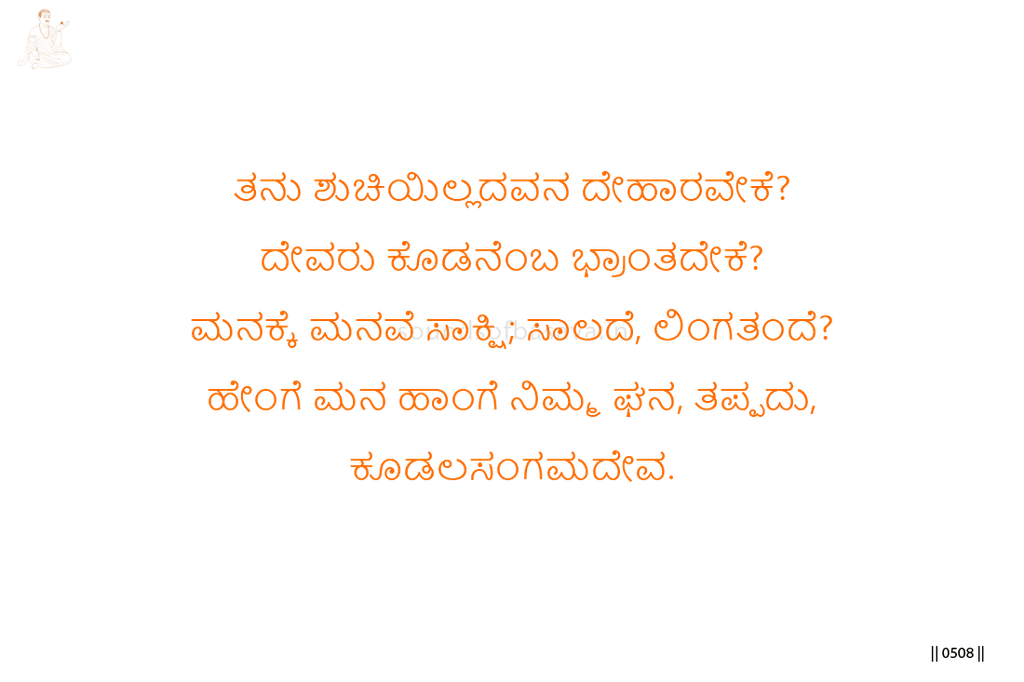
In this vachana, Basavanna questions outer worship when inner purity is absent. If the self is not pure, what use is body-centered worship?
He then questions the delusion that “God will give.” The issue is not grace itself, but passive expectation without inward correction. The seeker cannot use divine giving as an excuse to leave the mind unexamined.
Basavanna then gives the central teaching: for the mind, the mind itself is witness. The mind knows its own condition. Before Kudalasangama Deva, he teaches that Linga is not reached by bodily worship, expectation, or self-deception, but through the mind’s honest recognition of itself.
Imagery & Symbolic Relevance
The first image is inner impurity. Basavanna begins by asking what use bodily worship has when the self has not become pure. The problem is not the body itself, but worship that does not reach inward.
The second image is deluded expectation. To say “God will give” while avoiding inner purification becomes a form of bhranti, or confusion. Such expectation does not become realization.
The third image is the mind as witness. This is the center of the vachana. The mind cannot hide from itself. It knows its own movement, impurity, intention, and turning.
The question of Linga then follows. Linga is not established by outward claim. The mind’s own witness must become clear enough to stand before Linga without self-deception.
The final teaching is that as the mind stands, so the true measure follows. The inner condition cannot be bypassed. Before Kudalasangama Deva, the mind’s state becomes decisive.
Lingayoga
In Lingayoga, this vachana teaches inward examination. The seeker must not rely only on bodily worship, external practice, or expectation of divine giving.
For Pranalingi Sthala, the emphasis is on inward clarity. The mind must become honest before Linga. It must see its own condition rather than cover itself with outer worship.
The practice-point is direct: let the mind witness itself. Without that honesty, worship remains external and the relation to Linga does not become inwardly true.
Editorial Commentary
The line “God will give” should not be read as rejection of grace. Basavanna is correcting a delusion: expecting divine gift while leaving the mind unpurified.
The phrase “the mind itself is witness” should be kept central. It makes the vachana a teaching of self-examination rather than speculation.
Related Vachana
Supporting Vachana
Prasadi Sthala Vachana 849 — The Fragrance of Truth is Known Only By Living It
Prasadi Vachana 849 supports this vachana by teaching that truth must be known directly. There, taste is known by tasting, and fragrance does not need outside certification. Direct experience itself becomes the witness.
Vachana 647 says that for the mind, the mind itself is witness. Vachana 849 supports this by showing that living truth does not depend on outer proof alone. The seeker must know directly; otherwise worship, expectation, and speech remain incomplete before Kudalasangama Deva.
Advancing Vachana
Sharana Sthala Vachana 799 — Knowledge That Is Not Knowing
Sharana Vachana 799 advances this teaching by testing knowledge itself. There, Basavanna asks what kind of knowledge does not know Kudalasangama Deva and declares that such knowledge is still ignorance.
In Vachana 647, the mind is called to witness itself honestly before Linga. In Vachana 799, this advances into Sharana Sthala as the final measure of knowing: unless knowledge knows Kudalasangama Deva, it remains incomplete. Thus the Pranalingi teaching of inward witness matures into Sharana knowing that rests only in the Lord.
