

Summary
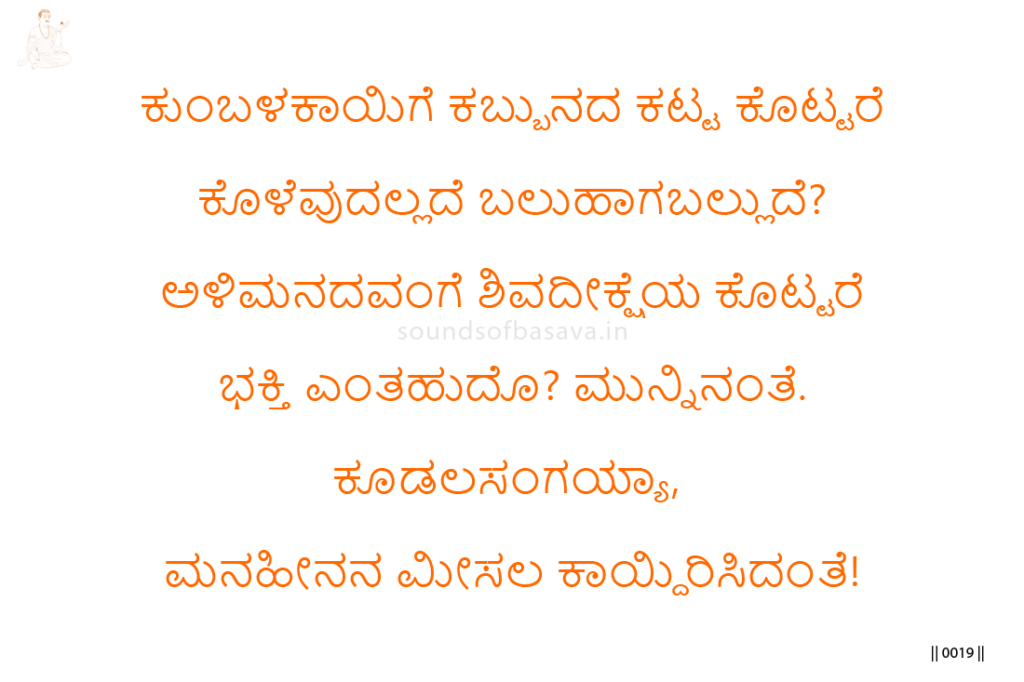
In this vachana, Basavanna shows that sacred giving cannot bear fruit where inward fitness is absent. A pumpkin wrapped or bound with a strong covering does not become sound if it is already spoiled within.
He applies this to initiation. If dīkṣā is given to one whose heart is weak, bhakti does not arise by that act alone.
The vachana teaches that the receiver matters. The Linga is sacred, but the mind that receives it must be steady, sincere, and prepared before Kudalasangama Deva.
Imagery & Symbolic Relevance
The pumpkin is the central image. Its outer covering may be strengthened, decorated, or protected, but inner decay remains untouched.
Basavanna uses this to show the failure of external treatment when the inward condition is unsound. The outer act cannot reverse what the inner state refuses to support.
The unsteady heart is the spiritual equivalent of the spoiled fruit. It receives the form, but does not hold the living substance of bhakti.
Dīkṣā represents sacred initiation and entry into the path. Basavanna does not reduce its importance; he clarifies that initiation must meet inward readiness.
The final image of guarding a barren or hollow fruit sharpens the warning. One may preserve the appearance, but preservation is not transformation.
Lingayoga
In Lingayoga, receiving Linga must be joined with inward preparedness. The Anga must become capable of holding what is given.
A restless or hollow mind may possess the sign of initiation without entering the discipline it demands.
This vachana asks the practitioner to examine receptivity. The issue is not whether the sacred has been given, but whether the inner field can sustain devotion.
Practice matures when dīkṣā becomes lived bhakti rather than retained form.
Editorial Commentary
This vachana should be read as a distinction between receiving and ripening.
Basavanna places responsibility on the inner condition of the seeker without diminishing the sanctity of initiation.
Related Vachana
Supporting Vachana
Vachana 83 — The Only Auspicious Moment
Vachana 83 rejects reliance on external timing. Vachana 92 continues the correction by showing that external initiation too must be joined with inward readiness.
Advancing Vachana
Maheshwara Vachana 71 — The Unacceptable Vows
The unprepared heart of Vachana 92 advances into the stone that does not yield in Maheshwara Vachana 71. What is shown here as inner unfitness becomes, in the next movement, a hardened condition that resists transformation before Kudalasangama Deva.
