

Summary
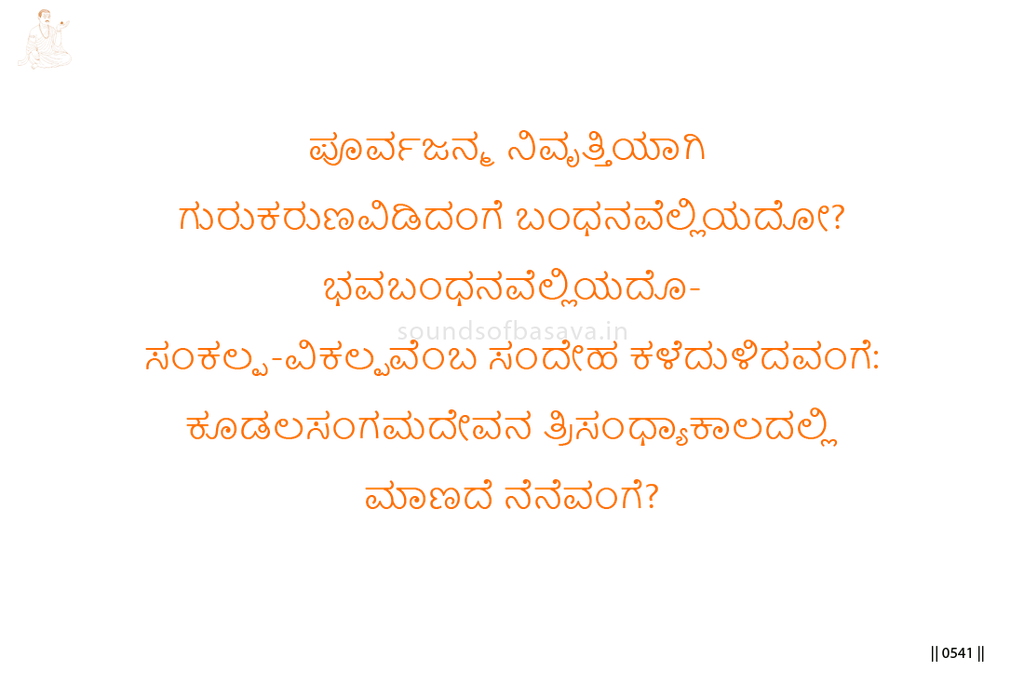
Basavanna speaks of Guru’s grace as the force that ends the burden of previous birth. When that grace has worked, he asks: where is bondage, and where is bhava-bondage?
The obstacle is sankalpa-vikalpa, the wavering of the mind through doubt, assertion, and counter-movement. When this doubt is removed, bondage loses its hold.
The teaching then becomes remembrance. The seeker must remember Kudalasangama Deva without lapse at the three sandhyā times.
Imagery & Symbolic Relevance
Previous birth represents the continuity of bondage carried from before. Guru’s grace cuts that continuity.
Bondage and bhava-bondage point to the hold of becoming. Basavanna’s question shows that when doubt is removed, bondage no longer stands in the same way.
Sankalpa-vikalpa is the central inner obstruction. The mind wavers, constructs, doubts, and divides. Its removal brings steadiness.
The three sandhyā times show disciplined remembrance. Basavanna does not abandon time; he sanctifies it through repeated recollection of Kudalasangama Deva.
Lingayoga
In Lingayoga, this vachana teaches that Guru’s grace must become inwardly effective. It removes doubt and steadies remembrance.
For Pranalingi Sthala, remembrance must not remain occasional. It must return again and again through the day, holding life in relation to Kudalasangama Deva.
The practice-point is direct: receive Guru’s grace, let sankalpa-vikalpa fall, and remember Kudalasangama Deva without lapse.
Editorial Commentary
The title should not suggest that time itself disappears. The Kannada emphasizes remembrance at the three sacred junctions.
The central movement is clearer as: Guru’s grace removes doubt, bondage loses its hold, and remembrance becomes steady.
Related Vachana
Supporting Vachana
Prasadi Sthala Vachana 1254 — The Grace That Arrives Unasked
Prasadi Vachana 1254 supports this teaching by showing the true Prasadi as one who does not desire or imagine, but receives only the Prasada that comes through the Guru.
Vachana 871 carries this into Pranalingi Sthala. Guru’s grace removes sankalpa-vikalpa, and the seeker no longer follows mental desire, imagination, or doubt. What remains is disciplined remembrance of Kudalasangama Deva.
Advancing Vachana
Sharana Sthala Vachana 174 — The Eternal Now of Devotion
Sharana Vachana 174 advances this teaching by carrying remembrance into the present without delay. It says not to speak of yesterday or tomorrow, but to become Sharana now and remember Kudalasangama without break.
In Vachana 871, remembrance is held at the three sandhyā times after Guru’s grace removes doubt. In Vachana 174, this matures into Sharana Sthala as present, unbroken remembrance before Kudalasangama Deva.
