

Summary
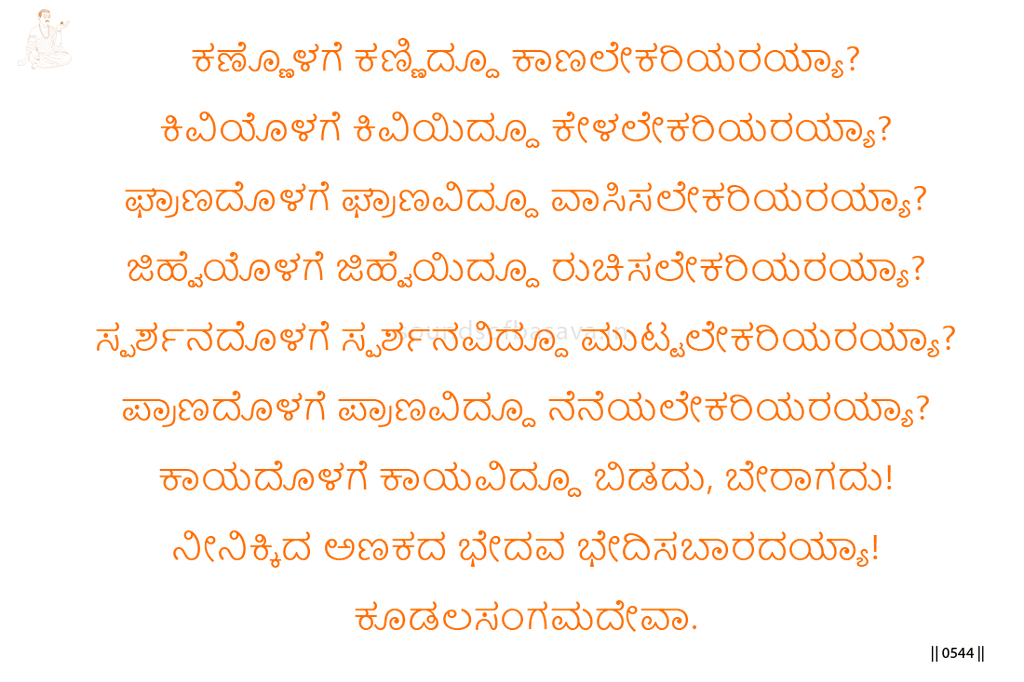
Basavanna examines each faculty from within itself. There is eye within eye, ear within ear, smell within smell, taste within taste, and touch within touch, yet ordinary operation does not become true knowing.
He then turns to prana. Even prana within prana does not remember by itself. Bodily life continues, but the subtle distinction placed within it is not easily discerned.
The teaching is clear: senses, breath, and body are present, but presence alone is not realization. The hidden bheda placed by Kudalasangama Deva must be known without breaking it through ordinary perception.
Imagery & Symbolic Relevance
The eye within the eye shows that physical sight is not inner seeing. The ear within the ear shows that hearing is not realization.
Smell, taste, and touch deepen the same point. Sensory contact does not reveal the inner principle by itself.
Prana within prana is the central movement. Life-force is present, yet remembrance does not arise automatically.
The body within the body does not leave or become separate. Basavanna points to a nearness that is never absent, yet cannot be grasped merely by the senses.
Lingayoga
In Lingayoga, this vachana teaches that the senses must be refined into awareness. Seeing, hearing, touching, breathing, and embodied living must not be mistaken for final knowing.
For Pranalingi Sthala, prana must become joined with remembrance. Breath alone does not complete the path unless it reveals its relation to Kudalasangama Deva.
The practice-point is direct: do not rely on sensory functioning alone. Let the senses, prana, and body become inwardly clarified.
Editorial Commentary
The phrase “hidden distinction” should be handled carefully. Basavanna is not rejecting the senses, prana, or body. He is saying that their ordinary functioning cannot by itself disclose the subtle bheda placed by Kudalasangama Deva.
Related Vachana
Supporting Vachana
Prasadi Sthala Vachana 1015 — How Can the Unknown Be Known?
Prasadi Vachana 1015 supports this teaching by questioning the limits of knowledge, bhava, speech, and doctrine. What is beyond ordinary knowing cannot be grasped by knowledge as an object, nor fully described by speech.
Vachana 909 carries this into Pranalingi Sthala. The senses and prana function, yet they do not automatically reveal the hidden truth within. Knowing requires grace-filled discernment beyond ordinary perception.
Advancing Vachana
Sharana Sthala Vachana 1337 — Show Me the Difference Between Prana and Prana-Linga
Sharana Vachana 1337 advances this teaching by directly asking for the distinction between prana and Prana-Linga to be shown. It confesses that outer worship has remained hollow when the living relation between prana and Linga is not known.
In Vachana 909, Basavanna says that even prana within prana does not remember by itself. In Vachana 1337, this becomes Sharana Sthala as the direct prayer to know the intimate relation between life-force and Prana-Linga before Kudalasangama Deva.
