

Summary
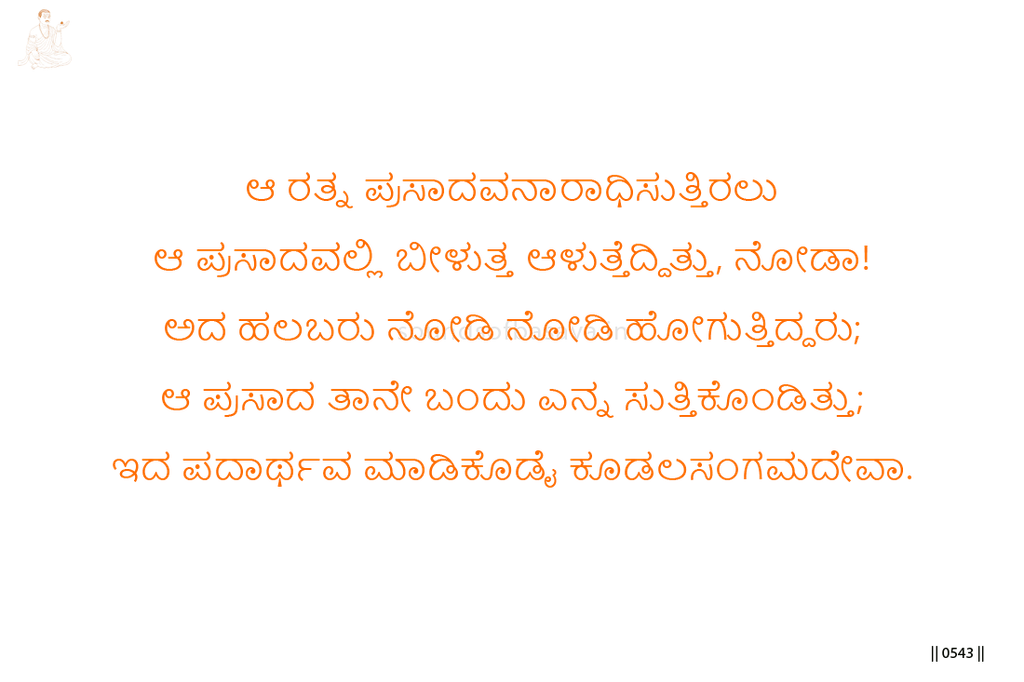
In this vachana, Basavanna speaks of the gem-like Prasada. While worshipping it, he does not remain outside as an observer. He falls into it and is drawn into its depth.
He then contrasts this with those who only look. Many see the Prasada again and again, yet pass away without entering it. Their seeing does not become inward participation.
The decisive movement is that Prasada itself comes and surrounds him. Grace is not merely before the seeker; it approaches, encircles, and holds him.
Basavanna finally asks Kudalasangama Deva to make its padārtha clear. He does not claim full understanding. He asks that the meaning, substance, and manifest truth of this Prasada be made known.
Imagery & Symbolic Relevance
The first image is the gem-like Prasada. A gem suggests preciousness, depth, and concentrated value. Prasada is therefore not treated as ordinary receiving.
The second image is worshipping the Prasada. Basavanna is not casually looking at it. He is already turned toward it with reverence.
The third image is falling into Prasada. This marks the difference between outer seeing and inward entry. Prasada becomes the field into which the seeker is drawn.
The many who look and pass away form the warning. Repeated sight does not itself bring transformation. One may see and still remain outside.
The Prasada coming and surrounding him shows grace as active. It is not held by the seeker; it holds the seeker.
The final image is padārtha. Basavanna asks that the inwardly received Prasada become clear in meaning and substance before Kudalasangama Deva.
Lingayoga
In Lingayoga, this vachana teaches the difference between seeing Prasada and being taken into Prasada. Outer sight is not enough. Worship must become inward participation.
For Pranalingi Sthala, the point is precise. Prasada must not remain a passing vision or private sweetness. It must ripen into clear lived understanding.
The practice-point is direct: do not merely look at Prasada and pass away. Let it draw the inner being, surround awareness, and reveal its padārtha through Kudalasangama Deva.
Editorial Commentary
The gem image should be retained because it gives Prasada its sense of precious inward depth.
The contrast between looking and being surrounded is central. Basavanna does not present Prasada as something possessed by the seeker, but as grace that comes near and takes hold.
Related Vachana
Supporting Vachana
Prasadi Sthala Vachana 1327 — The Prasada Came and Surrounded Me
Prasadi Vachana 1327 supports this vachana by giving the earlier Prasadi form of the same experience. There, the gem-like Prasada is worshipped, entered, and received as a presence that comes and surrounds the seeker.
Vachana 907 carries this into Pranalingi Sthala as ripening. What appears in Prasadi as being drawn into Prasada becomes here the prayer that its padārtha be made clear. Thus Prasadi inward participation supports the Pranalingi demand for Prasada to become known in meaning and substance.
Advancing Vachana
Sharana Sthala Vachana 1271 — Salutations to Chennabasavanna, the Embodiment of Prasada
Sharana Vachana 1271 advances this teaching by showing Prasada no longer only as an experience received by the seeker, but as a realized state embodied in Chennabasavanna. Basavanna cannot fully describe such a Prasadi and finally bows with “Namo, Namo.”
In Vachana 907, Prasada comes, surrounds, and seeks its padārtha through Kudalasangama Deva. In Vachana 1271, this matures into Sharana Sthala as reverence before one who has become the living embodiment of Prasada. Thus Pranalingi ripening advances into Sharana recognition of Prasada made visible in realized being.
