

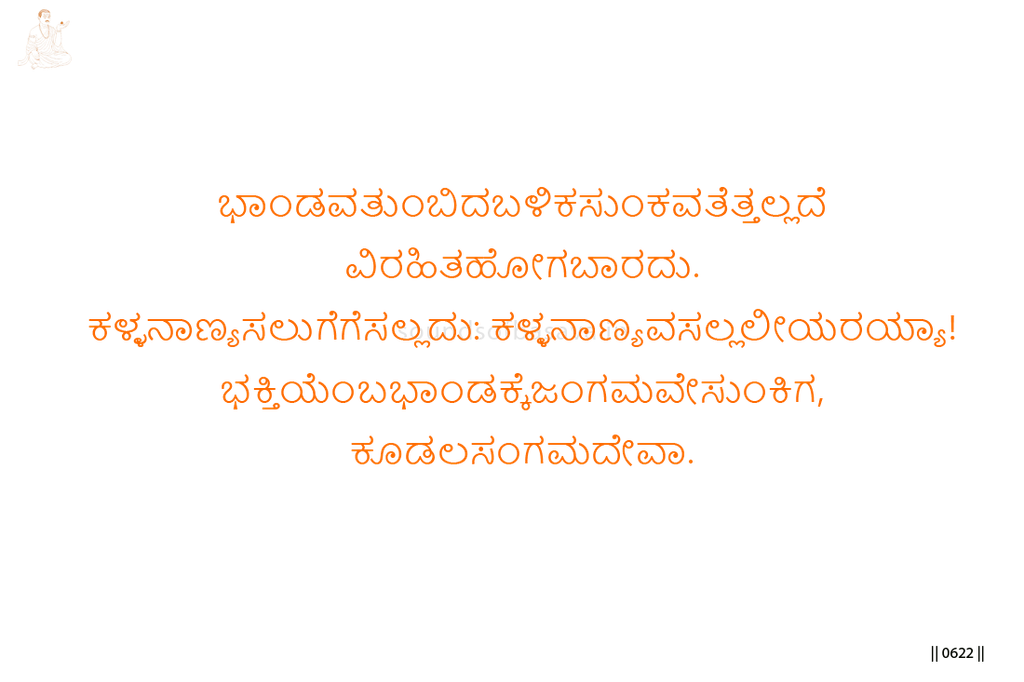
Summary
In this vachana, Basavanna uses the language of store, toll, and coin to test the truth of bhakti. A store may be filled, but its movement is not complete unless the proper due is rendered. In the same way, devotion cannot remain as private accumulation or outward appearance.
The counterfeit coin gives the second test. A false coin may resemble a true one, but it cannot pass in rightful exchange. So too, devotion that appears shaped like bhakti but lacks truth cannot pass where real offering is required.
The final line gives the center of the teaching: for the store called bhakti, Jangama is the toll-point. Jangama is the living field where devotion must reach, serve, and become accountable. Bhakti is therefore not complete by being stored inwardly or displayed outwardly. It must enter right relation with the living Jangama before Kudalasangama Deva.
Imagery & Symbolic Relevance
The filled store is the first image. It shows accumulation, fullness, and possession. Basavanna does not treat fullness as completion by itself. What is gathered must move rightly and meet its due.
The toll is the next image. Toll is not decoration; it is the point where passage is tested. Something cannot simply claim to be valid and pass on its own terms. It must be rendered where it is due.
The counterfeit coin sharpens the teaching. Its shape may be correct, but its substance is false. In real exchange, appearance is not enough. What is false cannot pass as true.
The store called bhakti gathers these images into one spiritual measure. Devotion may seem full through speech, emotion, practice, or reputation. Yet if it cannot pass into living relation, its fullness remains unproven.
The Jangama is the decisive image of completion. Here Jangama should not be reduced to a distant category or merely an individual figure. In the force of the vachana, Jangama is the living receiving field of devotion, the living society in which bhakti must become service, right conduct, and truthful circulation.
Together, the images teach that bhakti has value only when it is true enough to pass into life. Fullness must render its due. False coin fails. Jangama receives and tests what devotion really is.
Lingayoga
In Lingayoga, this vachana prevents bhakti from becoming inward storage or outward display. Devotion must become movement through right relation.
The practice-point is direct: let bhakti reach Jangama. If devotion remains only personal feeling, it is incomplete. If it takes the form of offering but does not enter the living field, it remains like a coin that has not passed.
For Sharana Sthala, the teaching also carries a social implication. A rightly formed Sharana life contributes to the living society through truth, service, and accountable offering. The greatness of a Sharana community does not arise from stored devotion, but from bhakti that circulates rightly through Jangama.
Editorial Commentary
The word “sunkiga” should be preserved in meaning. It points to the receiving or toll-point through which the goods of bhakti must pass. This makes Jangama central, not secondary. Basavanna’s concern is not merely whether devotion exists, but whether it becomes truthful in the living field.
Related Vachana
Supporting Vachana
Pranalingi Sthala Vachana 222 — The Ancient Guest Within
Pranalingi Vachana 222 supports this teaching by warning that Linga and Jangama may be given a place in religious language while the living presence is not recognized in life itself. That vachana insists that recognition must happen while the body is alive and awareness can respond. Vachana 198 applies the same concern to bhakti: devotion cannot remain stored, named, or displayed; it must pass into the living Jangama, where its truth is rendered.
Advancing Vachana
Aikya Sthala Vachana 418 — Awareness in Act and Thought
Aikya Vachana 418 advances this teaching by carrying bhakti into complete integration. Vachana 198 says that Jangama is the toll-point for the store called devotion. Aikya Vachana 418 shows the fulfilled state: conduct and thought must move in awareness, Linga must be seen in Jangama, and truth spoken must become truth lived. Thus the Sharana-stage test of bhakti advances into Aikya as undivided awareness in life, conduct, and living relation before Kudalasangama Deva.
