

Summary
Basavanna begins with two direct instructions: know conduct and know thought. Spiritual life cannot remain only in inward awareness, nor only in outward behavior. Both must be brought under clear seeing.
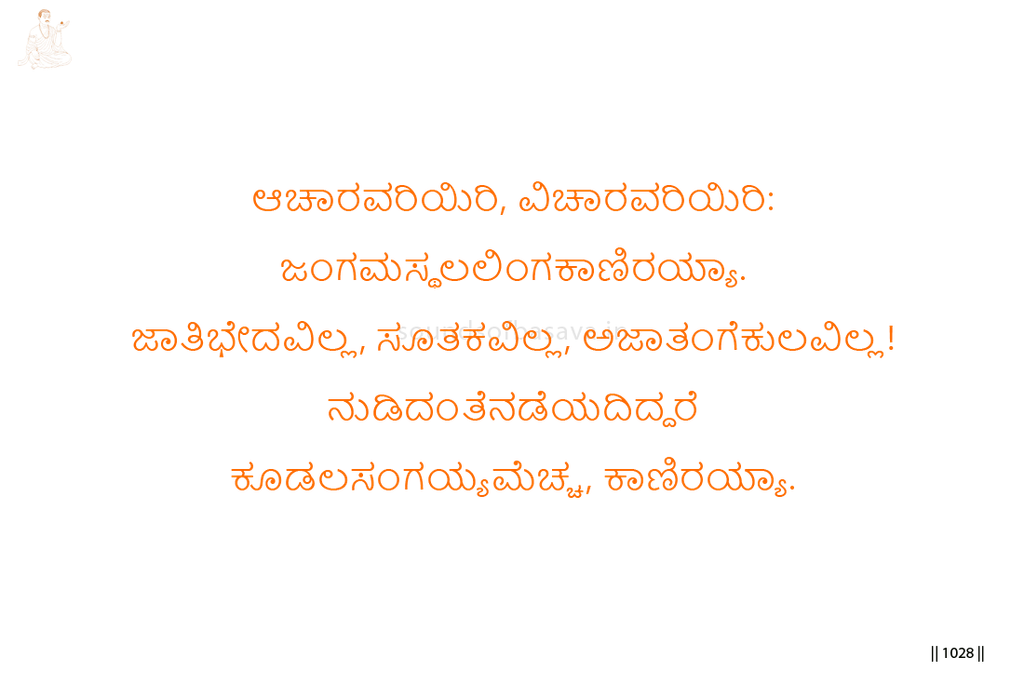
He then says: see the Linga in the Jangama-sthala. Linga must not be confined to fixed worship alone; it must be recognized in the living field of Jangama. The Aikya source states that Vachana 418 carries Linga-practice into full-life integration, where conduct and thought must move in awareness and Linga must be seen in Jangama.
The vachana then removes social and ritual divisions: there is no caste-difference, no sutaka, and no lineage for the Unborn. The final test is strict: if one does not walk as one has spoken, Kudalasangama Deva will not be pleased. Word, conduct, thought, and seeing must become one.
Imagery & Symbolic Relevance
The first instruction, “know conduct,” gives the outer field of the vachana. Conduct is the visible movement of life: how one walks, acts, serves, responds, and lives before others.
The second instruction, “know thought,” gives the inner field. Thought is not hidden from spiritual discipline. Basavanna places inward movement under the same demand as outward conduct.
Together, conduct and thought form the first pair. Outer action and inner reflection must not move separately. If conduct is right but thought is divided, practice remains incomplete. If thought is clear but conduct does not follow, awareness has not entered life.
The line “see the Linga in the Jangama-sthala” gives the central sacred image. Jangama-sthala is the living field where sacred presence moves. Linga must be seen there, not only in the fixed form.
This line continues the earlier Aikya movement from Linga and Jangama as two held together toward a more complete recognition. The source states that when Linga is seen in Jangama, human categorization collapses.
The line “there is no caste-difference” gives the first social correction. Once Linga is seen in Jangama, caste cannot remain the measure of the living sacred presence.
The line “there is no sutaka” gives the second correction. Ritual impurity cannot stand before the recognition of the Unborn. What is born, touched, polluted, or excluded belongs to social and bodily categories; Basavanna points beyond that measure.
The line “the Unborn has no lineage” gives the deepest ground of the teaching. The Unborn cannot be assigned caste, family, origin, or inherited status. The source explains that what is unborn has no caste, what is originless has no inherited division, and what is all-pervading cannot be segmented by human systems.
The final line, “if one does not walk as one has spoken,” gives the test of truth. Correct speech alone is not enough. If the word does not become conduct, the word remains divided from life.
The closing statement that Kudalasangama will not be pleased completes the warning. Basavanna does not allow sacred speech, equality-language, or Jangama-recognition to remain verbal. It must be lived.
Together, the lines move from conduct and thought, to Linga in Jangama, to the collapse of caste, impurity, and lineage, and finally to the demand that speech and life must agree.
Lingayoga
In Lingayoga, this vachana teaches integration. The seeker must not divide practice into separate compartments: inner thought, outer conduct, Linga-worship, Jangama-recognition, social relation, and speech must all stand in one awareness.
The practice-point is direct: know conduct, know thought, see Linga in Jangama, and live what is spoken. Do not let equality remain doctrine while conduct still follows caste, impurity, lineage, or social division.
The Aikya source states that word, thought, action, and awareness must align, and that nearness to Kudalasangama is not geographic, ritual, or social, but undividedness.
Editorial Commentary
This vachana should be read as a test of lived integration. Basavanna does not merely say that caste and impurity are false; he grounds that rejection in seeing Linga in Jangama and in recognizing the Unborn.
The final line must remain severe. If speech and conduct do not meet, the teaching has not become life. Kudalasangama Deva is not pleased by correct words that are not walked.
Related Vachana
Supporting Vachana
Sharana Sthala Vachana 194 — The Living and the Lifeless
Sharana Vachana 194 supports this Aikya vachana by correcting misplaced worship. In that vachana, people honor the stone serpent but strike the living serpent; they offer food to the Linga that does not eat, but send away the arriving Jangama. The source explains that the error is not worship itself, but the separation of sacred symbol from living encounter.
Aikya Vachana 418 carries this correction into full integration. In Sharana Vachana 194, Basavanna warns against honoring the fixed form while neglecting living sacred presence. In Aikya Vachana 418, he says directly: see the Linga in Jangama-sthala, and let what is spoken become what is lived.
Advancing Vachana
Aikya Sthala Vachana 1196 — Beyond the Five Impurities
Aikya Vachana 1196 advances this teaching within Aikya Sthala. In Vachana 418, Linga is to be seen in Jangama, and caste, impurity, lineage, and speech-conduct division are removed. In Vachana 1196, the non-separation is made still more explicit: between the devotee and the Linga there is no difference, between the devotee and the Jangama there is no difference, and when Guru, Linga, Jangama, and the devotee partake as one, division, separation, impurity, and sin have no place.
Thus Vachana 418 establishes awareness in conduct, thought, and living recognition, while Vachana 1196 carries that recognition into the fuller Aikya condition where devotee, Linga, Jangama, and lived embodiment are no longer spoken of through separation.
