

Summary
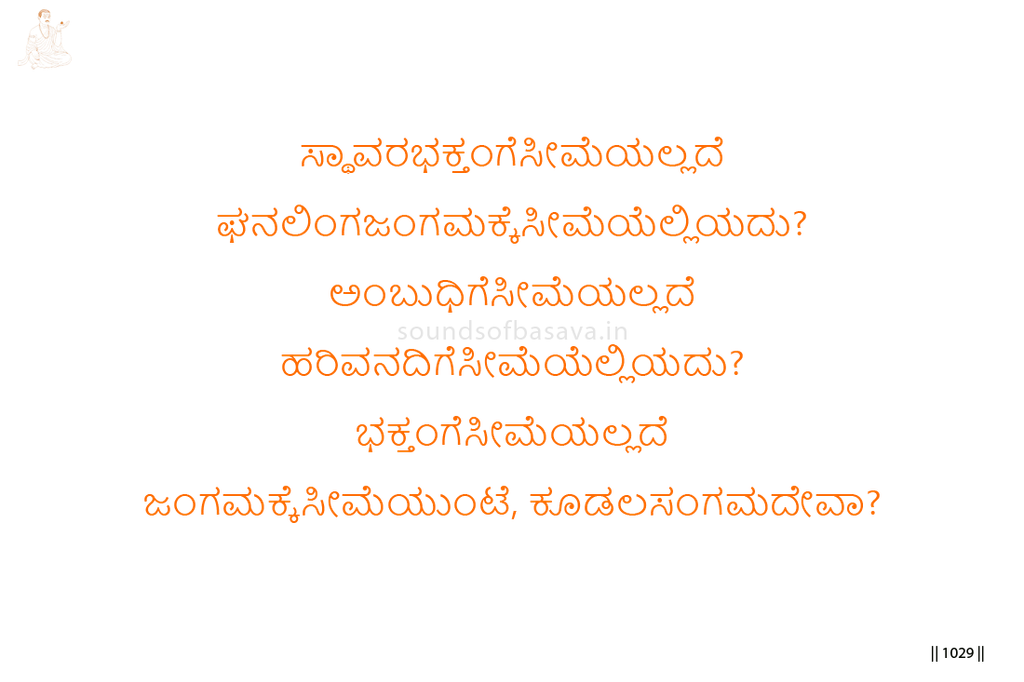
Basavanna moves from non-division to boundarylessness. He first asks whether the Sthavara-bhakta may appear to have a boundary, and then asks where any boundary can be placed upon the full Linga-Jangama.
The ocean and river image gives the central teaching. If the ocean cannot be enclosed, where can a boundary be placed upon the river that flows toward it? The river may appear limited by banks, movement, and direction, but its movement belongs to the ocean toward which it flows.
The final question brings the image back to Bhakta and Jangama. If the Bhakta cannot finally be limited, can the Jangama be limited? Before Kudalasangama Deva, the visible boundary of form, movement, body, or role cannot define the living sacred presence.
Imagery & Symbolic Relevance
The phrase “Sthavara-bhakta” gives the first image. Sthavara points to fixed form, stable devotion, and worship centered through a visible sacred support.
The question of boundary in relation to Sthavara-bhakta shows the limitation of form-bound devotion. Fixed form may guide, concentrate, and steady the seeker, but if the seeker stops there, boundary remains.
The phrase “Ghanalinga-Jangama” gives the next movement. Ghanalinga suggests fullness, density, and complete sacred presence. Jangama gives the living and moving form of that presence.
The question “where is the boundary for Ghanalinga-Jangama?” removes the limit. What is full Linga and living Jangama cannot be confined within the boundary that belongs to fixed form alone.
The ocean gives the next image. The ocean stands for vastness that cannot be enclosed by the eye, the hand, or ordinary measure.
The flowing river gives the corresponding image. The river moves through banks and directions, and so appears limited. Yet its movement is toward the ocean, and its meaning is fulfilled there.
The question “if the ocean has no boundary, where is the boundary for the flowing river?” gives the heart of the vachana. The river’s banks are visible, but they do not define its final truth. Its flow is already oriented toward the boundaryless ocean.
The line about the Bhakta extends the same image to the seeker. If the Bhakta’s movement is toward Kudalasangama Deva, the Bhakta cannot be finally confined by body, mind, identity, or separate selfhood.
The question about Jangama completes the expansion. If even the Bhakta cannot be finally bounded, how can Jangama, the living movement of sacred presence, be bounded?
Together, the lines move from fixed devotion, to full Linga-Jangama, to ocean and river, to Bhakta and Jangama. The teaching is that apparent limits may appear in practice, but they do not become the final truth before Kudalasangama Deva.
Lingayoga
In Lingayoga, this vachana teaches the seeker not to mistake the banks for the truth of the river. Form, body, practice, and individual movement may appear limited, but they must open toward the boundless field of Linga-Jangama.
The practice-point is direct: do not stop at fixed form as boundary. Let form open into living recognition. Let Bhakti flow until the apparent separation between river and ocean, Bhakta and Jangama, seeker and source no longer governs awareness.
This is a movement from form-bound devotion into boundaryless recognition. Difference is first softened; then boundary itself loses authority before Kudalasangama Deva.
Editorial Commentary
This vachana should be read as a boundary-dissolving continuation of the Linga-Jangama teaching. Earlier vachanas remove hierarchy and division; here Basavanna removes the idea of limit itself.
The river image should remain central. The river is not denied. Its movement is real within experience. But its separateness is not final. In the same way, Bhakta and Jangama may appear distinct in the field of practice, yet before Kudalasangama Deva, their boundary cannot be sustained.
Related Vachana
Supporting Vachana
Sharana Sthala Vachana 398 — The Living Altar
Sharana Vachana 398 supports this Aikya vachana by teaching that Linga-archane without Jangama is like water poured into a broken pot. Worship may be present, but it cannot hold its fruit when separated from Jangama. Linga-archane in the presence of Jangama is the path of Bhakti, and Jangama-Prasada itself becomes Linga-archane.
Aikya Vachana 419 carries this integration further. In Sharana Vachana 398, Linga-worship must not be cut off from Jangama-presence. In Aikya Vachana 419, even the boundary between fixed devotion, full Linga-Jangama, Bhakta, and Jangama is dissolved. What Sharana Vachana 398 protects from separation, Aikya Vachana 419 opens into immeasurable sacred presence.
Advancing Vachana
Aikya Sthala Vachana 1196 — Beyond the Five Impurities
Aikya Vachana 419 removes the boundaries that appear to divide Sthavara-bhakta, Ghanalinga-Jangama, river and ocean, and Bhakta and Jangama.
Vachana 1196 advances this boundarylessness into directly lived non-separation. It declares that there is no difference between the Bhakta and the Linga and no difference between the Bhakta and the Jangama. Guru, Linga, Jangama, and Bhakta partake together as one, leaving no place for division, separateness, impurity, or sin.
In Vachana 419, the river’s visible banks cannot define its final truth because its movement belongs to the boundless ocean. In Vachana 1196, the river–ocean teaching becomes shared sacred life: Bhakta, Linga, Jangama, and Guru no longer remain as separately bounded participants.
Thus Vachana 419 dissolves the idea of boundary, while Vachana 1196 reveals the fulfilled condition in which all partake as one before Kudalasangama Deva.
