

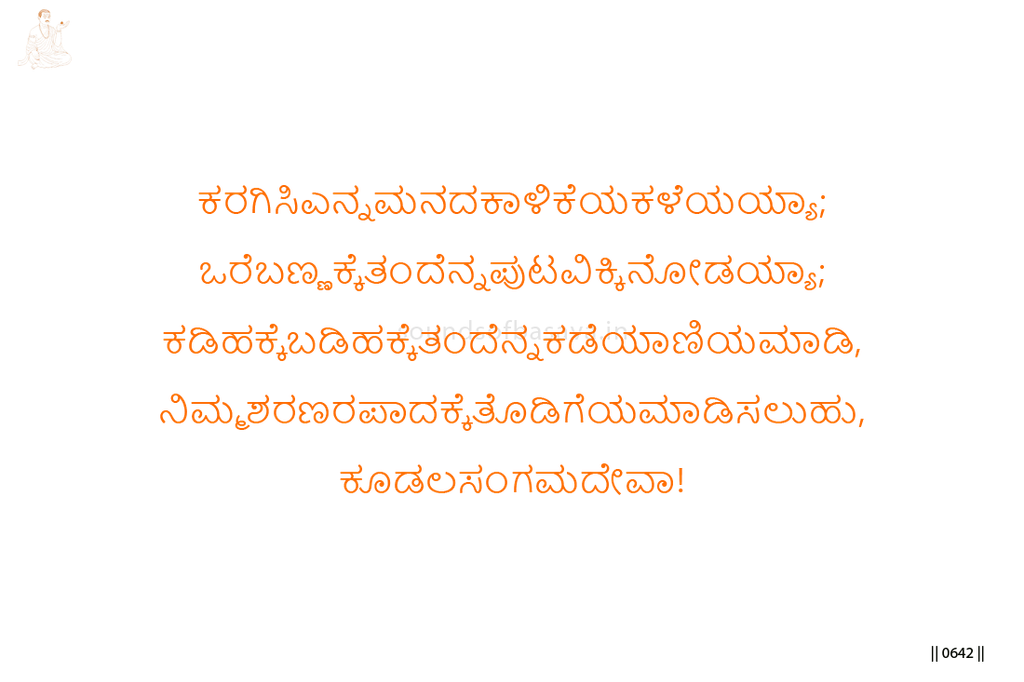
Summary
In this vachana, Basavanna asks Kudalasangama Deva to remove the dark impurity of his mind. He does not ask to be left as he is, but to be refined.
The images are those of melting, testing, cutting, and hammering. The seeker is placed before Divine scrutiny like metal being worked until its impurity is removed and its true worth is known.
The final aim is humility before the Sharanas. Basavanna asks to be made an ornament at their feet, not an ornament of status or pride. Purification becomes complete when the refined self is placed in service at the feet of Kudalasangama Deva’s Sharanas.
Imagery & Symbolic Relevance
The dark impurity of the mind is the first image. Basavanna begins with the inner stain that must be removed. The problem is not outer appearance, but what remains mixed within the mind.
Melting is the next movement. Metal cannot be purified while it remains hard and fixed. In the same way, the seeker must become workable before Kudalasangama Deva.
Testing for color or measure shows examination. The seeker is not declared pure by wish or claim. He is tested until the real condition becomes visible.
Cutting and hammering give the force of discipline. Basavanna does not soften the process. What is unfit must be struck, shaped, and made usable.
The ornament at the feet of the Sharanas is the final image. Refinement does not end in display. The purified self is placed low, near the feet, where surrender and service become its form.
Lingayoga
In Lingayoga, this vachana presents purification as surrender to being reshaped. The mind cannot purify itself by appearance; it must be offered into the transforming work of Kudalasangama Deva.
The practice-point is direct: do not resist the fire, test, cut, or hammer when they remove impurity. Let discipline make the mind fit for service.
For Sharana Sthala, the teaching is refined humility. The Sharana does not seek to become an ornament of self-importance, but an offering at the feet of Kudalasangama Deva’s Sharanas.
Editorial Commentary
The forge imagery should remain central. Basavanna’s prayer is not self-rejection, but willingness to be purified. The metal is worked because it can be made worthy. The final ornament must also be kept precise: the goal is not elevation above others, but placement at the feet of the Sharanas.
Related Vachana
Supporting Vachana
Pranalingi Sthala Vachana 568 — The Alchemy of Inner Transformation
Pranalingi Vachana 568 supports this teaching through the image of iron becoming gold by transforming touch. It teaches that the seeker is not made true by name, caste, argument, or display, but by actual change. Vachana 251 gives the Sharana form of the same principle: the mind’s impurity must be removed through melting, testing, cutting, and hammering until the seeker becomes fit to serve at the feet of Kudalasangama Deva’s Sharanas.
Advancing Vachana
Aikya Sthala Vachana 1100 — When Head and Feet Become One
Aikya Vachana 1100 advances this teaching by showing the culmination of surrender at the feet. In Vachana 251, Basavanna asks to be refined and made an ornament at the feet of the Sharanas. In Aikya Vachana 1100, the head merges with the Lord’s feet, distinction vanishes, and the darkness within is dispelled by the radiance of those feet. Thus the Sharana-stage prayer for purification and placement at the feet advances into Aikya as direct union before Kudalasangama Deva.
