

Summary
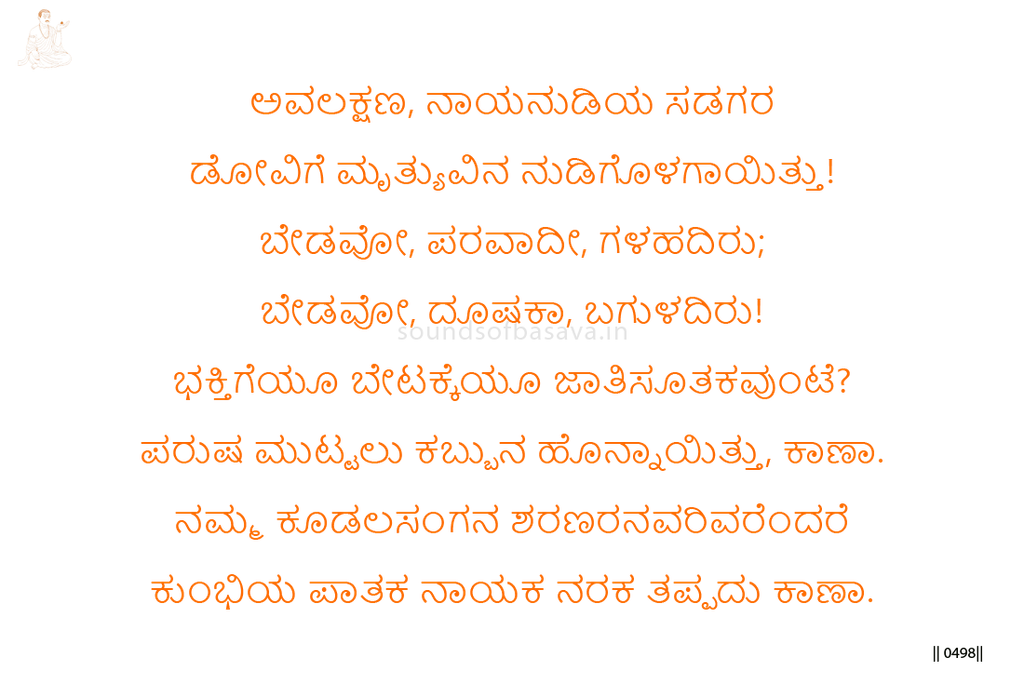
In this vachana, Basavanna begins with the image of a crooked dog’s tongue. Speech that moves without discipline, truth, or right measure becomes speech touched by death. He warns against quarrel and blame, showing that distorted speech is itself a sign of inward disorder.
He then asks whether Bhakti and knowledge have caste-boundary. This question cuts through inherited status and social division. Devotion and knowing are not measured by birth, but by transformation.
The central image is iron becoming gold through the touch of the parasu stone (philosopher’s stone), a legendary substance believed to transform base metal into gold and therefore used as a symbol of spiritual transformation. In the same way, the seeker is not made true by claim, speech, or caste identity, but by actual change. Those who do not know the Sharanas of Kudalasangama fall into the condition of ruin. The teaching is that true spiritual life is transformation, not inherited status or verbal display.
Imagery & Symbolic Relevance
The crooked dog’s tongue is the first image. It suggests speech without right direction. Basavanna places such speech near death because words that arise from distortion do not lead toward life or truth.
The warning against quarrel is the next movement. Argument and opposition do not establish Bhakti. They scatter the mind and keep the seeker outside transformation.
The warning against blame continues the same concern. Fault-finding speech may appear sharp, but it does not prove realization. It can become another form of inward impurity.
The question about Bhakti and knowledge having caste-boundary is central. Basavanna rejects the idea that devotion or knowing belongs to birth, caste, or inherited social standing.
The iron and gold image gives the decisive teaching. Iron does not become gold by being called gold. It becomes gold through transforming touch. Likewise, the seeker is not transformed by name, caste, argument, or display, but by living contact with truth.
The reference to the Sharanas of Kudalasangama gives the final measure. To know the Sharanas is to recognize the living field of transformation. To remain without that recognition is to remain exposed to spiritual fall.
Lingayoga
In Lingayoga, this vachana teaches that transformation must be real. Speech, caste, argument, blame, and public identity cannot substitute for inward change.
For Pranalingi Sthala, the emphasis is on living transformation through direct contact. The seeker must become changed like iron touched by parasu. Without such transformation, Bhakti and knowledge remain words.
The practice-point is direct: guard speech, abandon caste-measure, and seek the company and recognition of Kudalasangama Deva’s Sharanas. The path is not inherited; it is lived and transformed.
Editorial Commentary
The dog-tongue image should be kept severe. Basavanna is not speaking about ordinary speech alone, but about speech that has lost truth and direction.
The caste question should also be kept central. The vachana does not merely praise equality in general; it specifically denies caste-boundary to Bhakti and knowledge.
The iron becoming gold is not an image of surface decoration. It is an image of change in condition. Basavanna’s concern is not appearance of devotion, but transformation of the seeker.
Related Vachana
Supporting Vachana
Prasadi Sthala Vachana 142 — The Nobility of the Linga-Bearer
Prasadi Vachana 142 supports this vachana by teaching that Linga-touch, not caste-status, is the decisive measure. There, Basavanna says that whatever one may be outwardly, without Linga-touch the condition remains low; but when Linga touches, the old measure changes, just as iron touched by parasu becomes gold.
Vachana 568 carries that teaching into Pranalingi Sthala. It asks whether Bhakti and knowledge have caste-boundary, and again gives the image of iron becoming gold through transforming touch. Thus Prasadi Vachana 142 supports the Pranalingi teaching that spiritual worth is not inherited by birth; it is received through living transformation before Kudalasangama Deva.
Advancing Vachana
Sharana Sthala Vachana 628 — Breaking of Bonds
Sharana Vachana 628 advances this teaching by showing what transformation requires in the Sharana state. There, Basavanna says that if the Brahmin becomes a devotee, he must abandon the bondage of the sacred thread; if the garland-maker becomes a devotee, he must abandon old dependence on the village deity; if the merchant becomes a devotee, he must abandon hidden attachments; and if the metal-worker becomes a devotee, he must abandon dependence on Kalika.
In Vachana 568, Bhakti and knowledge are declared free from caste-boundary, and transformation is shown through iron becoming gold. In Vachana 628, that transformation advances into Sharana Sthala as the breaking of inherited bonds. Thus the Pranalingi rejection of caste-bound spiritual measure matures into Sharana belonging: the seeker is no longer held by birth, occupation, or old dependence, but only by the bond of Kudalasangama Deva’s Sharanas.
