

Summary
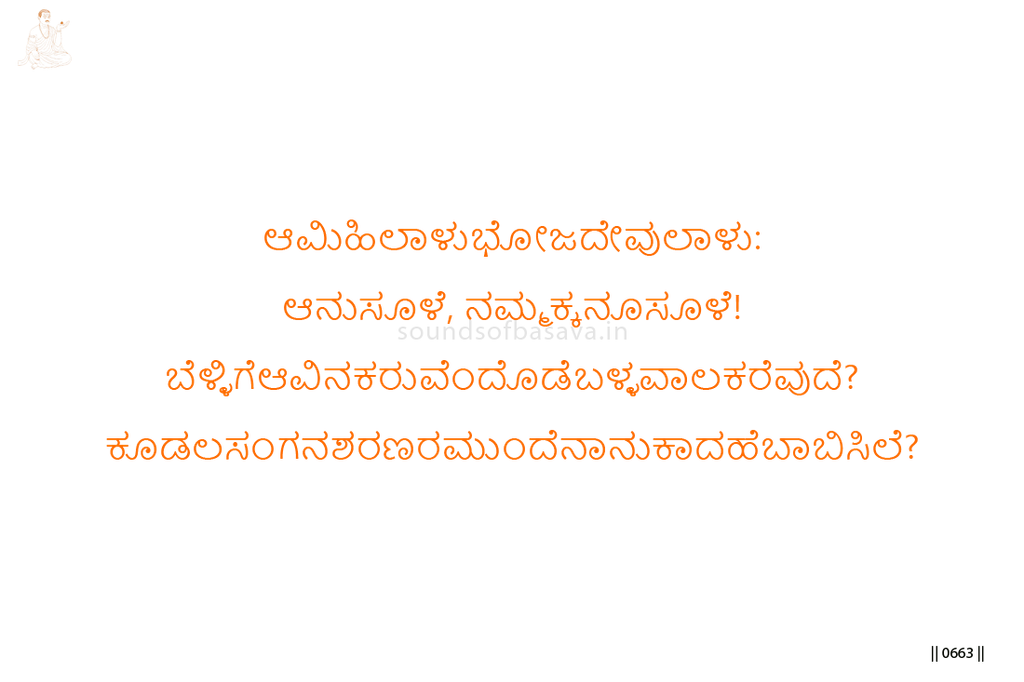
In this vachana, Basavanna names Mahilāḷu as the deceiver and Devalāḷu as the one the world calls righteous.
He then turns the accusation inward. He says, “I too am a courtesan, a courtesan among our own.” Even his thought is caught in the bargains of the world.
He then gives the calf-image. If the calf of a white cow is merely called a milking cow, will it give milk? Before Kudalasangama’s Sharanas, Basavanna waits in the heat, seeking lived truth rather than the comfort of name.
Imagery & Symbolic Relevance
Mahilāḷu and Devalāḷu open the vachana through contrast. One is named as deceiver; the other is treated as righteous by the world. Basavanna does not trust either designation by itself.
The word sūḷe, courtesan, is the sharp self-image. It points to bargaining, compromise, and inward entanglement.
“A courtesan among our own” deepens the confession. Basavanna is not only speaking of outer society; he sees the same transactional movement in his own thought.
The calf of the white cow is the central comparison. Birth, colour, name, or association does not make a calf into a milking cow.
Milk is the proof of ripeness. A name cannot produce what maturity alone can give.
Standing before Kudalasangama’s Sharanas in the heat is the final image. Basavanna chooses exposure before the Sharanas over shelter in false naming.
Lingayoga
In Lingayoga, this vachana tests whether sacred identity has become substance.
The practice-point is direct: do not trust name, appearance, association, or even one’s own devotional thought when it is still bargaining with the world. Stand before the Sharanas of Kudalasangama Deva until the inner condition becomes true.
For Sharana Sthala, this is humility before the difference between being called and being ripened.
Editorial Commentary
The opening contrast should remain specific: Mahilāḷu as deceiver and Devalāḷu as one the world calls righteous. The phrase sūḷe should not be softened, because it reveals the inward bargain of thought. The calf-image gives the main teaching: naming cannot create capacity. The final waiting before the Sharanas shows where false designation is corrected — in the presence of lived realization.
Related Vachana
Supporting Vachana
Pranalingi Sthala Vachana 603 — Beyond Measure — The Exposure of False Purity
Pranalingi Vachana 603 supports this teaching by showing that sacred claim, vessel, rule, or procedure cannot make an unfit condition pure. Vachana 328 gives the Sharana form of the same test: calling a calf a milking cow does not produce milk, and calling oneself by a sacred or respectable name does not create inward ripeness before Kudalasangama Deva’s Sharanas.
Advancing Vachana
Aikya Sthala Vachana 1246 — The Hidden Primordial Form
Aikya Vachana 1246 advances this teaching by showing that the true state of the Sharana cannot be grasped through outward form. Vachana 328 rejects name without substance and waits before the Sharanas; Aikya Vachana 1246 carries this into the deeper recognition that realized truth may be hidden within form and cannot be measured by surface appearance before Kudalasangama Deva.
