

Summary
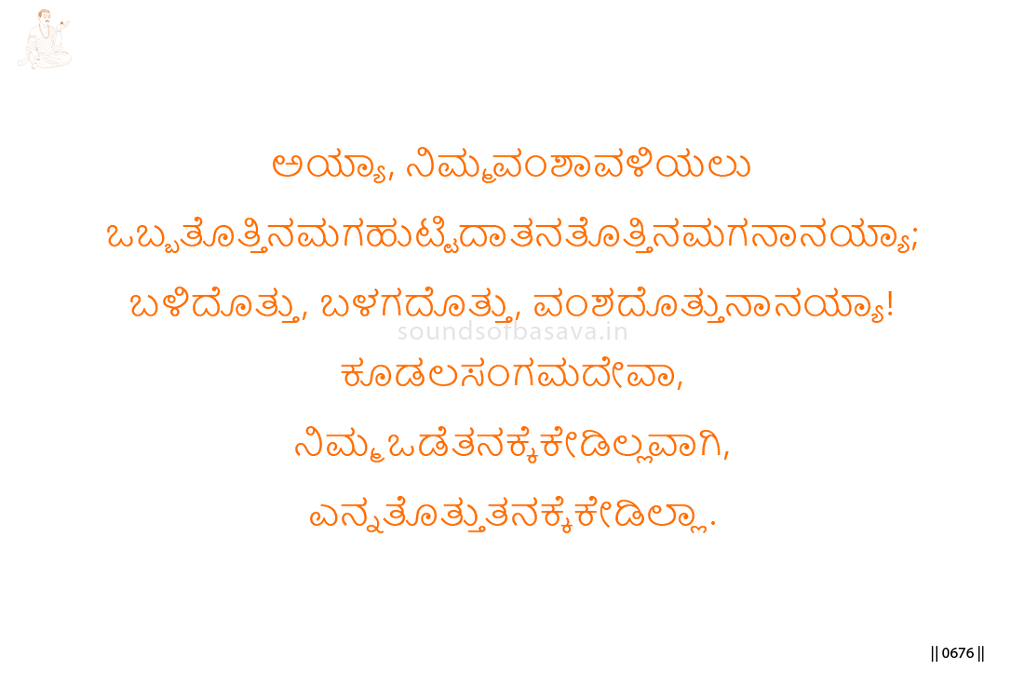
In this vachana, Basavanna says that within Kudalasangama Deva’s lineage a servant’s son has been born.
He then places himself in that line: he is the servant-son of that servant. By bond, by fellowship, and by lineage, he belongs as servant.
He ends by joining the two sides without shame: there is no defect in the Lord’s Lordship, and no defect in his own servant-state.
Imagery & Symbolic Relevance
The Lord’s lineage is the opening image. Basavanna does not begin with worldly ancestry, but with belonging inside Kudalasangama Deva’s line.
The servant’s son is the next image. The birth being claimed is not birth into status, but birth into service.
“I am that servant’s son” gives Basavanna’s self-placement. He does not stand as owner, heir of pride, or independent claimant. He stands in continuity of service.
Bond, fellowship, and lineage extend the image. Servant-belonging is not accidental; it touches relation, community, and inheritance.
The Lord’s Lordship gives one side of the relation. Kudalasangama Deva remains the Master without loss or blemish.
Basavanna’s servant-state gives the other side. To be servant in that lineage is not deficiency. It is his rightful place.
Lingayoga
In Lingayoga, this vachana teaches identity through surrendered relation.
The practice-point is direct: do not seek dignity through ownership or status. Let belonging to Kudalasangama Deva’s lineage become servant-conduct, where the Lord remains Lord and the seeker stands without shame as servant.
For Sharana Sthala, this is lineage expressed as service.
Editorial Commentary
The clarity of the vachana lies in the relation between odetana and tottutana: Lordship and servant-state. Basavanna does not erase the relation between Lord and servant; he purifies it of social shame and self-importance. His belonging is firm because it arises within Kudalasangama Deva’s lineage.
Related Vachana
Supporting Vachana
Pranalingi Sthala Vachana 352 — The Hidden Source and the Hand’s Devotion
Pranalingi Vachana 352 supports this teaching by showing that what seems absent is already given: the devotion of the ancient forebears has been placed in the seeker’s own hand by Kudalasangama Deva. Vachana 354 gives the Sharana form of that same nearness: the seeker is not outside the line, but born into the Lord’s lineage as servant, held by bond, fellowship, and inheritance.
Advancing Vachana
Aikya Sthala Vachana 4 — The Seven Becomings
Aikya Vachana 4 advances this teaching by showing Basavanna formed, named, called, and placed through successive becomings by Kudalasangama Deva. Vachana 354 says that he is born within the Lord’s lineage as servant, with no defect in the Lord’s Lordship and no defect in his servant-state. Aikya Vachana 4 carries that servant-belonging into complete availability, where the seeker appears only in whatever becoming Kudalasangama Deva ordains.
