

Summary
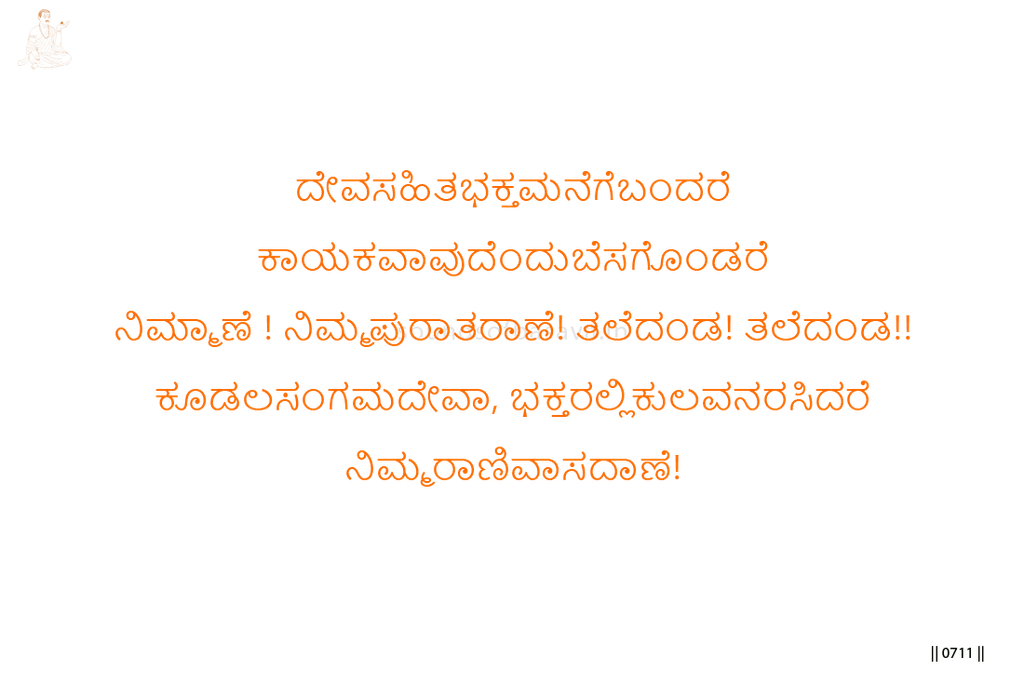
In this vachana, Basavanna says that when a Bhakta comes to the house with Deva, the Divine, one must not ask, “What is his Kayaka?” Here Kayaka means the person’s work, livelihood, or social occupation. In this context, such a question becomes a way of measuring the devotee by social identity.
Basavanna then makes the warning stronger. If caste is searched for among Bhaktas, he invokes Kudalasangama Deva, the Lord’s Purātanas, and the Lord’s own royal abode as witness. He says, “Let my head fall, let my head fall.” The severity shows how completely caste-measure must be rejected in the presence of a devotee.
The teaching is direct: when a devotee comes bearing Divine presence, receive the devotee as sacred. Do not reduce that arrival to caste, occupation, birth, or social rank.
Imagery & Symbolic Relevance
The Bhakta coming to the house with Deva is the first image. For the reader, this means the devotee is not treated as an ordinary visitor. The Divine presence comes with the devotee.
The question, “What is his Kayaka?” is the next image. Kayaka is normally sacred work, but here the question becomes dangerous because it can become a social test. Instead of seeing devotion, the mind begins to ask, “What work does he do? What place does he hold? What is his standing?”
The search for caste among Bhaktas gives the central warning. Basavanna does not allow caste to be applied as a measure within the field of devotion. A Bhakta is to be recognized through devotion, not birth.
The oath by Kudalasangama Deva and the Purātanas gives the vachana its solemn force. Purātanas means the ancient realized ones or elder Sharanas of the path. Basavanna places his statement before the Lord and the realized lineage of Sharanas.
The repeated cry, “Let my head fall,” is the final severe image. It should not be read as ordinary violence. It is a vow of absolute rejection: a head that thinks in caste before a Bhakta has failed in spiritual perception.
The imagery therefore moves from sacred arrival, to wrong questioning, to caste-searching, to solemn oath, and finally to the vow that such perception must be cut off.
Lingayoga
In Lingayoga, this vachana teaches that recognition must be stronger than social conditioning.
The practice-point is direct: when a Bhakta or Sharana comes, do not first ask about occupation, caste, birth, or status. See whether devotion is present. Receive the person as one who comes with Kudalasangama Deva.
For Sharana Sthala, this is sacred hospitality. The house, the mind, and the community must be purified of caste-measure. The Sharana receives the Divine through the devotee and does not block that arrival with social judgment.
Editorial Commentary
The key word needing clarity is Kayaka. In Basavanna’s wider teaching, Kayaka is sacred work. But in this vachana, asking “what is his Kayaka?” becomes a way of measuring the Bhakta by occupation and social position. The vachana’s central point is therefore not against work; it is against using work, caste, or birth to judge a devotee who comes with Divine presence.
Related Vachana
Supporting Vachana
Pranalingi Sthala Vachana 403 — The Heart’s Hidden Truth
Pranalingi Vachana 403 supports this teaching by saying that another person’s heart cannot be fully known, and that one should not quickly call a Shiva-bhakta good or bad by surface judgment. It ends with the strong declaration that Jangama is Linga. Vachana 453 carries this restraint into the concrete act of receiving a devotee: when the Bhakta comes with Deva, do not ask occupation or search caste, because living sacred presence must not be reduced to outer classification.
Advancing Vachana
Aikya Sthala Vachana 879 — The One Without a Second
Aikya Vachana 879 advances this teaching by dissolving division into one earth, one water, one lineage, one fruit, and one support in Kudalasangama Deva. Vachana 453 rejects caste-searching among Bhaktas at the threshold of reception; Aikya Vachana 879 carries this into Aikya, where true lineage is no longer birth or caste, but knowing the one support of Kudalasangama Deva.
