

Summary
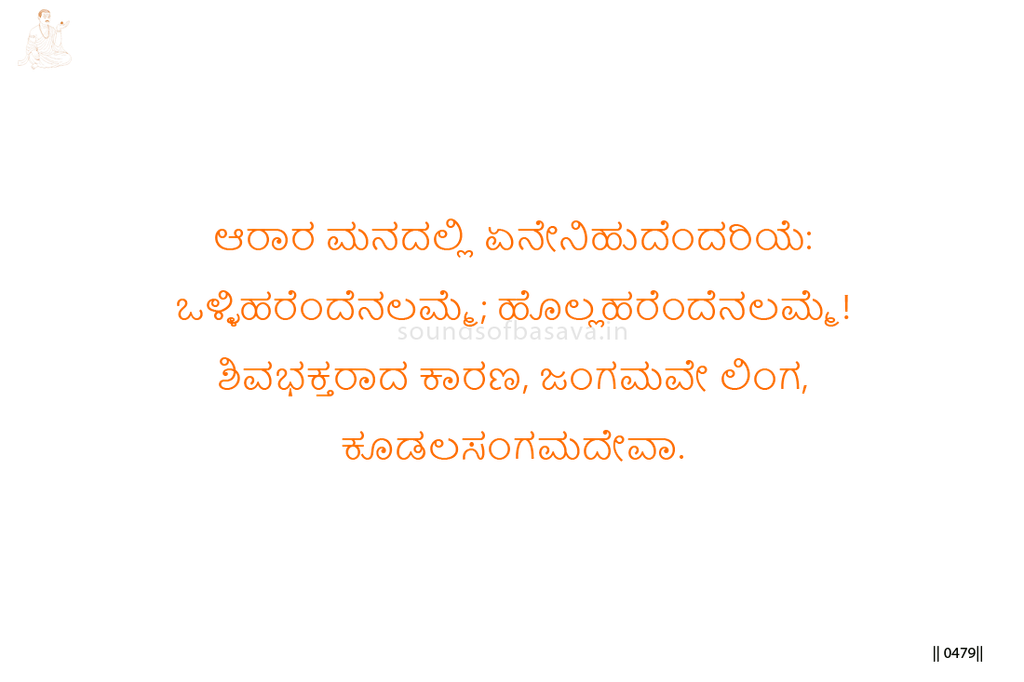
In this vachana, Basavanna asks who can know what is truly present in another person’s heart. The inward state is not open to ordinary judgment.
He then rejects quick labeling. One should not say, “This one is good,” or “This one is bad,” when the person is a Shiva-bhakta. The visible surface does not give final knowledge of devotion.
The final declaration gives the center of the teaching: Jangama is Linga. Before Kudalasangama Deva, the living devotee must not be reduced to outer judgment, because the Jangama stands as living Linga.
Imagery & Symbolic Relevance
The heart is the first image. It is the hidden inner place where devotion, motive, surrender, and truth may dwell. Basavanna begins by showing that this inward place cannot be fully known by another.
The question, “Who can know?” establishes humility before another’s inner state. Human judgment may see conduct and appearance, but it cannot fully enter the heart.
The labels “good” and “bad” are the next images. Basavanna does not allow these labels to become final measures when the person is a Shiva-bhakta. Such naming can become shallow when it does not know the inward condition.
The Shiva-bhakta is therefore placed beyond surface judgment. The devotee’s true worth is not decided merely by public classification.
The final image is Jangama as Linga. This is the decisive spiritual identification. The living Jangama is not separate from the Linga. To judge carelessly is therefore to risk failing to recognize living sacred presence.
Lingayoga
In Lingayoga, this vachana teaches restraint in judging another seeker’s inner state. The path requires discernment, but not arrogance about what cannot be seen.
For Pranalingi Sthala, the emphasis is on inward reality. The living relation to Linga may be hidden within the devotee. Therefore the seeker must approach Shiva-bhaktas and Jangama with reverence.
The practice-point is simple: do not make outer judgment the final measure. Recognize Jangama as Linga before Kudalasangama Deva.
Editorial Commentary
The word “heart” should be kept central. Basavanna is not speaking mainly about public reputation, but about the hidden inward condition.
The refusal to call one person good and another bad does not abolish conduct. It corrects the pride of claiming final knowledge of another’s spiritual state.
“Jangama is Linga” is the key line. It turns the whole vachana from judgment to reverence.
Related Vachana
Supporting Vachana
Prasadi Sthala Vachana 657 — True Nobility Is Linga-Bhakti
Prasadi Vachana 657 supports this vachana by rejecting outer status as the measure of spiritual worth. There, Basavanna says that even one born as a Shvapacha is truly noble if that person is a Linga-bhakta. He then asks what use outward religious acts have if the mind itself remains untouched.
Vachana 403 gives the same correction through another doorway. It asks who can know another’s heart and warns against calling a Shiva-bhakta good or bad by surface judgment. Thus Prasadi Vachana 657 supports the Pranalingi teaching that inward devotion, not outward classification, is the true measure before Kudalasangama Deva.
Advancing Vachana
Sharana Sthala Vachana 396 — When God Knocks
Sharana Vachana 396 advances this teaching by moving from recognition to conduct. In Vachana 403, Basavanna declares that Jangama is Linga. In Vachana 396, when the Jangama comes to the threshold, Basavanna says that Kudalasangama Deva Himself has arrived in living form, and he refuses to remain elevated before that presence.
Thus the Pranalingi teaching that Jangama is Linga advances into Sharana Sthala as embodied humility. The seeker must not merely avoid judging the Jangama outwardly; he must rise, lower himself, and receive the living Linga through reverent conduct.
