

Summary
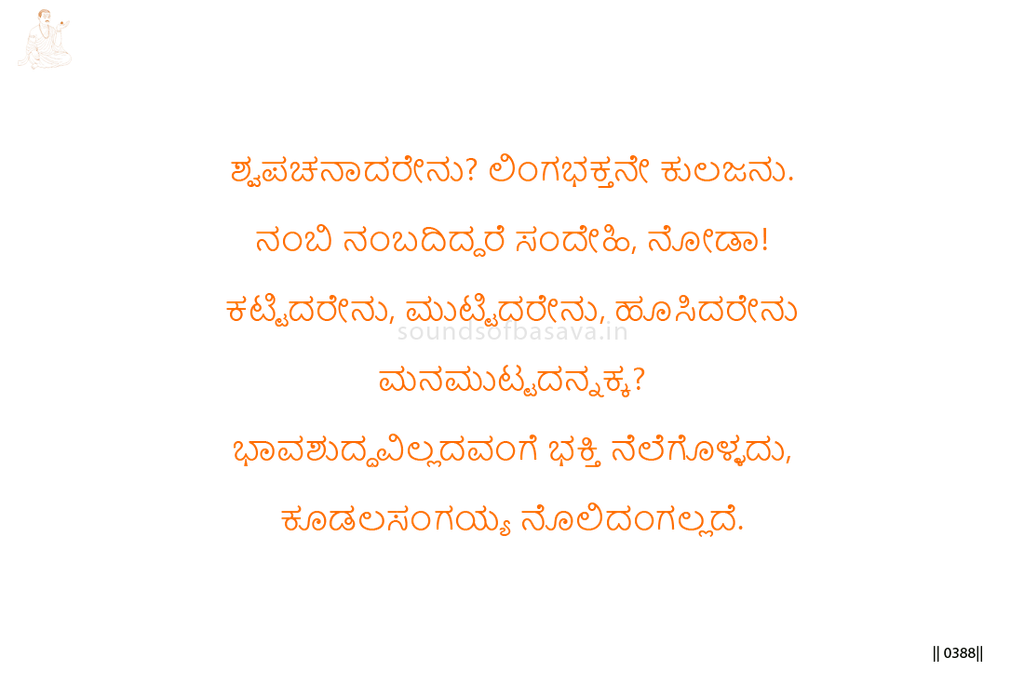
In this vachana, Basavanna rejects birth as the measure of spiritual worth.
He asks: what does it matter if one is born as a Shvapacha? If that person is a Linga-Bhakta, that person is truly noble.
He then turns to the doubter. Building, touching, or offering have no worth if the mind itself remains untouched. Outer religious acts cannot establish Bhakti when the inner condition has not changed.
The teaching is direct: Bhakti does not take root where bhava is impure. Only when Kudalasangama Deva graces does devotion become established.
Imagery & Symbolic Relevance
The word Shvapacha gives the vachana its force. Basavanna names one placed at the lowest edge of social hierarchy and overturns that judgment through Linga-Bhakti.
True nobility is not birth-lineage. It is the condition of one whose life is joined to Linga through devotion.
The doubter is asked to look carefully. Basavanna is not arguing from social opinion. He asks the seeker to see what truly matters.
The sequence of building, touching, and offering points to outward religious activity. These acts may appear sacred, but they remain incomplete if the mind has not been touched.
The mind is the decisive field. Unless the mind is inwardly touched and purified, outer acts do not become living devotion.
Bhava-shuddhi is the ground of Bhakti. Without purity of inner feeling, devotion cannot become steady.
Lingayoga
In Lingayoga, this vachana shifts the measure from birth and outer act to inner transformation.
The seeker is not made worthy by caste, inherited status, ritual position, or external offering. The true measure is Linga-Bhakti joined with bhava-shuddhi.
For Prasadi Sthala, the point is precise: one must receive grace inwardly. What is built, touched, or offered must not remain outside the mind. When Kudalasangama Deva graces, Bhakti takes root in the purified inner condition.
Editorial Commentary
“Shvapacha” should be retained because it directly confronts birth-based hierarchy.
“Linga-Bhakta alone is noble” should not be read as creating another caste. Basavanna is replacing birth-measure with devotion-measure.
The actions of building, touching, and offering should be read as outward religious acts. Basavanna does not reject them by themselves. He rejects their claim to worth when the mind remains untouched.
The key term is bhava-shuddhi. Without purity of inner feeling, Bhakti does not settle. With Kudalasangama Deva’s grace, devotion becomes rooted beyond birth, status, and outer display.
Related Vachana
Supporting Vachana
Maheshwara Sthala Vachana 285 — The Pride of Caste and the Wandering Mind
Maheshwara Vachana 285 supports this vachana by rejecting caste-pride and divided perception in relation to Jangama and Linga. In Vachana 657, Basavanna says that even one born as a Shvapacha becomes truly noble through Linga-Bhakti. In Maheshwara Vachana 285, caste-pride divides the Jangama and corrupts Linga-worship. Both vachanas reject birth, caste, and outer status as measures of spiritual truth before Kudalasangama Deva.
Advancing Vachana
Pranalingi Sthala Vachana 403 — The Heart’s Hidden Truth
Pranalingi Vachana 403 advances this teaching by carrying the rejection of outer status into the recognition of inward sacred presence. In Vachana 657, Basavanna says that Linga-Bhakti, not birth, makes one truly noble, and that outer religious acts have no worth if the mind remains untouched. In Vachana 403, this becomes the Pranalingi warning not to judge a Shiva-bhakta by surface categories of good and bad, because the inward state is hidden and Jangama is Linga. The movement is from Prasadi purity of bhava to Pranalingi reverence for the living Linga within the devotee.
