

Summary
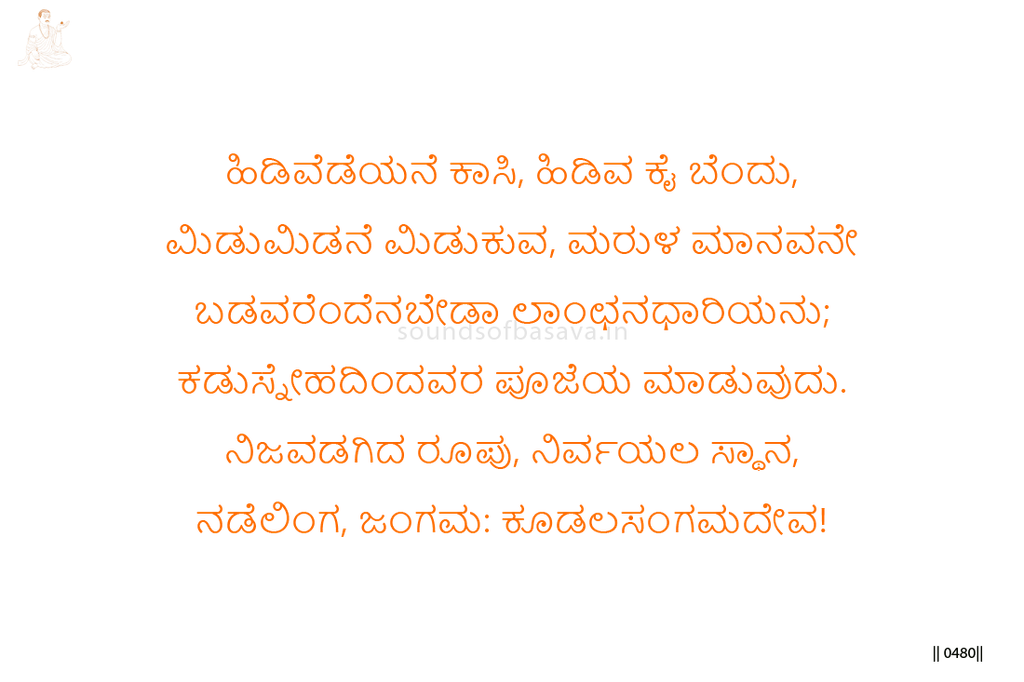
In this vachana, Basavanna warns against judging the one who bears the Linga. Even if the hand trembles or the person appears unsteady, the Linga-bearer should not be called poor.
The correction is reverence. Such a one must be worshipped with deep love, because the Linga-bearer stands at a subtle point of practice where form, inward steadiness, and living realization meet.
Basavanna then gives the final teaching before Kudalasangama Deva: the true form is the formless state, and the moving Linga is Jangama. The bearer of the Linga must therefore be seen with love, not dismissed by outer appearance.
Imagery & Symbolic Relevance
The first image is the Linga held in the hand. The hand shows direct nearness to practice. The Linga is not distant; it is held and approached immediately.
The trembling or wavering hand shows the seeker’s fragile condition. Basavanna does not treat this as a reason for contempt. The one who stands near the sacred may still struggle with steadiness.
The deluded human being is the one who judges wrongly. Such a person sees wavering and calls it poverty, but does not understand the sacred nearness of the Linga-bearer.
The Linga-mark bearer is therefore to be worshipped with deep love. The mark is not merely an outer sign; it calls for reverence when joined to living devotion.
The true form and the formless state form the next movement. Basavanna shows that the held form of the Linga points beyond itself. The form is not rejected, but it must open into the formless.
The final image is the moving Linga as Jangama. Jangama is not separate from Linga. What is held in the hand must be recognized in the living movement of realized presence.
Lingayoga
In Lingayoga, this vachana teaches steadiness and reverence at the point of practice. The seeker may hold the Linga, yet still face wavering of hand, attention, or mind.
The response is not self-condemnation or judgment of another. Basavanna directs the seeker toward deep love. Steadfast devotion is the way the held Linga opens into the formless state.
For Pranalingi Sthala, the teaching is precise: the Linga is not to remain only an object in the palm. Through steady reverence, the seeker recognizes the living continuity of Linga and Jangama before Kudalasangama Deva.
Editorial Commentary
The warning “do not call him poor” should be kept central. Basavanna is correcting superficial judgment of the Linga-bearer.
The trembling hand does not cancel sacred worth. It marks the vulnerability of the threshold where practice is present but steadiness must deepen.
The final statement joins form, formlessness, Linga, and Jangama. The vachana should therefore not be reduced to a comment on external Linga-wearing alone. It points to the movement from held form into living realization.
Related Vachana
Supporting Vachana
Prasadi Sthala Vachana 400 — The Poison of Seeking
Prasadi Vachana 400 supports this vachana by showing that sacred practice must be governed by right motive. There, Linga-archana is not rejected, but the seeker’s grasping toward Prasada after hearing of Jangama becomes a stain when it is driven by seeking.
Vachana 416 also stands at a delicate point of practice. The Linga-bearer is not to be judged by outer wavering, but must be approached with deep love. Vachana 400 supports this by showing that Linga, Jangama, and Prasada must be received with disciplined reverence rather than restless grasping. In both vachanas, the outer sacred act becomes true only when the inner condition is rightly held before Kudalasangama Deva.
Advancing Vachana
Sharana Sthala Vachana 48 — The Whirl of Distortion and the Prayer for Placement
Sharana Vachana 48 advances this teaching by carrying the problem of wavering into direct prayer. In Vachana 416, the Linga-bearer stands at the threshold where the hand may tremble and steadiness must be protected through deep love. In Vachana 48, body, mind, and senses are troubled by distortion, and the seeker asks not to be left in divided awareness but to be placed in Kudalasangama Deva’s own mind among the Sharanas.
Thus the Pranalingi threshold of Linga-bearing advances into Sharana Sthala as the prayer for stable placement. The seeker does not merely hold the Linga; he asks to be held by Kudalasangama Deva, so that wavering does not become separation.
