

Summary
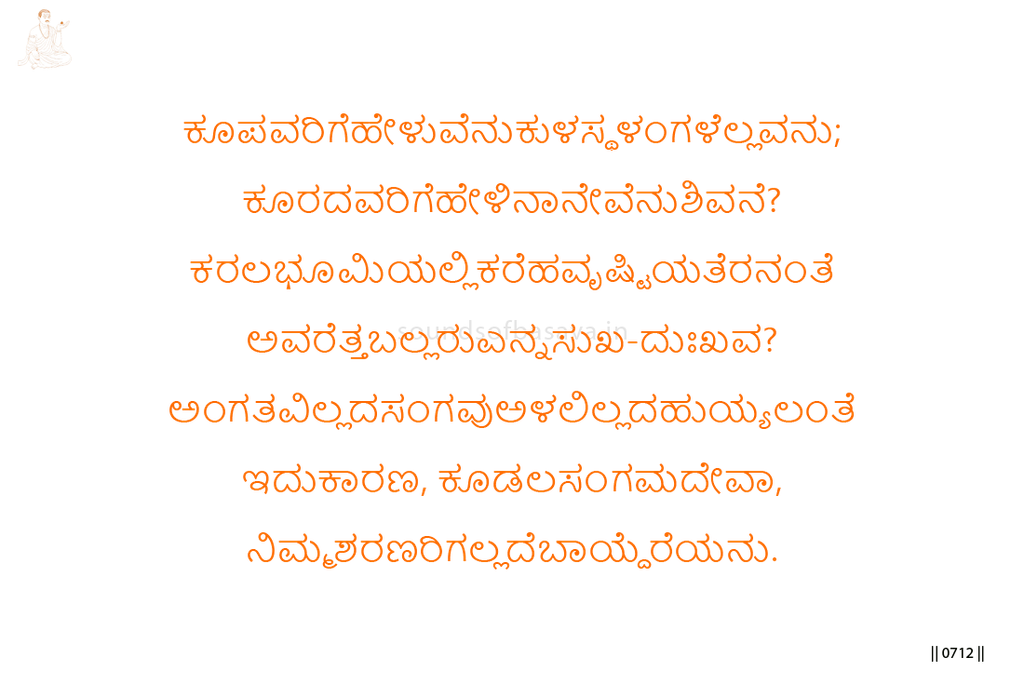
In this vachana, Basavanna says that he will speak the inner teaching only to those who are truly near. Here, “near” does not mean physically close or socially connected. It means inwardly ready: softened, receptive, and able to receive what is spoken.
He then asks: what can he say to those who are not near in this way? Is he himself Shiva, able to awaken anyone by force? This is an important moment of humility. Basavanna does not claim the power to make an unreceptive heart receive truth.
He compares such speaking to rain falling upon hard ground. Rain is life-giving, but if the ground cannot receive it, nothing grows. In the same way, sacred speech does not become realization in one who lacks inward readiness.
Basavanna ends by saying that he will not open his mouth except to Kudalasangama Deva’s Sharanas. The teaching is direct: truth must be spoken where there is living receptivity, not scattered where it becomes only noise.
Imagery & Symbolic Relevance
Those who are near form the first image. For the reader, this nearness should be understood inwardly. A person is near when the heart is ready to receive, not merely when the body is present.
Those who are not near form the contrast. They may hear words, attend gatherings, or stand nearby, but if inward openness is absent, the teaching does not enter.
The question “Am I Shiva?” gives the vachana its humility. Basavanna does not speak as one who can force transformation. He knows that even true words require a prepared listener.
Rain falling on hard ground is the central image. Rain itself is not at fault. It has the power to nourish. The problem is the ground. If the ground is hard, barren, or stone-like, the rain cannot enter and produce growth.
Joy and sorrow are also mentioned. Basavanna is saying that those without inward readiness cannot truly understand even the movement of lived experience. Happiness and suffering do not ripen into wisdom if the heart remains closed.
The gathering without Angatva is the final image. Angatva means inward participation or living connectedness. A gathering without Angatva is not true Sharana-sanga. It is only an outer assembly, like sound without depth.
The imagery therefore moves from readiness, to unreceptive hearing, to hard ground, to empty gathering, and finally to the decision to speak only where truth can be received.
Lingayoga
In Lingayoga, this vachana teaches that sacred speech requires a receiving ground.
The practice-point is direct: do not treat Anubhava as information to be distributed anywhere. Anubhava means lived realization. It must be spoken, heard, and received in a field of readiness.
For Sharana Sthala, this is disciplined speech. The Sharana does not speak from pride, debate, or display. He speaks where the listener has become inwardly prepared, and he remains silent where speech would become noise.
Editorial Commentary
The key clarification for the reader is that this vachana is not about social exclusion. Basavanna is not saying that truth belongs to a closed group by identity. He is saying that truth must meet receptivity. Rain does not fail when it falls on stone; the stone simply does not receive. In the same way, speech does not become Anubhava unless the listener has become inwardly tillable ground.
Related Vachana
Supporting Vachana
Pranalingi Sthala Vachana 592 — The Seed and the Soil
Pranalingi Vachana 592 supports this teaching through a closely related image. There, Basavanna says that something lifeless placed in soil will not take root below or bear fruit above. The soil may be capable of receiving life, but a dead thing cannot sprout.
Vachana 456 gives the Sharana form of this same principle. Rain may fall, and truth may be spoken, but without inward life and receptivity, nothing ripens. Both vachanas teach that sacred presence must meet living readiness before transformation can occur before Kudalasangama Deva.
Advancing Vachana
Aikya Sthala Vachana 458 — Can One Return to Divided Devotion?
Aikya Vachana 458 advances this teaching by showing that grace may stand near and yet remain unreachable to those without discernment. The problem is not distance from grace, but incapacity to receive it.
Vachana 456 says that speech to the unreceptive is like rain upon hard ground. Aikya Vachana 458 carries this into Aikya: where discernment and inner readiness are absent, even nearby Prasada remains far; where realization has ripened, the seeker no longer returns to divided perception.
