
Summary
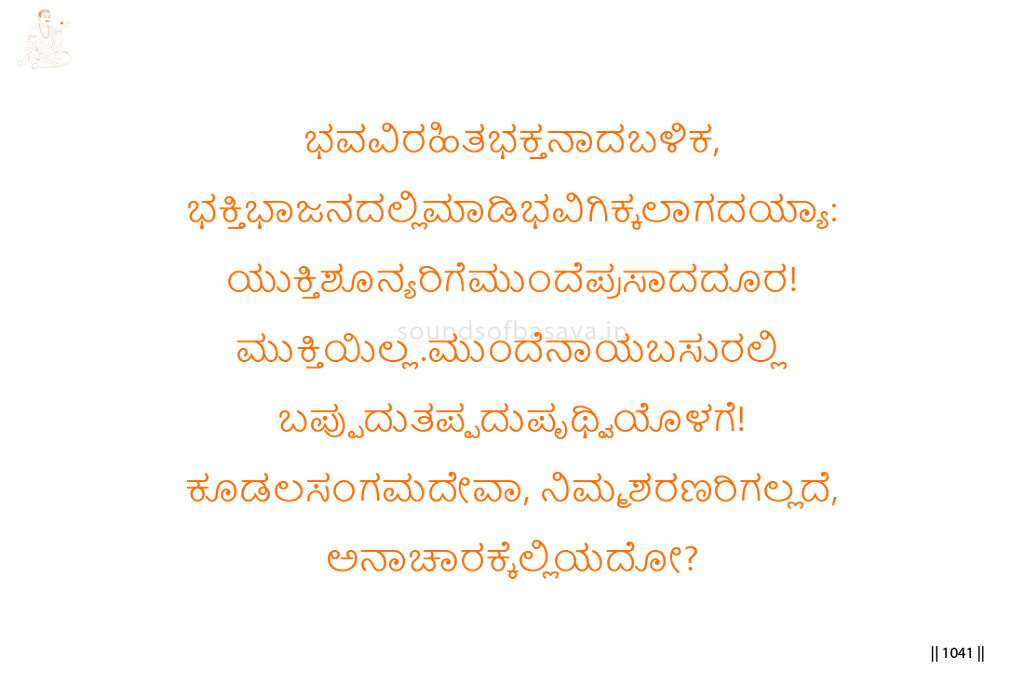
Basavanna asks whether one who has become a Bhakta free from the Bhavi condition can again be made Bhavi within the vessel of devotion. The question points to the impossibility of honestly returning to divided devotion after inner division has been broken.
The vachana then turns to discernment. For those without yukti, Prasada remains far, and Mukti does not arise. The distance is not because grace is absent, but because the capacity to receive it is absent.
The final question places the matter before Kudalasangama Deva. If Prasada and Mukti belong to the Lord’s Sharanas, where can they stand for those who remain without proper conduct? The teaching is not social rejection, but a distinction between ripened receptivity and unaligned living.
Imagery & Symbolic Relevance
The first image is the Bhakta who has become free from Bhavi. Bhavi here marks the divided and untransformed condition. To become Bhavi-free is to come out of that fracture.
The second image is the vessel of devotion. Bhakti is not treated as a loose emotion or outer identity. It becomes the vessel in which the seeker is held, formed, and preserved.
The question of becoming Bhavi again gives the central movement. Basavanna asks whether one who has entered true devotion can be returned to the old divided condition. The implied answer is no: what has been inwardly transformed cannot honestly resume its former fragmentation.
The phrase “without yukti” gives the next image. Yukti is discernment, not cleverness alone. It is the capacity to recognize, receive, and remain aligned with truth.
Prasada being far is the next image. Prasada is not denied, but it remains unreachable to those without discernment. The distance is therefore not outer distance; it is the distance created by incapacity to receive.
The statement “there is no Mukti” deepens the warning. Liberation cannot arise where discernment is absent and Prasada is not received.
The final contrast is between Kudalasangama Deva’s Sharanas and the unaligned. The Sharanas are those who are fit to receive, because they stand in the path with discernment and conduct. The Anacharis remain outside that fitness because their living is not aligned.
Together, the images move from freedom from Bhavi, to the vessel of devotion, to the necessity of discernment, to the receiving of Prasada, and finally to the question of who is fit for Mukti before Kudalasangama Deva.
Lingayoga
In Lingayoga, this vachana teaches that devotion must not return to divided perception once inner division has been broken. The seeker cannot treat Bhakti as a vessel and still preserve the Bhavi condition within it.
The practice-point is direct: cultivate yukti, the discernment through which Prasada can be received. Without such readiness, even nearness to grace does not become transformation.
This vachana also teaches that Mukti is not gained through name, appearance, or association alone. It belongs to the ripened condition of the Sharana, where devotion, discernment, Prasada, and conduct stand together before Kudalasangama Deva.
Editorial Commentary
This vachana should be read as a teaching on irreversible inward change and fitness to receive. Basavanna does not merely condemn the unaligned; he shows why Prasada remains far from them. Grace is not treated as absent, but as unreceived where yukti is absent. The force of the vachana lies in the question: after becoming free from Bhavi, how can one return to broken devotion?
Related Vachana
Supporting Vachana
Sharana Sthala Vachana 456 — Rain Upon Stone
Sharana Vachana 456 supports this Aikya vachana by teaching that sacred speech must meet a receptive ground. There, Basavanna compares speaking truth to rain falling on hard ground: rain has power to nourish, but if the ground cannot receive it, nothing grows. Aikya Vachana 458 carries the same principle into Prasada and Mukti. Where yukti is absent, Prasada remains far; where readiness has ripened, grace can be received.
Advancing Vachana
Aikya Sthala Vachana 462 — The State of Undivided Awareness
Vachana 458 teaches that without Yukti, Prasada remains distant and Mukti cannot arise.
Vachana 462 advances this into fulfilment. Through Guru, Linga, and Jangama arise Padodaka and Prasada; that very Bhava then becomes Mahaprasada, leaving no other Prasada to be sought.
Thus discernment and right conduct ripen into undivided awareness, where Prasada is no longer merely received outwardly but becomes the seeker’s established inner state before Kudalasangama Deva.
