

Summary
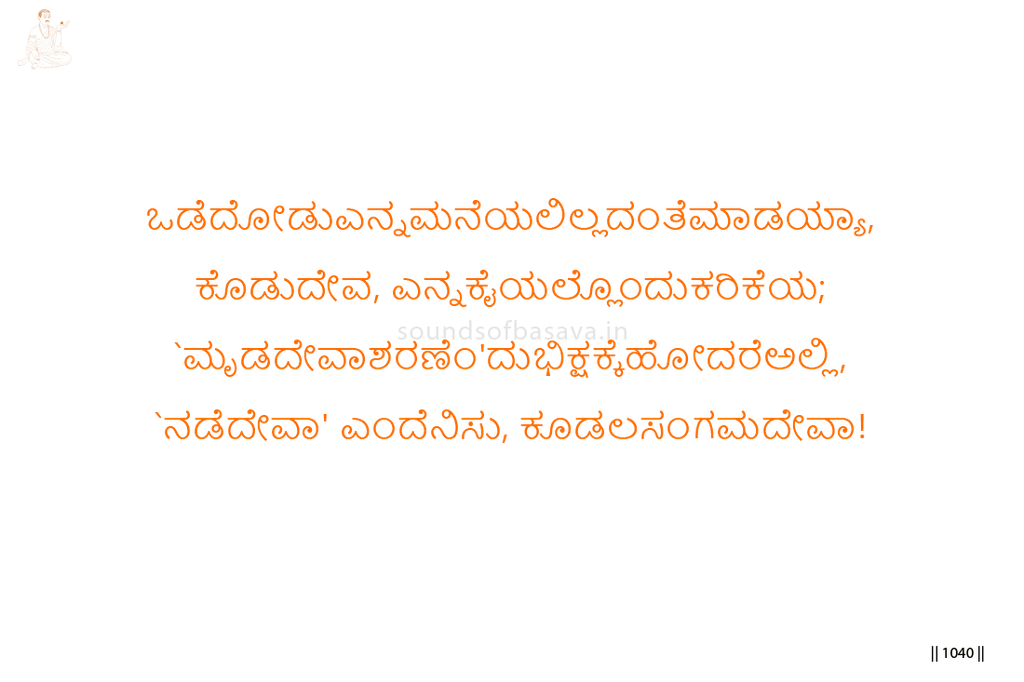
Basavanna begins by asking Kudalasangama Deva not to make him divided. The prayer is not for outer gain, but for inward wholeness. The seeker does not want to live as though Anga and Linga were separated.
He then asks for a single blade of grass to be placed in his hand. The image reduces offering to its simplest form. A small, truthful receiving is better than outward abundance joined to inward division.
The final movement tests the sincerity of refuge. If he goes begging while saying, “Mrudadeva, refuge,” let him be told, “Go on, Deva.” Basavanna would rather be turned away than be allowed to remain in false devotional nearness. The refusal itself becomes a protection of truth before Kudalasangama Deva.
Imagery & Symbolic Relevance
The first image is being made divided. Basavanna asks that such division should not be allowed in his house. The house is the seeker’s inner dwelling, the place where devotion must remain whole.
The division named here is not merely social or emotional. In the movement of the vachana, it points to the split between the seeker and the Divine, between Anga and Linga. Basavanna’s first prayer is therefore for non-division.
The second image is the single blade of grass. Its smallness is essential. Basavanna does not ask for wealth, ritual abundance, or visible greatness. He asks for the smallest possible sign of honest receiving.
The hand is the place where the blade is placed. The hand receives and offers. By asking only for one blade, Basavanna strips devotion of display and leaves only sincerity.
The act of going for alms gives the next image. Begging shows dependence and asking. In this vachana, it becomes the test of whether the seeker approaches from truthful surrender or from need clothed in sacred speech.
The words “Mrudadeva, refuge” give the speech of devotion. Basavanna does not reject refuge, but he refuses to let the word “refuge” become a cover for inward falseness.
The reply “Go on, Deva” is the severe turning point. Instead of being accepted, the seeker may be sent away. This refusal is not treated as cruelty. It protects the seeker from false inclusion.
The final address to Kudalasangama Deva gathers the whole movement. Division must be kept away, offering must remain truthful, begging must not become disguised craving, and refuge must not be spoken without inward fitness.
Lingayoga
In Lingayoga, this vachana teaches that the first need is inward wholeness. The seeker must not approach Linga while living from division.
The practice-point is direct: let even a blade of grass be enough when it is received truthfully. Do not cover inner lack with devotional speech. Do not turn refuge into begging.
This vachana also shows that correction may come as refusal. To be turned away from false nearness is better than to be accepted while division remains. Practice matures when the seeker values truth more than comfort before Kudalasangama Deva.
Editorial Commentary
This vachana should be read as a prayer for uncompromising sincerity. Basavanna does not ask for easy grace or devotional consolation. He asks to be kept from division and to be denied if his refuge is not true. The force of the vachana lies in this reversal: rejection, when it prevents falsehood, becomes a form of protection.
Related Vachana
Supporting Vachana
Sharana Sthala Vachana 442 — The Warrior-Devotee
Sharana Vachana 442 supports this Aikya vachana by teaching that one who runs is not a warrior, and one who begs is not a bhakta. There, Basavanna declares before Kudalasangama Deva, “I shall not run; I shall not beg.” Aikya Vachana 457 carries this concern inward. If the seeker approaches with the speech of refuge while still divided, refusal itself becomes necessary correction.
Advancing Vachana
Aikya Sthala Vachana 458 — Can One Return to Divided Devotion?
Aikya Vachana 458 advances this teaching by asking whether one who has become free of inner division can return to divided devotion. In Vachana 457, Basavanna asks that division not remain in his inner house and accepts being turned away if his refuge is false. In Vachana 458, this concern deepens into the question of whether true devotion, once freed from fracture, can return to broken worship before Kudalasangama Deva.
