

Summary
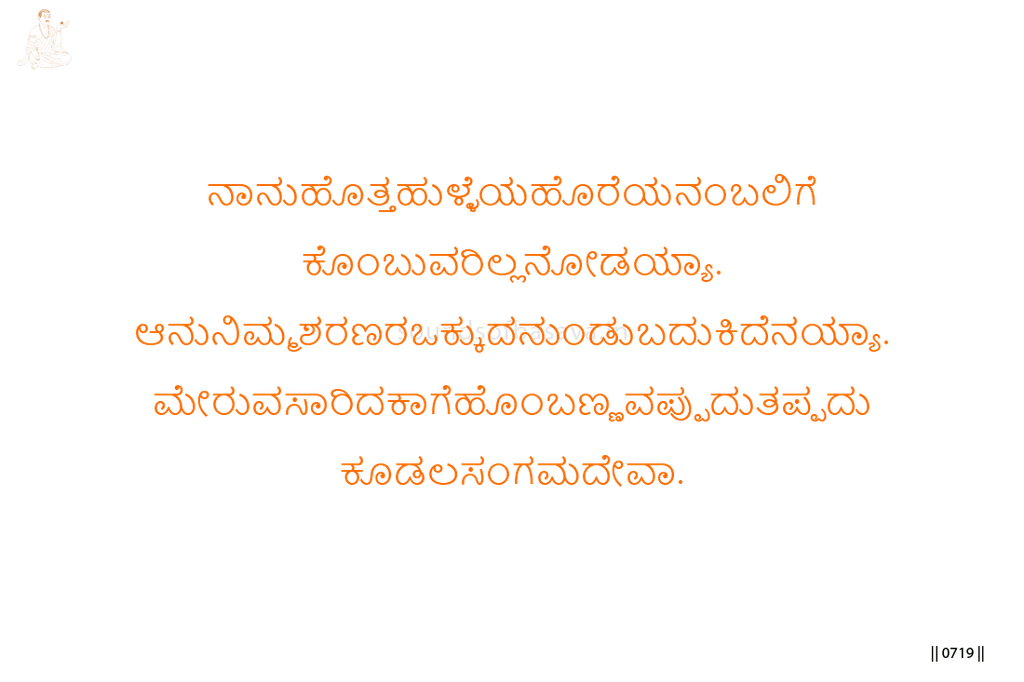
In this vachana, Basavanna says that he does not go about announcing what he has gathered or received. What he has received from Kudalasangama Deva’s Sharanas is not for display; it is for living.
The important distinction is between proclaiming and living. To proclaim is to turn what has been received into self-display. To live by it is to let it quietly sustain conduct, speech, and inner steadiness.
He then gives the image of the crow and Mount Meru. Even if a crow speaks of Mount Meru, Meru does not lose its golden greatness. In the same way, truth does not become smaller because the speaker is humble, ordinary, or socially insignificant.
The teaching is direct: do not boast of what you have received, and do not measure truth by the status of the one who carries it. Receive from the Sharanas, live by it, and leave truth untouched by self-display.
Imagery & Symbolic Relevance
What is gathered is the first image. It refers to what Basavanna has received through the Sharanas: teaching, grace, correction, and lived nourishment.
Not going about proclaiming it is the second image. The reader should notice the restraint here. Basavanna does not deny receiving. He refuses to turn receiving into advertisement.
Living by what is received from the Sharanas is the central practice. The value of received truth is proved by life, not by announcement.
The crow is the image of the ordinary carrier. A crow is not majestic like an eagle or swan. Basavanna uses it to show that the speaker’s outer status does not determine the value of truth.
Mount Meru is the image of greatness that cannot be reduced. Meru remains golden and vast whether a crow speaks of it or not. Truth remains truth whether carried by a great one, a small one, or one who does not seek recognition.
The imagery therefore moves from receiving, to restraint, to living, to the crow, and finally to Meru’s unchanged greatness.
Lingayoga
In Lingayoga, this vachana teaches assimilation without display.
The practice-point is direct: what is received from the Sharanas should become life, not pride. Let the teaching change how you live. Do not use it to build a spiritual image.
For Sharana Sthala, this is humility after receiving. The Sharana does not say, “See what I have gathered.” He says, in effect, “I live by what the Sharanas have given.”
Editorial Commentary
Basavanna is not glorifying the crow or making the crow equal to Meru. He is saying that Meru’s greatness does not depend on the crow. Likewise, truth is not weakened by a humble carrier, and the carrier need not become proud because he speaks of truth.
Related Vachana
Supporting Vachana
Pranalingi Sthala Vachana 907 — The Ripening of the Gem
Pranalingi Vachana 907 supports this teaching by distinguishing outer sight from inward participation. There, many look at the gem-like Prasada and pass away, but Basavanna falls into it, is surrounded by it, and asks Kudalasangama Deva to reveal its padārtha, its meaning and substance. Vachana 471 carries the same discipline into Sharana Sthala: what is received must not remain something seen, named, or proclaimed from outside; it must become inwardly lived.
Advancing Vachana
Aikya Sthala Vachana 67 — The Indwelling Mountain
Aikya Vachana 67 directly advances this teaching through the same images of the crow and Mount Meru. In Sharana Vachana 471, Basavanna lives by what he receives from Kudalasangama Deva’s Sharanas; just as a crow approaching the golden Meru cannot remain unaffected, Sharana-nearness transforms the one who receives. In Aikya Vachana 67, Basavanna asks how Meru’s greatness could naturally exist in a crow, then gives the Aikya resolution: when the all-complete Linga abides within him, his natural limitation can no longer be the final measure. Thus transformation received through the Sharanas advances into the indwelling presence of Linga, where the Anga is no longer judged by its unaided nature but by Kudalasangama Deva abiding within.

