

Summary
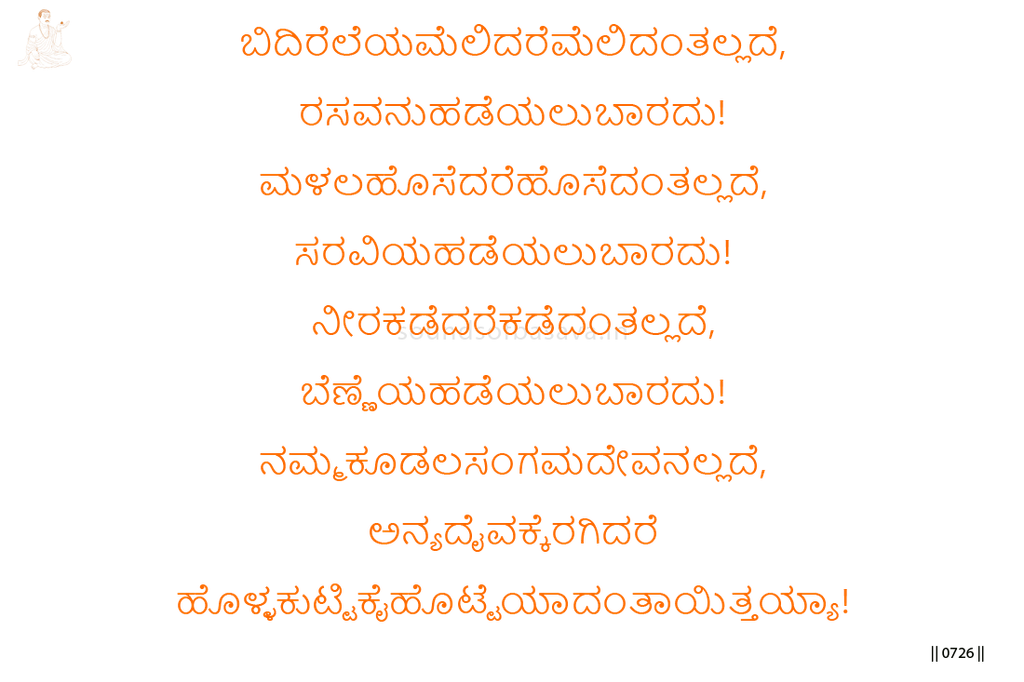
In this vachana, Basavanna teaches that effort cannot produce what the substance itself does not contain.
He gives three ordinary images. Chewing bamboo leaves will not produce sweetness. Pounding empty husk will not produce grain. Churning water will not produce butter. In each case, the action may be intense, but the needed essence is absent.
Basavanna then applies this law to spiritual life. Leaving Kudalasangama Deva and turning toward another deity is like pounding empty husk. The hands become wounded, but nothing real is gained. The teaching is direct: spiritual effort must be directed toward the true source. Practice, devotion, labor, and repetition cannot bear fruit when they are turned away from the living substance of Kudalasangama Deva.
Imagery & Symbolic Relevance
Bamboo leaves form the first image. They may be chewed, but they do not contain sweetness. The problem is not weak chewing; the problem is absence of sweetness in the thing being chewed.
Empty husk gives the second image. Husk may resemble the outer covering of grain, but the grain itself is absent. Pounding it only produces dust and fatigue.
Water gives the third image. Churning is the right method when there is milk or curd, but water contains no butter. The method cannot create the essence if the essence is not present.
The wounded hands give the final image. False effort does not merely fail; it injures the seeker. Misdirected striving wears out the body, mind, and devotion.
The turn away from Kudalasangama Deva is the spiritual center of the vachana. Basavanna is not criticizing effort itself. He is criticizing effort placed in the wrong ground. Only what contains essence can yield essence.
The imagery therefore moves from chewing, to pounding, to churning, to injury, and finally to the warning that turning from Kudalasangama Deva makes spiritual labor barren.
Lingayoga
In Lingayoga, this vachana teaches right orientation of practice.
The practice-point is direct: do not measure spiritual life by effort alone. Ask whether the effort is grounded in Kudalasangama Deva. Repetition, worship, discipline, or devotion cannot ripen if the living source is absent.
For Sharana Sthala, this is discernment of essence. The Sharana does not waste life-force on what cannot yield realization. He turns toward the source that alone contains the fruit of the path.
Editorial Commentary
This vachana should not be expanded into a general rejection of work or discipline. Basavanna’s images show the opposite. Chewing, pounding, and churning are valid actions when applied to the right substance. The warning is against misdirected practice: method cannot replace essence.
Related Vachana
Supporting Vachana
Pranalingi Sthala Vachana 566 — The Linga in the Palm
Pranalingi Vachana 566 supports this teaching by beginning with the Linga directly present in the palm and warning against saying that another deity is equal to that Linga. When the Linga is already present, divided speech and divided allegiance become serious failures of recognition.
Vachana 553 carries this into Sharana Sthala through the law of substance. If one leaves Kudalasangama Deva and turns elsewhere, no amount of effort can produce the fruit of realization. Vachana 566 shows the contradiction; Vachana 553 shows the consequence.
Advancing Vachana
Aikya Sthala Vachana 1154 — The Revelation of Linga-Aikya
Aikya Vachana 1154 advances this teaching by moving from essential discernment to the revealed mystery of Prana-Linga and Linga-Prana. There, what could not be known through ages, worlds, or celestial powers is revealed through direct instruction, the veil of delusion is removed, and the state of Linga-Aikya is shown.
Vachana 553 says that only the true substance can yield true fruit. Aikya Vachana 1154 carries this into fulfillment: when the right source is revealed, seeking no longer wastes itself on empty husk. The seeker is shown the living relation of Linga and Prana, and the path ripens into Aikya before Kudalasangama Deva.
