

Summary
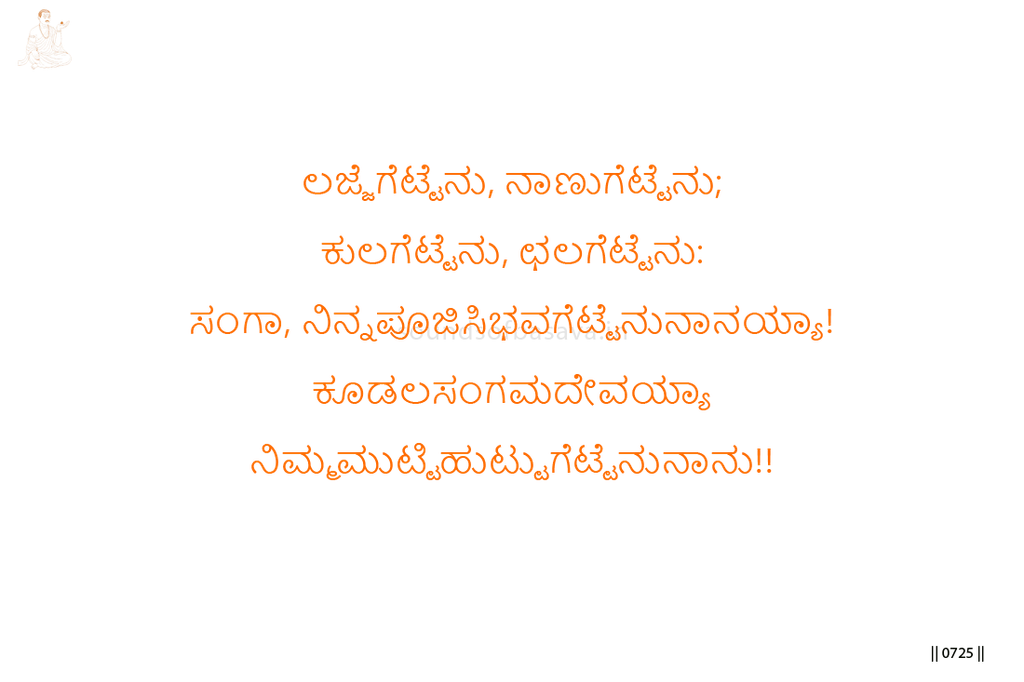
In this vachana, Basavanna says that shame left him, modesty left him, caste left him, and custom left him. These are not small social details. They are the inner and outer measures by which the world usually defines a person.
For the reader, shame means fear of social judgment. Modesty means socially trained reserve or self-protection before others. Caste means inherited social identity. Custom means habitual convention and inherited practice.
Basavanna then gives the cause. By worshipping Kudalasangama Deva, he lost bhava, the world of conditioned becoming. By touching Kudalasangama Deva, he was born anew.
The teaching is direct: true worship and living contact with Kudalasangama Deva do not merely improve the old self. They loosen the structures that once defined it and bring a new birth in the path.
Imagery & Symbolic Relevance
Shame is the first fallen covering. It points to the pressure of social judgment: what others will say, how one will be seen, and how one must behave to remain acceptable.
Modesty is the second covering. In this vachana, it is not praised as spiritual humility. It refers to socially conditioned reserve, the learned habit of holding oneself within the limits approved by the world.
Caste is the third covering. It refers to inherited social identity and lineage-measure. Basavanna says this too has fallen away.
Custom is the fourth covering. Custom means habitual convention, inherited practice, and the patterns by which a person is made to belong to the world’s order.
The loss of bhava is the central spiritual turn. Bhava here means worldly becoming: the condition in which the self is shaped by social identity, habit, fear, and inherited measure. Basavanna does not say that the physical world disappears. He says its authority over him is lost.
Worship gives the movement its cause. This is not social rebellion by itself. The fall of shame, caste, and custom happens because the seeker turns toward Kudalasangama Deva.
Touch gives the final image. Touch means direct sacred contact, not distant belief or mere thought. Through that contact, Basavanna says he is born anew.
The imagery therefore moves from social coverings, to worship, to the loss of worldly becoming, and finally to rebirth through Kudalasangama Deva’s touch.
Lingayoga
In Lingayoga, this vachana teaches that worship must reach identity itself.
The practice-point is direct: examine what still defines the self after worship. If fear of judgment, inherited status, caste-measure, custom, or social approval still governs the seeker, worship has not fully entered the being.
For Sharana Sthala, this is rebirth through Divine contact. The Sharana is not merely a person with new religious language. He is one whose older measures have fallen away through living relation to Kudalasangama Deva.
Editorial Commentary
This vachana should not be expanded into general social rebellion alone. Basavanna gives the precise cause: worshipping Kudalasangama Deva and touching Him. The old social self falls away because Divine contact has changed the ground of identity. The strongest line is the final one: “by touching You, I was born anew.”
Related Vachana
Supporting Vachana
Pranalingi Sthala Vachana 715 — The Master of the House
Pranalingi Vachana 715 supports this teaching by overturning birth-based judgment. There, Basavanna says that even one called Shvapacha becomes truly Kulaja when Kudalasangama Deva dwells within. True nobility is decided by Divine presence, not by birth or outer designation.
Vachana 521 says that caste and custom fell away through worship and touch of Kudalasangama Deva. Pranalingi Vachana 715 gives the supporting ground: when Kudalasangama Deva is present within, inherited social measure loses its authority.
Advancing Vachana
Aikya Sthala Vachana 529 — The Radiance Within
Aikya Vachana 529 advances this teaching by carrying the loss of social identity into a wider recognition of direct Divine authority. There, externalized sacred structures, inherited arrangements, and institutional measures are questioned before the living truth of Kudalasangama Deva.
Vachana 521 says that shame, modesty, caste, custom, and worldly becoming fall away through worship and touch. Aikya Vachana 529 carries this into Aikya: once the seeker is born anew through direct relation to Kudalasangama Deva, no outer structure can finally define sacred identity. The reborn one stands by the Lord’s living truth, not by the world’s measure.
