

Summary
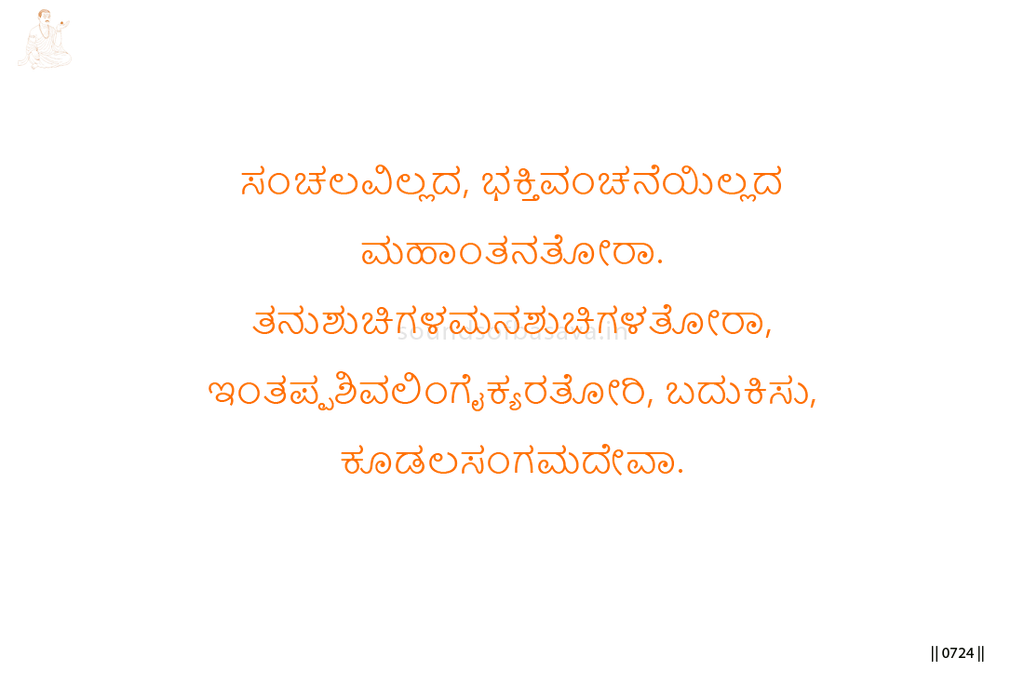
In this vachana, Basavanna asks Kudalasangama Deva to show him the Mahantas, the great ones of the path.
For the reader, Mahanta does not mean a person of social importance or public status. It means one who has become inwardly mature. Basavanna defines such greatness clearly: no agitation, no deceit in devotion, purity of body, purity of mind, and establishment in Linga.
He is not asking merely to see such people from a distance. He asks to be shown them and made to live among them. This is important. The presence of such Sharanas becomes the living environment in which the seeker is corrected, steadied, and deepened.
The teaching is direct: true greatness is not speech, title, ritual rank, or display. True greatness is stillness in movement, devotion without deception, purity in body and mind, and abiding in Linga.
Imagery & Symbolic Relevance
Freedom from agitation is the first mark. Basavanna does not say the great ones do nothing. They may move, work, speak, and serve, but inward disturbance does not rule them.
Devotion without deceit is the second mark. This means Bhakti without hidden motive, performance, pride, or inward contradiction. The devotion seen outside must be true inside.
Purity of body is the third mark. This should not be reduced to ritual cleanliness alone. It means conduct is clean: action does not exploit, deceive, injure, or contradict the path.
Purity of mind is the fourth mark. The mind is not split between sacred speech and hidden desire. It has become clear, steady, and aligned.
Establishment in Linga is the final mark. A Lingaikya is one whose life is joined to Linga, not merely one who speaks of Linga. The Divine is no longer an occasional thought; it has become the ground of life.
The movement of the vachana is clear: Basavanna seeks not the loud, learned, or honored, but the inwardly steady, pure, undeceitful, and Linga-established.
Lingayoga
In Lingayoga, this vachana teaches the value of realized company.
The practice-point is direct: seek the company of those whose devotion is clean and whose life is steady. Do not confuse spiritual greatness with speech, appearance, or position.
For Sharana Sthala, this is the longing to live near embodied truth. The Sharana knows that realization is strengthened by living among those whose body, mind, devotion, and awareness are already aligned with Kudalasangama Deva.
Editorial Commentary
This vachana follows naturally after Vachana 512. There, Basavanna asks not to be shown those who merely speak of Dharma without knowing the Lord. Here, he asks positively to be shown the great ones who actually embody what Dharma requires. The focus has moved from rejecting hollow speech to seeking living presence.
Related Vachana
Supporting Vachana
Pranalingi Sthala Vachana 644 — The Unbroken Way
Pranalingi Vachana 644 supports this teaching by insisting that truth, purity, and daily observance must be continuous. It warns that outer cleansing or sacred surroundings cannot replace lived steadiness when conduct remains broken.
This prepares Vachana 513 directly. Basavanna now asks to be shown those in whom that continuity has matured: the ones without agitation, without deceit in Bhakti, pure in body and mind, and established in Linga.
Advancing Vachana
Aikya Sthala Vachana 514 — I Cannot Remain with Them
Aikya Vachana 514 advances this teaching by carrying Basavanna’s longing for Linga-established great ones into firm spiritual discernment. There, he says he cannot remain with those whose life is limited to outward action without Anubhava, but he cannot be apart from those who live in Anubhava and are immersed in Shiva.
Vachana 513 asks Kudalasangama Deva: “Show me such great ones, pure in body and mind, free from deceit in devotion, established in Linga, and let me live among them.” Aikya Vachana 514 carries this into Aikya: the seeker no longer merely asks for such company; he cannot live apart from it. Where Anubhava is present, he remains. Where action lacks realization, he cannot abide.
