

Summary
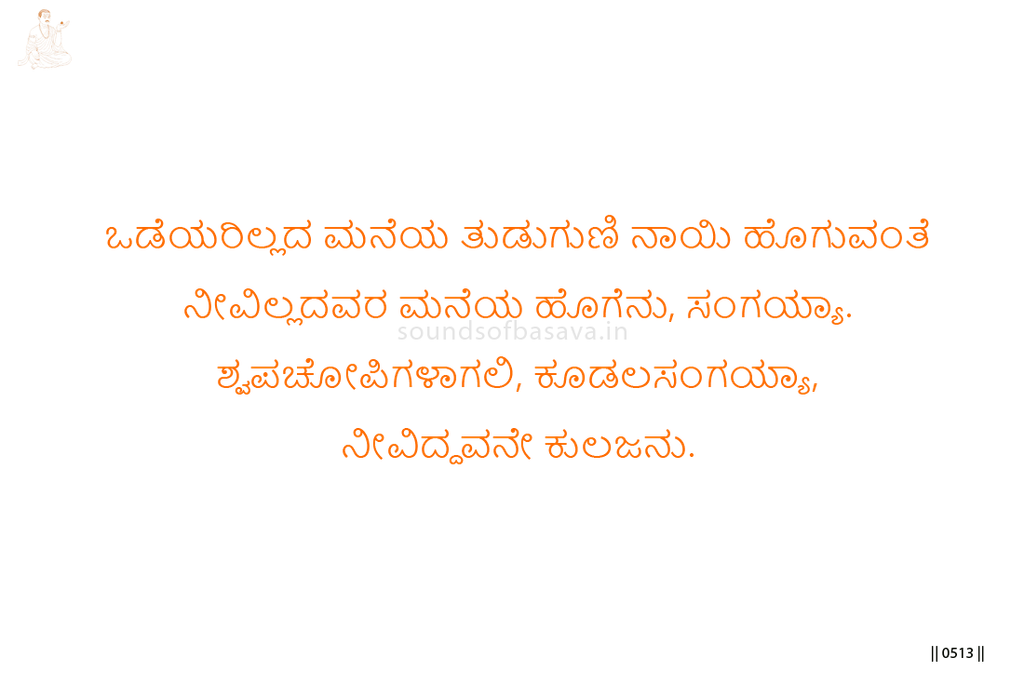
In this vachana, Basavanna uses the image of a house without its master. In such a house, stray dogs enter and move about. A house without its owner becomes open to disorder.
He then turns the image toward spiritual association. O Sangayya, he says that he will not enter the house of those in whom You do not dwell. The issue is not outer house or social place alone, but the absence of Kudalasangama Deva as the living presence.
The final line overturns birth-based judgment. Even if one is called Shvapacha, if Kudalasangayya is present in that person, he is truly Kulaja. The teaching is that noble lineage is not decided by birth, but by the indwelling presence of Kudalasangama Deva.
Imagery & Symbolic Relevance
The house without a master is the first image. A house is meant to be ordered by its owner. Without the master, it becomes unguarded and exposed.
The stray dog entering the house shows disorder entering where rightful presence is absent. Basavanna uses this image to show what happens when life is not governed by the Lord’s presence.
The refusal to enter such a house is important. Basavanna does not seek association where Kudalasangama Deva is absent. Spiritual company is measured by Divine presence, not by social standing.
The Shvapacha image gives the decisive reversal. Shvapacha refers to one placed at the lowest edge of social judgment. Basavanna refuses to let that outer status become the final measure.
Kulaja is redefined. True nobility belongs to the one in whom Kudalasangama Deva dwells. The presence of the Lord makes the person worthy, regardless of social designation.
Lingayoga
In Lingayoga, this vachana teaches discernment of presence. The seeker must not measure people by outer house, caste, status, or name.
For Pranalingi Sthala, the emphasis is inward habitation. The true question is whether Kudalasangama Deva dwells within. Where He is absent, the house is unguarded; where He is present, even one socially dismissed becomes noble.
The practice-point is direct: seek the company where the Lord dwells. Do not judge by birth or outer standing. Recognize the one made noble by Kudalasangama Deva’s presence.
Editorial Commentary
The house image should be kept central. Basavanna is not merely speaking about a physical dwelling; he uses the house to show the condition of a life without the Master.
The final line must not be softened. It directly overturns social ranking by declaring that even a Shvapacha becomes Kulaja when Kudalasangama Deva is present.
Related Vachana
Supporting Vachana
Prasadi Sthala Vachana 657 — True Nobility Is Linga-Bhakti
Prasadi Vachana 657 supports this vachana by teaching that birth is not the true measure of spiritual worth. There, Basavanna asks what it matters if one is born as a Shvapacha, if that person is a Linga-Bhakta. The true measure is inner relation to Linga and purity of bhava.
Vachana 715 carries the same teaching into Pranalingi Sthala. It says that even if one is called Shvapacha, the one in whom Kudalasangama Deva dwells is truly Kulaja. Thus Prasadi Vachana 657 supports the Pranalingi teaching that Divine presence, not social birth, establishes real nobility.
Advancing Vachana
Sharana Sthala Vachana 802 — The Empty House
Sharana Vachana 802 advances this teaching by turning the house image inward. There, Basavanna asks where Linga can dwell if arrogance fills the house of the mind, and says that the body itself must become Linga when ego has no place.
In Vachana 715, the house without its Master is unfit, while the one in whom Kudalasangama Deva dwells becomes truly noble. In Vachana 802, this advances into Sharana Sthala as the inner discipline of emptying arrogance so that Linga may dwell fully. Thus the Pranalingi teaching of the Master’s presence matures into Sharana realization, where the whole body becomes the dwelling of Linga before Kudalasangama Deva.
