
Summary
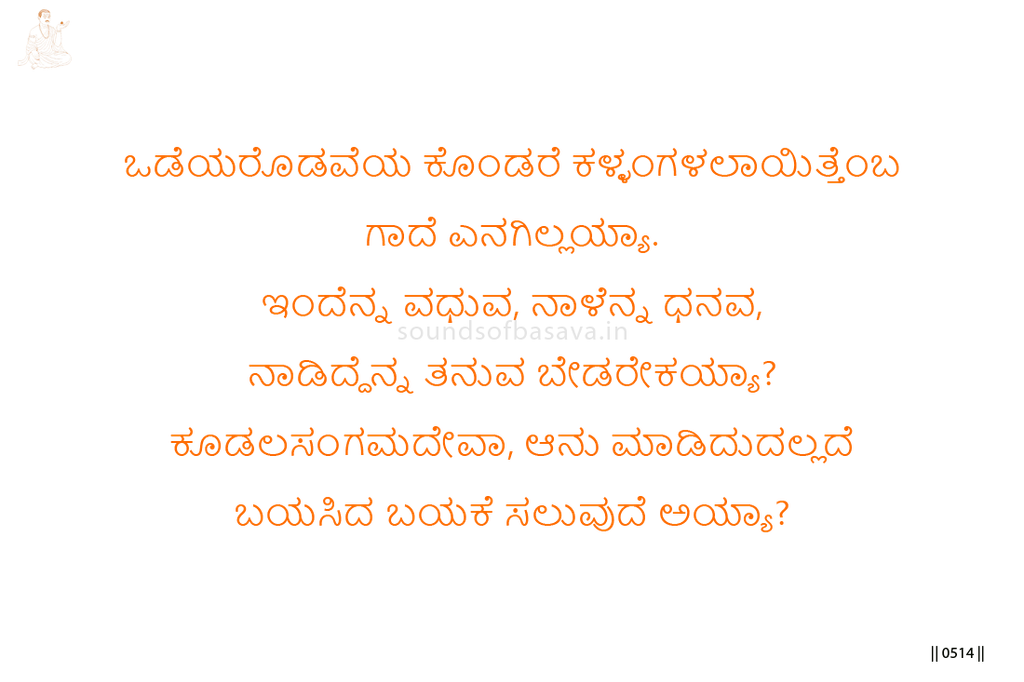
In this vachana, Basavanna places ordinary desire before Kudalasangama Deva. He does not allow worldly sayings or public assumptions to decide what should be asked of the Lord.
He names the usual human concerns: today’s companion, tomorrow’s wealth, and the body that must continue into the coming days. These represent pleasure, possession, and bodily preservation.
The decisive question is whether desire alone can bring fulfilment apart from what has actually been done. Basavanna does not treat wanting as attainment. Before Kudalasangama Deva, desire must be tested by action, truth, and right orientation.
Imagery & Symbolic Relevance
The first movement concerns the saying of others. Basavanna refuses to let worldly speech become the measure of spiritual truth.
Today’s companion is the first desire. It points to immediate attachment and the nearness of present pleasure.
Tomorrow’s wealth is the second desire. It points to accumulation, security, and the hope of future possession.
The body of the coming days is the third concern. The body must be sustained, but it must not become the center around which all seeking turns.
The final question gives the correction. A desired desire does not become fulfilled merely because it is desired. What has not been rightly lived or done cannot be claimed as fruit before Kudalasangama Deva.
Lingayoga
In Lingayoga, this vachana teaches discrimination between desire and rightful action. The seeker must not confuse wanting with fulfilment.
For Pranalingi Sthala, the emphasis is inward clarity. The seeker must distinguish what belongs to the body, what belongs to wealth, what belongs to passing desire, and what belongs before Kudalasangama Deva.
The practice-point is direct: do not ask the Eternal to serve passing desire. Act rightly where action is needed, and place desire itself under the witness of Kudalasangama Deva.
Editorial Commentary
This vachana should not be read as a rejection of work, body, or worldly responsibility. Basavanna’s concern is more precise: desire alone does not bear fruit, and the Lord must not be treated as a means for ordinary craving.
The sequence of today, tomorrow, and the body of the coming days should be preserved. It shows how desire moves through present pleasure, future possession, and bodily continuity.
Related Vachana
Supporting Vachana
Prasadi Sthala Vachana 18 — The Triad of Attachment
Prasadi Vachana 18 supports this vachana by showing how Māyā draws the unsettled seeker through gold, form, and earth. Gold signifies wealth and accumulation, form signifies visible attraction, and earth signifies possession and the wish to claim.
Vachana 723 carries this field into Pranalingi Sthala. It names companion, wealth, and body, and then asks whether desire can be fulfilled apart from what has been done. Thus Prasadi 18 supports the Pranalingi teaching that worldly attraction must be seen clearly and must not govern the seeker’s relation to Kudalasangama Deva.
Advancing Vachana
Sharana Sthala Vachana 1053 — The Only True Wealth
Sharana Vachana 1053 advances this teaching by redefining wealth and desire. There, Basavanna says he has no elephants, treasure houses, or royal horses, yet he does not ask Kudalasangama Deva for worldly gain. Instead, he asks to be restrained if desire arises again, and declares that refusing a Sharana in need is the greater failure.
In Vachana 723, Basavanna questions whether passing desire can be fulfilled apart from rightful action. In Vachana 1053, this matures into Sharana Sthala as freedom from worldly asking and readiness for Dasoha. Thus the Pranalingi examination of desire advances into Sharana wealth, where possession loses its value and generosity toward the Sharana becomes the true measure before Kudalasangama Deva.
