

Summary
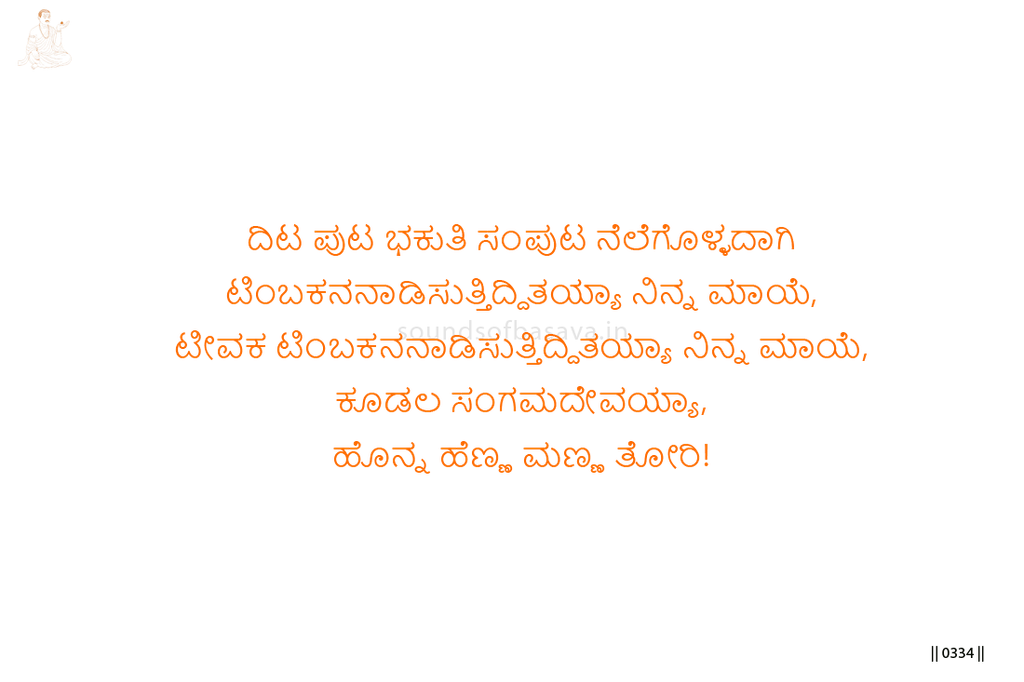
In this vachana, Basavanna shows the speaker being driven by Māyā before steadiness has taken root. The movement is restless and outward. Māyā does not remain hidden; it places before the speaker specific objects of attraction — gold, form, and earth.
The teaching is direct: when inner steadiness is absent, what is shown outwardly begins to move the seeker. Gold appears as value, form appears as attraction, and earth appears as possession. Before Kudalasangama Deva, Basavanna does not disguise this condition. He names the working of Māyā and shows how the seeker is drawn again into restlessness.
Imagery & Symbolic Relevance
The first image is the absence of settled steadiness. The vachana begins from a condition where devotion has not yet become firm. Because it has not taken root, the speaker is vulnerable to being driven.
The second image is Māyā driving the seeker. Māyā is not shown here as an abstract doctrine, but as an active force that moves the speaker outward. The repeated sense of being driven reveals loss of inward stability.
The final image is the triad of gold, form, and earth. Gold signifies wealth, attraction to value, and the pull of accumulation. Form signifies visible attraction and the power of what appears desirable. Earth signifies ground, possession, and the wish to claim what can be held as one’s own.
Together, these images show how restlessness takes shape through what is placed before the seeker. The danger is not merely that these objects exist, but that the unsettled seeker is moved by them.
Lingayoga
In Lingayoga, this vachana shows a simple inward warning: when steadiness has not settled, the seeker must recognize how easily outward objects begin to command attention. The vachana does not describe a method or discipline in detail. It shows the condition that must be seen clearly.
For Prasadi Sthala, the relevance lies in reception. What appears before the seeker must not be received as possession, craving, or self-fulfillment. Basavanna places this weakness before Kudalasangama Deva so that the movement of Māyā is no longer hidden.
Editorial Commentary
Gold, form, and earth should not be read merely as three external objects. They represent the visible points where Māyā catches the unsettled seeker. The vachana’s concern is not ownership of things alone, but the inward movement that begins when the seeker is drawn by what is shown.
Basavanna’s strength lies in naming the condition without ornament. He does not claim that steadiness is already complete. He shows the danger plainly before Kudalasangama Deva.
Related Vachana
Supporting Vachana
Maheshwara Sthala Vachana 310 — The Washerman and the Three Attachments
Maheshwara Vachana 310 supports this vachana by deepening the same field of attachment. Vachana 18 names gold, form, and earth as the objects placed before the unsettled seeker. Vachana 310 expands this into wealth, flesh, and land, showing how such attachments exhaust the seeker and obscure the true taste found only in Kudalasangama Deva. The support is direct: what appears desirable becomes spiritually destructive when it replaces inward turning.
Advancing Vachana
Pranalingi Sthala Vachana 786 — Not a Blade of Grass Outside the Linga
Pranalingi Vachana 786 advances this movement by transforming the problem of attraction into the discipline of purified receiving. In Vachana 18, Māyā places gold, form, and earth before the seeker. In Vachana 786, the seeker refuses to receive anything unless it comes through the Linga as Prasada. The outward pull of objects is therefore answered by complete Linga-centered reception, where not even a blade of grass is taken as personal possession.
