

Summary
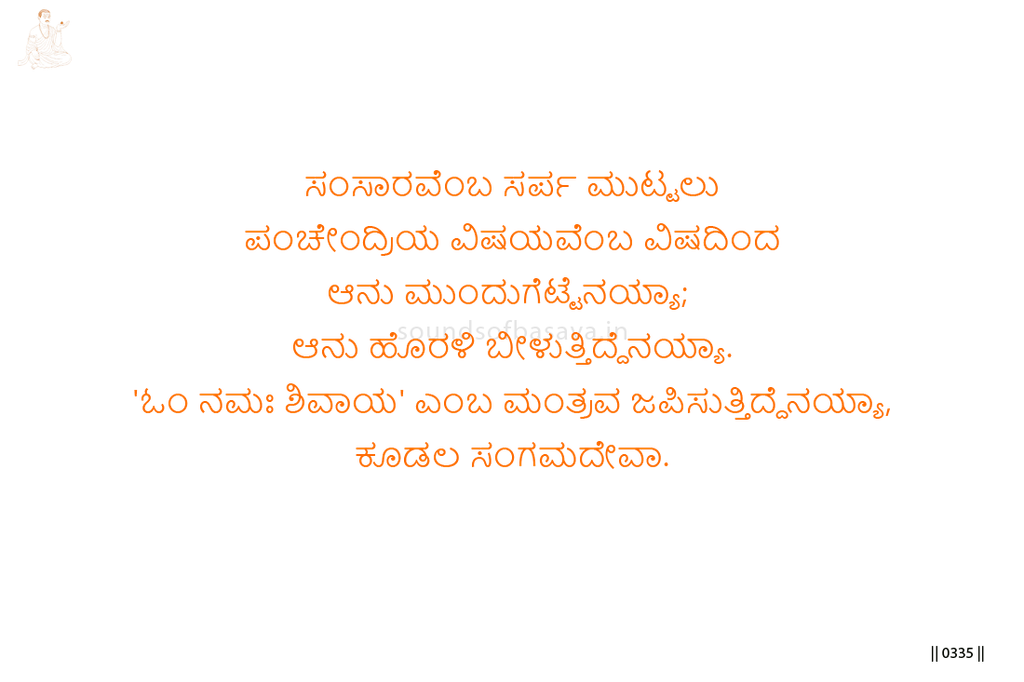
In this vachana, Basavanna presents samsara as a serpent and the five sense-objects as poison. When the speaker comes into contact with this serpent, the poison takes effect. He falls, sinks, and cannot steady himself by his own strength.
In that fallen condition, he chants “Om Namah Shivaya,” the Panchakshari mantra that means “Salutations to Shiva.” In the Lingayat tradition, this mantra is not merely a sacred formula but a direct remembrance of the Divine presence. By repeating it, the speaker turns away from the poison that has entered through the sense-objects and directs his awareness toward Kudalasangama Deva. The mantra marks his turning toward Kudalasangama Deva, but the vachana does not end with chanting alone. The decisive restoration comes when the Sharanas of Kudalasangama arrive and say, “Do not fear.” Through their nearness and assurance, the speaker lives again.
The teaching is clear: contact with samsara wounds the seeker through the poison of sensory attraction, but the Divine Name and the presence of the Sharanas become the means of restoration. Before Kudalasangama Deva, Basavanna shows both the danger and the remedy.
Imagery & Symbolic Relevance
The first image is the serpent of samsara. A serpent suggests danger that may not be fully understood until contact has occurred. Once touched, its consequence is immediate.
The second image is poison. Basavanna identifies this poison with the five sense-objects. The danger is not the senses as bodily faculties, but the objects toward which they are drawn and through which the speaker becomes affected.
The fall is the next important image. The speaker does not merely say that he was tempted or troubled. He says he fell and sank. This shows the lived effect of the poison: loss of steadiness and inability to stand by oneself.
The mantra “Om Namah Shivaya” becomes the counter-movement. It is the sound of turning in the midst of the fall. The speaker does not remain silent under the poison; he calls upon the sacred Name.
The arrival of the Sharanas completes the imagery. They do not give a long teaching. They come and say, “Do not fear.” Their presence itself becomes reassurance. The fallen speaker is restored not by argument, but by the living nearness of those who belong to Kudalasangama.
Lingayoga
In Lingayoga, this vachana shows the need to recognize how contact with samsara enters through attraction to sense-objects. The danger must be seen plainly. The seeker falls when he takes hold of what carries poison.
The practice-related movement is equally plain: chant the Name and remain near the Sharanas. The mantra turns the speaker toward Kudalasangama Deva, while the Sharanas steady him through living assurance. For Prasadi Sthala, the restored life is received through grace-bearing presence, not claimed as self-achievement.
Editorial Commentary
This vachana should not be read as a rejection of the senses themselves. Basavanna’s concern is the poison of the sense-objects when the speaker is drawn into them through samsara. The serpent image gives urgency to the teaching: the danger is not theoretical; it has already entered.
The words “Do not fear” are therefore central. They show the function of the Sharanas as restoring presence. The speaker is not left with poison, fall, and fear. In the company of Kudalasangama’s Sharanas, life is returned.
Related Vachana
Supporting Vachana
Maheshwara Sthala Vachana 119 — The Venom of Association
Maheshwara Vachana 119 supports this vachana by developing the same serpent-and-poison imagery into the question of true and harmful association. Vachana 20 shows the seeker affected by the poison of samsara and the five sense-objects. Vachana 119 clarifies that what one comes near can steady or poison the inner life. The support is direct: danger enters through contact, and restoration requires the company of the true.
Advancing Vachana
Pranalingi Sthala Vachana 78 — The True Mastery
Pranalingi Vachana 78 advances this vachana by carrying “Om Namah Shivaya” from emergency utterance into mature inner alignment. In Vachana 20, the speaker chants the mantra while fallen under the effect of poison. In Vachana 78, the same mantra is shown as true mastery, not as control over others, but as the power that brings the restless inner condition into alignment with Kudalasangama Deva. Thus the Name first appears as antidote and later matures as steady mastery.
