

Summary
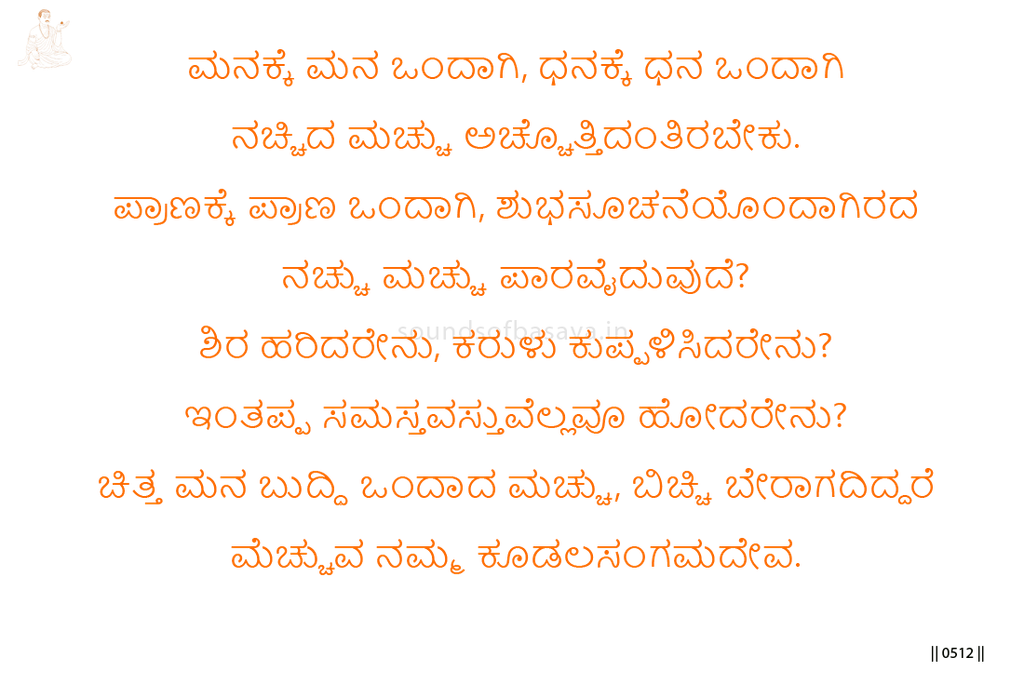
In this vachana, Basavanna calls for inward oneness. Mind must become one with mind, wealth with wealth, life-force (prana) with life-force, and auspicious knowing must remain one. Without such steadiness, how can the crossing take place?
He then dismisses outer loss as secondary. What if the head is broken, the body is torn, or all possessions are lost? These are not the final measure.
The decisive test is whether chitta (the deeper field of consciousness that stores impressions and tendencies), mind, and buddhi (discriminating intelligence) become one and do not separate again. Only such undivided steadiness is pleasing to Kudalasangama Deva.
Imagery & Symbolic Relevance
Mind becoming one with mind is the first movement. It points to the end of inner contradiction. The mind should not divide against itself.
Wealth becoming one with wealth shows that possession and value must not scatter the seeker. What is held must not pull consciousness away from its center.
Prana becoming one with prana deepens the same movement. Life itself must not be divided between outward movement and inward truth.
Auspicious knowing must also become one. Knowledge is not enough if it remains fragmented, partial, or unstable.
The images of broken head, torn body, and lost possessions show that physical suffering and outer loss are not the deepest danger. Basavanna places the real question elsewhere.
The final image is chitta, mind, and buddhi becoming one without separating. This is the heart of the vachana. The seeker must not remain inwardly split after seeing the path.
Lingayoga
In Lingayoga, this vachana teaches inner integration. Mind, life, value, and knowing must not move in different directions.
For Pranalingi Sthala, the emphasis is stabilization. The seeker may have insight, practice, and devotion, but if chitta, mind, and buddhi scatter again, the crossing remains incomplete.
The practice-point is direct: gather the inner faculties into one steady movement before Kudalasangama Deva. Do not let outer hardship or loss become the measure; let undivided awareness be the measure.
Editorial Commentary
The repeated “becoming one” should be preserved. Basavanna is not speaking of verbal unity, but of inward non-fragmentation.
The bodily images should not dominate the interpretation. They serve to show that outer injury and loss are secondary to the deeper question of inner division.
Related Vachana
Supporting Vachana
Prasadi Sthala Vachana 260 — Not Washed but Made Pure
Prasadi Vachana 260 supports this vachana by showing the need for inward purification. There, Basavanna asks Kudalasangama Deva to remove the faults within and make him pure; the mind is shown as caught and covered, needing release through surrender.
Vachana 691 shows the fruit of that purification: mind, prana, knowing, chitta, mind, and buddhi must become one and not scatter again. Thus Prasadi Vachana 260 prepares the Pranalingi teaching that purification must mature into one-pointed inner alignment before Kudalasangama Deva.
Advancing Vachana
Sharana Sthala Vachana 869 — Beyond Division — The True Sharana
Sharana Vachana 869 advances this teaching by carrying inner oneness into Sharana identity. There, Basavanna asks how one can be a Sharana while remaining bound by division and identity, and he describes the true Sharanas as those transformed beyond such separations.
In Vachana 691, chitta, mind, and buddhi must become one and not separate again. In Vachana 869, this advances into Sharana Sthala as freedom from the divisions that prevent one from becoming a true Sharana. Thus the Pranalingi demand for inner alignment matures into Sharana transformation before Kudalasangama Deva.
