
Summary
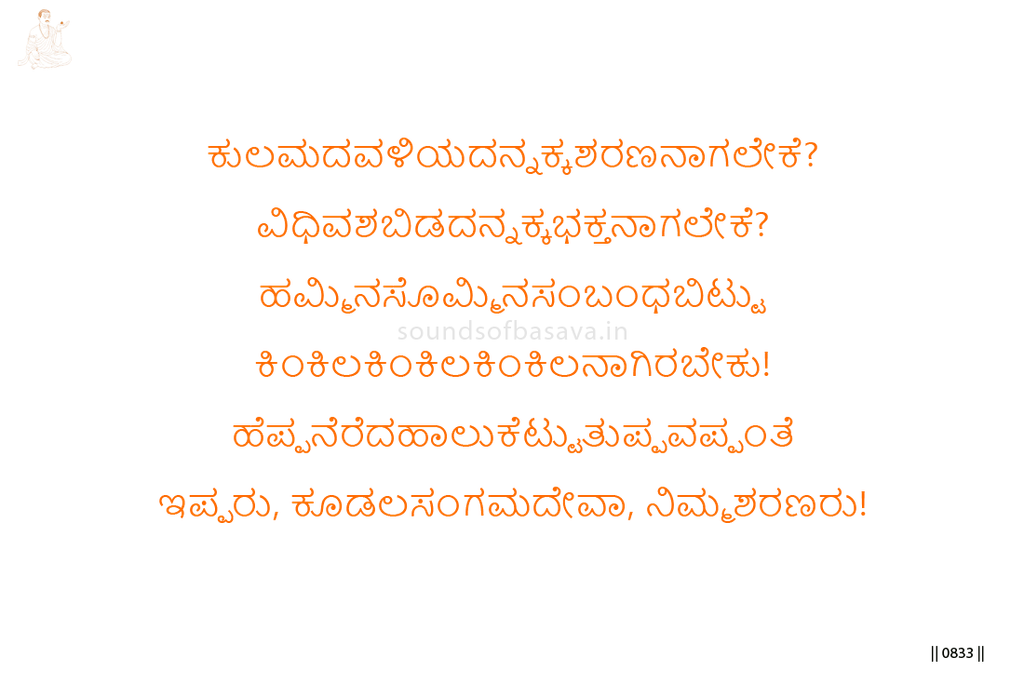
Basavanna asks how one can become a Sharana if the pride of kula has not fallen away. He then asks how one can become a Bhakta if one remains under the hold of fate. The teaching begins by removing two false grounds of spiritual identity: inherited division and submission to limitation.
He then says that the relation of “this and that,” the entanglement of separate claims, must be left behind. Only then can one become bright, sparkling again and again. The Sharana is not marked by social origin or fatalistic belief, but by a radiance that appears when division has been abandoned.
The final image is milk transformed into ghee. Milk does not remain in its raw condition; through proper transformation it becomes ghee. In the same way, Kudalasangama Deva’s Sharanas are those who have passed beyond division and fate-bound identity into refined, luminous being.
Imagery & Symbolic Relevance
The first image is kula-mada, the pride or intoxication of lineage, caste, or inherited standing. Basavanna says that one who has not cast this off cannot become a Sharana. Sharanahood is therefore not compatible with identity built upon division.
The second image is vidhi-vaśa, being under the sway of fate. One who remains bound by fate cannot become a Bhakta. Basavanna does not allow devotion to become passive submission to inherited condition or limitation.
The phrase about leaving the relation of “this and that” carries the inward movement. The seeker must leave the web of separate claims, comparisons, and entanglements. Without this leaving, the old identity continues.
The repeated “kiṅkila, kiṅkila, kiṅkila” gives the image of brightness or sparkling vitality. The true Sharana does not merely abandon division as an idea; he shines with the clarity that follows such abandonment.
The milk-to-ghee image completes the teaching. Milk must undergo transformation before it becomes ghee. Its origin is not the final measure; its ripening is. Likewise, the Sharana is known not by birth, caste, fate, or inherited condition, but by transformed being.
Kudalasangama Deva’s Sharanas are therefore compared to ripened ghee. Their worth lies in transformation, refinement, and freedom from the divisions that once held them.
Lingayoga
In Lingayoga, this vachana teaches that spiritual maturity requires release from inherited identity and fatalistic self-understanding. The practitioner must not build devotion upon kula-mada or vidhi-vaśa.
For Sharana Sthala, the practice-point is direct: the Sharana must leave division. The title Sharana cannot be claimed while the mind remains bound by caste-pride, lineage-pride, separate relation, or the belief that fate fixes one’s spiritual condition.
The milk-to-ghee image also clarifies transformation. The body and life are not rejected, but they must be refined. When the raw condition is transformed, the Sharana shines before Kudalasangama Deva.
Editorial Commentary
The key terms kula-mada and vidhi-vaśa should be retained in meaning. Kula-mada refers to pride arising from lineage, caste, or inherited standing. Vidhi-vaśa refers to being held under fate or destiny as a limiting force. Basavanna rejects both as grounds for Bhakta or Sharana identity. The true measure is transformation, expressed through the image of milk becoming ghee.
Related Vachana
Supporting Vachana
Pranalingi Sthala Vachana 715 — The Master of the House
Pranalingi Vachana 715 supports this teaching by overturning birth-based judgment. It says that Basavanna will not enter the house where Kudalasangayya is absent, but even one called Shvapacha is truly Kulaja if Kudalasangayya is present. This prepares Vachana 869 directly. In Vachana 715, noble lineage is redefined by the indwelling presence of Kudalasangama Deva; in Vachana 869, one cannot become a Sharana while retaining kula-pride, and Kudalasangama Deva’s Sharanas are known by transformation rather than inherited division.
Advancing Vachana
Aikya Sthala Vachana 1196 — Beyond the Five Impurities
Aikya Vachana 1196 advances this teaching by carrying freedom from lineage and caste-pride into complete Aikya recognition. It rejects the impurities of birth, caste, bodily condition, contact, and death when applied to devotees united in Anga and Linga, reborn through Guru, established through Linga, and fulfilled in true Linga-Aikya. This is the natural Aikya fulfillment of Vachana 869. In Sharana Vachana 869, the Sharana must leave kula-mada and fate-bound identity; in Aikya Vachana 1196, even the social and ritual categories built upon birth, caste, body, contact, and death lose their authority before Kudalasangama Deva.
