

Summary
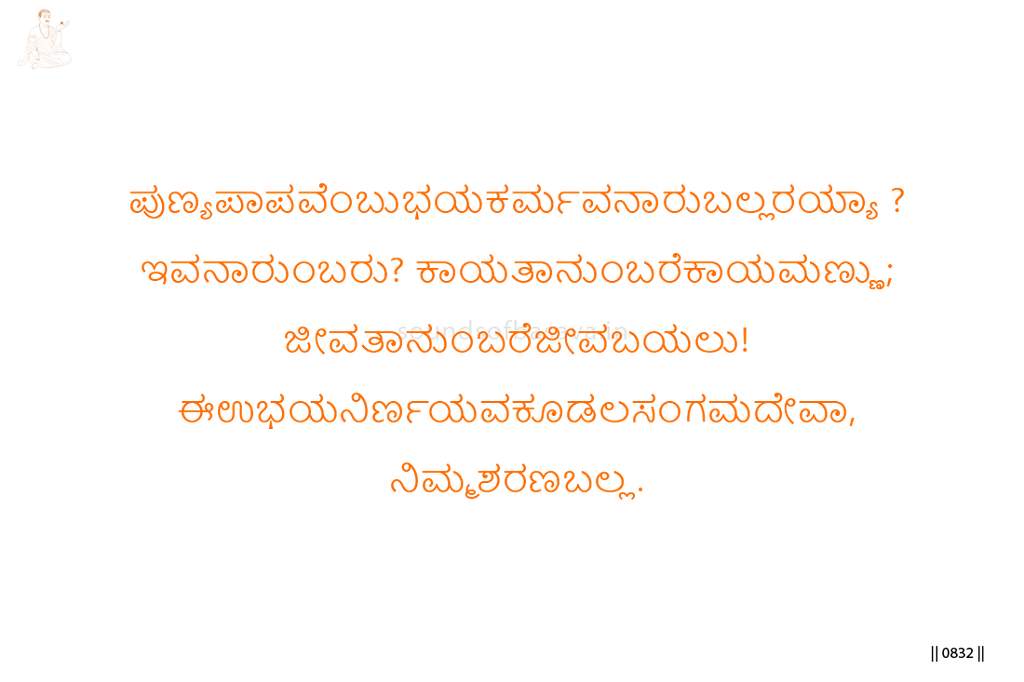
Basavanna asks who truly knows the twofold karma called merit and sin. The question turns attention away from moral labels and toward the one who claims to know, possess, or be bound by them.
He then tests the possible claimant. If the body claims to be the one, the body is only earth. If life claims to be the one, life is only open expanse. Neither body nor life can finally stand as the true possessor of merit and sin.
The final line gives the measure: only Kudalasangama Deva’s Sharana knows this discernment of both. The Sharana sees clearly that the body and life cannot be treated as final claimants of karmic identity. Merit and sin are understood only when the false claimant has been examined.
Imagery & Symbolic Relevance
The twofold karma of merit and sin is the opening image. Basavanna does not first define them. He asks who can know them. This shifts the inquiry from action as category to the knower who claims relation to action.
The body is the first tested claimant. The body may appear to act, receive, enjoy, suffer, and carry consequence. Yet Basavanna says that when examined, the body is earth. It cannot be the final knower of merit and sin.
Life is the second tested claimant. Life appears subtler than body and may seem closer to identity. Yet Basavanna says that life is open expanse. It too cannot be fixed as the final claimant of karmic ownership.
The contrast between body and life gives the vachana its precision. The gross body returns to earth; life is not a solid owner that can hold merit and sin as possessions. Both are insufficient as final grounds of karmic identity.
The “discernment of both” is the decisive phrase. It refers to seeing through both merit and sin, and also through body and life as claimants. This discernment does not belong to ordinary self-understanding.
The Sharana is the one who knows. Basavanna places this clarity in the Sharana because the Sharana no longer rests in the ordinary claim, “I am the doer; I am the receiver of merit or sin.” The Sharana sees the matter before Kudalasangama Deva.
Lingayoga
In Lingayoga, this vachana teaches inquiry into the claimant of karma. The practitioner must not merely ask whether an action is merit or sin; he must also ask who is claiming them.
For Sharana Sthala, the practice-point is clear discernment. The body cannot be treated as the final self, and life cannot be held as a separate possessor. The Sharana sees through both forms of mistaken ownership.
This does not deny right conduct. It removes the false center that turns conduct into self-claim. When body and life are rightly discerned, merit and sin no longer become the ground of identity before Kudalasangama Deva.
Editorial Commentary
The phrase “twofold karma” should be kept close to the source. Basavanna is speaking of puṇya and pāpa together, not as separate topics but as a paired structure of karmic identity. The body as earth and life as open expanse are the two source-given images through which the claimant is examined.
Related Vachana
Supporting Vachana
Pranalingi Sthala Vachana 964 — What Is Offered in the Body—Does It Truly Merge in the Linga?
Pranalingi Vachana 964 supports this teaching by distinguishing prana from the karma-born body. It says that prana may merge in Linga and become without separate division, while the karma-born body continues to be held by the Sharana. This prepares Vachana 863 directly. In Vachana 964, body and prana must be carefully discerned so that embodied continuation is not mistaken for bondage; in Vachana 863, body and life are again examined, and only Kudalasangama Deva’s Sharana knows the discernment by which merit and sin lose their false claimant.
Advancing Vachana
Aikya Sthala Vachana 1269 — Beyond Merit and Sin
Aikya Vachana 1269 advances this teaching by carrying the discernment of merit and sin into complete peace beyond spiritual accounting. There, Basavanna says he does not know merit, sin, heaven, or hell; having become a Sharana of Shiva and having worshipped Kudalasangama Deva, he has become pure, fulfilled, and free from anxiety. This is the natural Aikya fulfillment of Vachana 863. In Sharana Vachana 863, the body and life cannot claim merit and sin; in Aikya Vachana 1269, even concern for merit, sin, heaven, and hell falls away, leaving repose in Kudalasangama Deva.
