

Summary
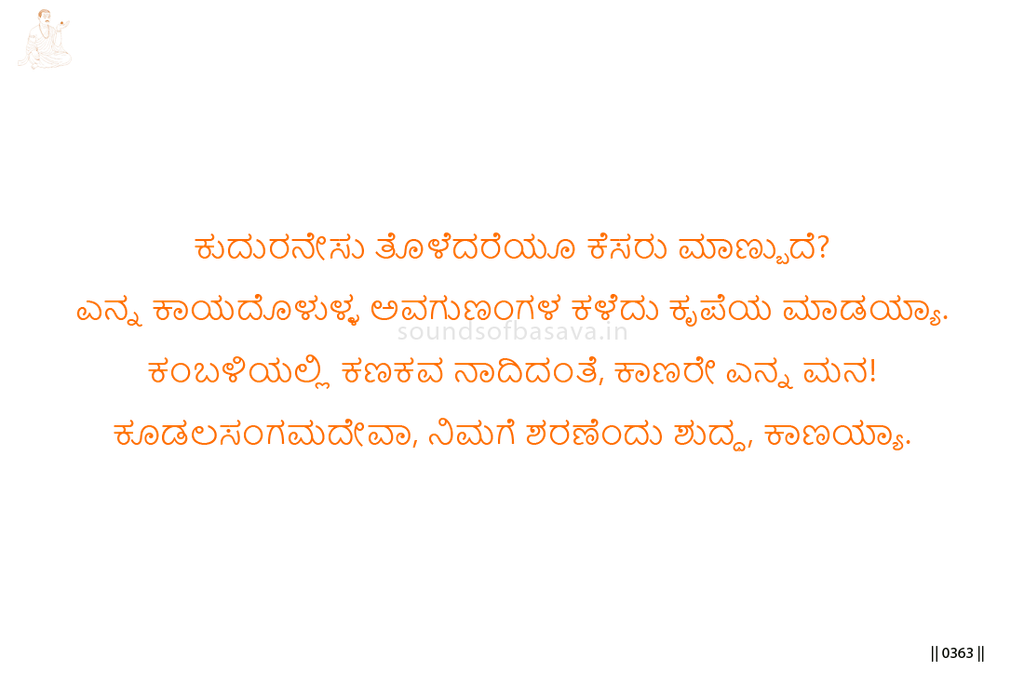
In this vachana, Basavanna asks whether washing a horse truly removes its mud. The image shows the limit of surface cleansing. Washing may remove what is visible for a moment, but it does not remove the tendency that brings the stain back.
He then turns the image toward himself. The real concern is not dirt on the surface, but the faults within the body and the troubled condition of the mind. Basavanna asks Kudalasangama Deva to remove these faults through grace.
The mind is shown as caught in a wool-like covering. It is not clear, open, or pure by itself. Basavanna therefore does not claim purity through his own effort. He stands in surrender and asks Kudalasangama Deva to make him pure.
Imagery & Symbolic Relevance
The first image is the washed horse. A horse may be washed, yet mud can return. Basavanna uses this image to show that outer cleansing does not necessarily change the deeper condition. What is removed from the surface may reappear if the root remains.
The second image is the faults in the body. Basavanna does not speak vaguely. He asks that the defects within his embodied condition be removed. The problem is inwardly carried, not merely outwardly visible.
The third image is the mind caught like gold in a woollen covering. Wool holds, wraps, and entangles. The mind is not presented as naturally free here; it is covered, caught, and in need of release.
The final movement is surrender. Basavanna does not say, “I have made myself pure.” He says, “I am surrendered to You; make me pure.” Purity is therefore received through Kudalasangama Deva’s grace.
Lingayoga
In Lingayoga, this vachana shows that outer cleansing is not enough. The seeker may clean the body, correct appearance, or repeat discipline, yet the inner faults may remain.
For Prasadi Sthala, the relevance lies in honest receiving. The seeker receives the truth that he cannot purify himself merely by surface effort. He offers himself in surrender and receives purification from Kudalasangama Deva.
Editorial Commentary
The washed horse image gives the first warning: surface cleaning does not guarantee inner change. Basavanna is not rejecting cleanliness; he is showing its limit when the deeper tendency remains untouched.
The faults named in the body point to embodied weakness, habit, and impurity carried within lived existence. These are not removed by appearance alone.
The wool-covered mind image shows entanglement. Wool can hold and conceal; similarly, the mind may remain caught in its own coverings. Basavanna’s prayer is therefore simple and direct: remove the faults and make me pure through surrender.
Related Vachana
Supporting Vachana
Maheshwara Sthala Vachana 50 — Weeds Within
Maheshwara Vachana 50 supports this vachana by using the image of hidden weeds in a field. In Vachana 260, washing the horse does not solve the deeper condition, and Basavanna asks Kudalasangama Deva to remove the faults within. In Maheshwara Vachana 50, the weed of one’s own defects must be uprooted so that growth in Linga can occur. The support is direct: impurity must be removed at the root, not merely washed at the surface.
Advancing Vachana
Pranalingi Sthala Vachana 691 — The One-Pointed Alignment
Pranalingi Vachana 691 advances this movement by showing the purified state as inward non-fragmentation. In Vachana 260, Basavanna asks Kudalasangama Deva to remove faults and make him pure through surrender. In Vachana 691, mind, awareness, and knowing must become one and not scatter again. Thus the Prasadi plea for purification advances into Pranalingi as one-pointed inner alignment before Kudalasangama Deva.
