

Summary
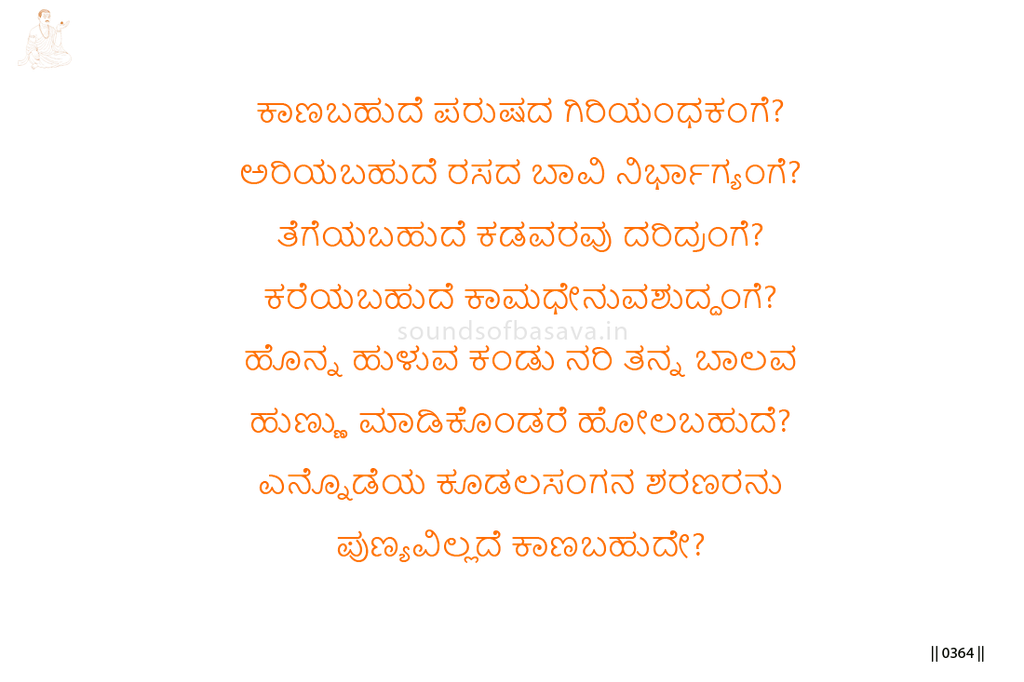
In this vachana, Basavanna asks a series of questions to show that sacred reality cannot be reached by desire, imitation, or outer nearness alone. A blind person cannot behold the mountain peak. The unfortunate cannot draw from the well of nectar. The poor cannot uncover hidden treasure. The impure cannot receive Kamadhenu.
Each image shows the same principle: the object may exist, but one must have the capacity to receive it. Presence alone is not enough. Without the required inward fitness, even what is near remains unseen, untasted, or unused.
The final question brings the teaching to the Sharanas of Kudalasangama Deva. Can one behold them without puṇya? Basavanna’s answer is implied: no. To truly see the Sharanas, one must have ripened merit, grace, and inward receptivity. Otherwise one may stand near them and still fail to recognize their greatness.
Imagery & Symbolic Relevance
The blind person before the mountain peak shows incapacity of sight. The peak may be vast and present, but blindness prevents its recognition. Basavanna uses this to show that spiritual greatness cannot be known by mere physical nearness.
The well of nectar represents hidden sweetness or sustaining essence. For the unfortunate one, it remains inaccessible. The nectar exists, but the person lacks the condition through which it can be drawn and received.
The hidden treasure represents wealth that is present but not available to one without the means to uncover it. Poverty here points to lack of inward resource. Without the right capacity, treasure remains buried.
Kamadhenu represents abundance and fulfillment. Basavanna asks whether the impure can call or receive such a source. The image shows that sacred abundance cannot be handled by an unprepared vessel.
The fox and the firefly give the sharpest warning. A fox that sees a small glow and harms its own tail cannot thereby become a lion. Superficial imitation does not produce real transformation. Mistaking a small glitter for true greatness leads only to distortion.
The final image is the Sharana. To behold Kudalasangama Deva’s Sharanas is not merely to look at them. It is to recognize, receive, and be changed by their presence. That requires puṇya.
Lingayoga
In Lingayoga, this vachana shows that true seeing requires prepared awareness. The seeker may encounter sacred presence, hear teachings, or live near the Sharanas, yet still remain unable to receive them rightly.
For Prasadi Sthala, the relevance lies in receiving through ripened fitness. Prasadi is not entitlement. The seeker receives only when the inner condition is made capable of receiving. Puṇya here is the readiness through which grace can be recognized.
Editorial Commentary
The repeated question “Can it be?” gives the vachana its force. Basavanna is not denying the existence of the mountain, nectar, treasure, Kamadhenu, or Sharana. He is asking whether the one who lacks the required condition can truly receive them.
The fox-firefly image warns against imitation. A small outward resemblance to light is not the same as real greatness. Spiritual transformation cannot be produced by copying signs, gestures, or appearances.
The word puṇya should be understood here as ripened spiritual merit or fitness. It is the inward condition through which the Sharana can be truly seen. Without it, the seeker may look, admire, or imitate, but the real seeing does not occur.
Related Vachana
Supporting Vachana
Maheshwara Sthala Vachana 405 — The Burn Before the Fire
Maheshwara Vachana 405 supports this vachana by showing the pain of seeing the Sharanas without truly seeing them. In Vachana 268, Basavanna asks whether Kudalasangama Deva’s Sharanas can be seen without puṇya. In Maheshwara Vachana 405, he says that even when the Sharanas are present, failure of true seeing causes inward burning. The support is direct: outward encounter is incomplete without inward recognition.
Advancing Vachana
Pranalingi Sthala Vachana 1041 — The Living Jangama Within
Pranalingi Vachana 1041 advances this movement by showing how true seeing becomes possible through Jangama-knowledge. In Vachana 268, Basavanna teaches that one cannot truly behold the Sharanas without ripened fitness. In Vachana 1041, Jangama is the living knowledge without which Linga, Guru, and Prasada cannot be seen. Thus the Prasadi teaching of required receptivity advances into Pranalingi as living Jangama-knowledge that opens true sight before Kudalasangama Deva.
