

Summary
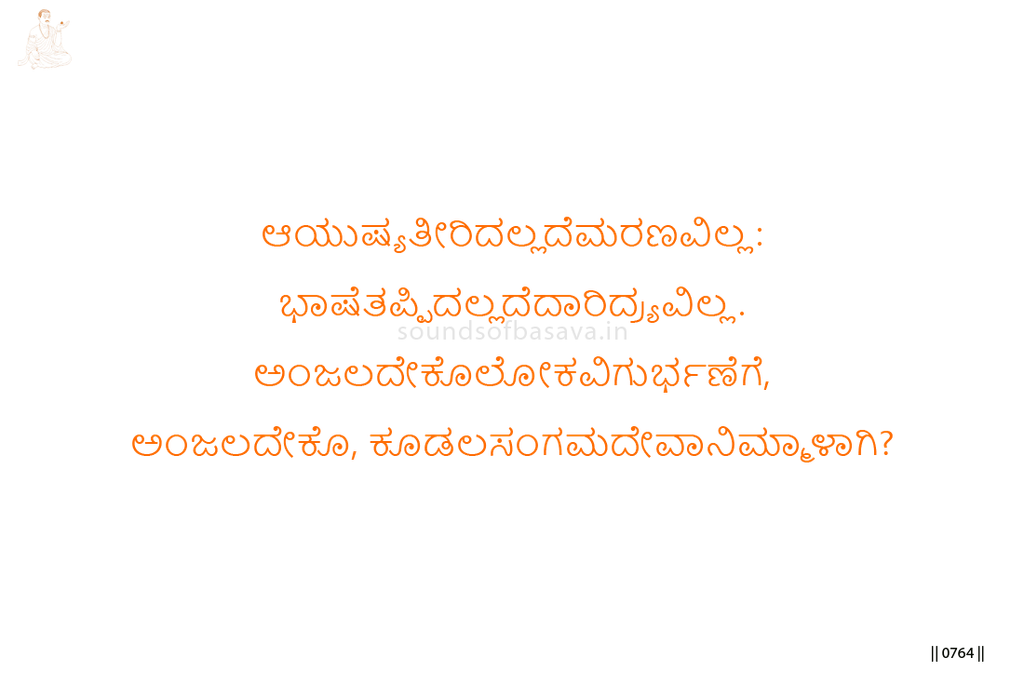
In this vachana, Basavanna sets limits around fear.
He says that death does not come unless the measure of life is complete. He also says that poverty does not come unless speech has failed. These two statements correct ordinary anxiety. Death belongs to the course of life; true poverty begins when speech loses truth.
Basavanna then asks why one should fear the world’s reproach. If life and death do not belong to the world’s opinion, and if true loss begins only when speech falls away from truth, then worldly criticism is not the deepest danger.
The final line turns toward Kudalasangama Deva. Fear loses its ground when the seeker abides in Him. The point is not careless boldness, but right measure: fear should not be given to the world when the real concern is truth before Kudalasangama Deva.
The teaching is direct: the Sharana need not fear worldly reproach; he must guard truthful speech and remain inwardly settled in Kudalasangama Deva.
Imagery & Symbolic Relevance
The first image is the measure of life. Basavanna says death comes only when life’s span is complete. This removes death from the field of social fear and anxious imagination.
The second image is poverty. Poverty is not defined first as lack of wealth. Basavanna connects it to speech that has failed. When speech turns away from truth, the person becomes poor in the deeper sense.
Speech is therefore central to the vachana. It is not merely sound or communication. It reveals whether the inner life remains aligned with truth.
The world’s reproach is the next image. The world may criticize, mock, or judge, but Basavanna refuses to make that the measure of fear. The world’s voice cannot decide the truth of the Sharana.
The final image is abiding in Kudalasangama Deva. This is the ground of fearlessness. The seeker does not stand before the world alone; he stands in relation to the Lord.
The movement of the vachana is therefore from fear of death, to fear of poverty, to fear of worldly reproach, and finally to freedom from fear through abiding in Kudalasangama Deva.
Lingayoga
In Lingayoga, this vachana teaches steadiness in the face of fear.
The seeker should not let the world’s judgment become the center of practice. What must be guarded is truthful speech and inward abidance. If speech remains true and the heart remains settled in Kudalasangama Deva, worldly reproach loses its power.
For Sharana Sthala, the practice-point is clear: do not fear the world more than falsehood. Do not allow public criticism to disturb the refuge already taken. Remain truthful in speech and steady before Kudalasangama Deva.
Editorial Commentary
The vachana should remain compact. Its force lies in the two opening measures: death belongs to the completion of life, and poverty belongs to the failure of speech. The later question about fearing the world should be read through these measures. Basavanna is not dismissing responsibility; he is relocating fear from public opinion to truth before Kudalasangama Deva.
Related Vachana
Supporting Vachana
Pranalingi Sthala Vachana 644 — The Unbroken Way
Pranalingi Vachana 644 supports this teaching by saying that truth, purity, and daily observance must be lived without break. It also warns that nearness to sacred surroundings and later outer cleansing cannot replace steady conduct. This supports Vachana 690 directly. Vachana 690 says poverty comes when speech fails; Vachana 644 gives the supporting discipline: truth must not be occasional, and purity cannot be restored by outer means while conduct remains broken. Together, they show that the real danger is not worldly reproach, but loss of truth and continuity before Kudalasangama Deva.
Advancing Vachana
Aikya Sthala Vachana 1322 — Gently, Gently Beyond Even the Six Sthalas
Aikya Vachana 1322 advances this teaching by carrying fearlessness beyond the claim of stages. There, Bhakta, Maheshwara, Prasadi, Pranalingi, Sharana, and Aikya are crossed gently, and the seeker enters the Fearless State where even stage-identity is no longer held. This is the natural advancement from Vachana 690. Vachana 690 frees the Sharana from fear of worldly reproach by settling him in Kudalasangama Deva; Aikya Vachana 1322 shows the completed movement, where fear itself loses ground because the need to measure, claim, or defend oneself has fallen away.
