

Summary
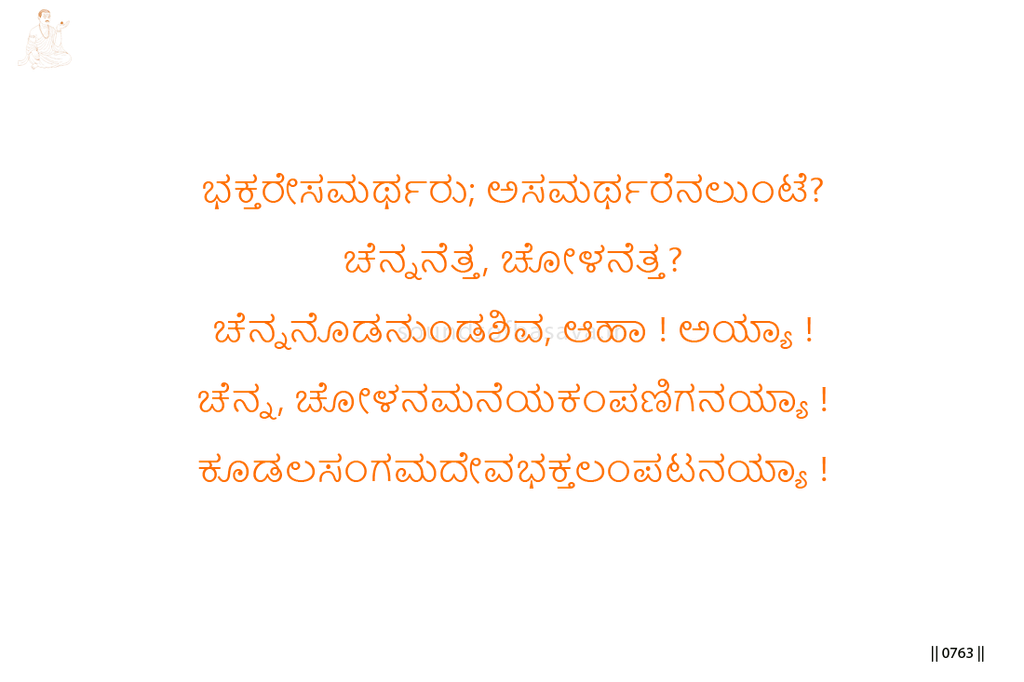
In this vachana, Basavanna declares that the Bhaktas are capable and complete. He asks how they can be called incapable.
He then places Chennayya and the Chola king side by side. The comparison is deliberate. One stands in humble devotional life; the other represents worldly power and public greatness. Basavanna’s question overturns ordinary measure: spiritual worth is not decided by rank, wealth, house, or outer standing.
The decisive image is Shiva’s joy in Chennayya. The Lord is not drawn by royal greatness, but by Bhakti. Chennayya’s standing before Shiva reveals that the true devotee cannot be measured by the world’s scale.
The final line names Kudalasangama Deva as one who delights in Bhakti. The Lord’s delight rests where devotion is true, not where status appears great.
The teaching is direct: the Sharana is not incomplete because the world calls him ordinary. Where Bhakti is whole, spiritual worth is whole before Kudalasangama Deva.
Imagery & Symbolic Relevance
The opening declaration is the foundation: “The Bhaktas are capable.” Basavanna begins by affirming the fullness of the devotee. Capability here is not worldly competence, but the spiritual completeness that comes through true Bhakti.
The question “Can they be called incapable?” rejects the language of deficiency. The Bhakta may be socially humble, outwardly ordinary, or unseen by worldly power, but this does not make him spiritually lacking.
Chennayya and the Chola king form the central contrast. Chennayya represents devotion hidden in ordinary life. The Chola king represents visible authority, wealth, and public greatness. Basavanna does not measure them by external comparison; he asks where true worth stands.
Shiva’s joy in Chennayya gives the answer. The Lord recognizes what the world may overlook. Chennayya’s devotion becomes the place of Divine delight.
The mention of Chennayya in relation to the Chola’s house sharpens the reversal. Even where worldly power appears greater, the spiritual center rests with the devotee whose Bhakti is true.
Kudalasangama Deva as one who delights in Bhakti completes the vachana. The Lord’s measure is not social rank, royal splendor, or outer position. His delight is in devotion.
The movement of the vachana is therefore from worldly comparison to spiritual measure, from Chola’s visible greatness to Chennayya’s hidden worth, and from social judgment to Kudalasangama Deva’s delight in Bhakti.
Lingayoga
In Lingayoga, this vachana teaches the seeker not to judge devotion by outward standing.
The true measure is not whether a person appears powerful, learned, wealthy, or socially honored. The measure is whether Bhakti is alive and steady. Chennayya shows that ordinary life does not prevent Divine nearness.
For Sharana Sthala, the practice-point is clear: do not call the Bhakta incomplete because the world sees only humble form. Learn to recognize where Kudalasangama Deva’s delight rests.
Editorial Commentary
The contrast between Chennayya and the Chola king should remain central. Its force lies in a simple reversal: the world may honor power, but Shiva rejoices in Bhakti. Chennayya should be read as the living example of devotional fullness hidden within ordinary life.
Related Vachana
Supporting Vachana
Pranalingi Sthala Vachana 352 — The Hidden Source and the Hand’s Devotion
Pranalingi Vachana 352 supports this teaching by showing Chennayya carrying grass for the king’s horses. The image is humble, but Basavanna sees realized worth within that ordinary service. This supports Vachana 683 directly. Vachana 683 contrasts Chennayya with the Chola king and shows Shiva’s delight in Chennayya’s Bhakti. Vachana 352 gives the supporting ground: Chennayya’s outer work may appear simple, but his inward standing is not measured by appearance.
Advancing Vachana
Aikya Sthala Vachana 1348 — All Are the Children of Chennayya
Aikya Vachana 1348 advances this teaching by expanding Chennayya’s significance beyond one comparison. There, worlds, beings, gods, sages, inner beings, and those like “me” and “you” are all called children of Chennayya. This is the natural advancement from Vachana 683. Vachana 683 shows Chennayya’s Bhakti outweighing the worldly greatness of the Chola king; Aikya Vachana 1348 expands that reversal into a vision where all hierarchy falls away in the lineage of Chennayya before Kudalasangama Deva.
