

Summary
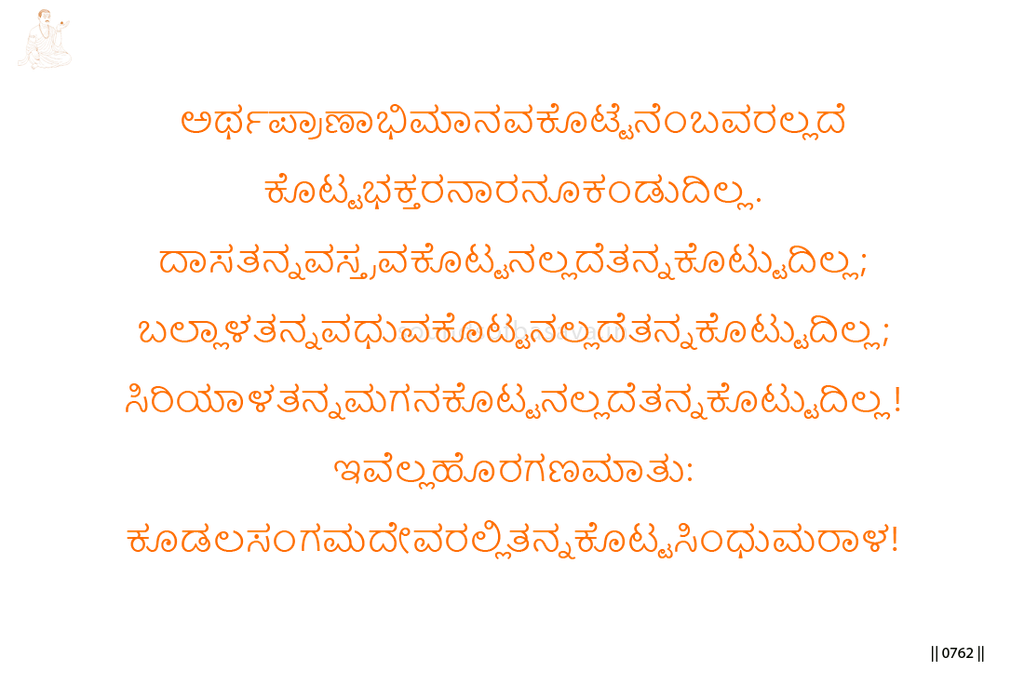
In this vachana, Basavanna examines the difference between giving something and giving oneself.
He begins with the claim: “We have given wealth, life, and self-regard.” But he immediately asks where the devotee is who has truly given himself. The issue is not the size of the gift. The issue is whether the giver still remains inwardly separate, holding himself back.
Basavanna then gives three examples. Dasayya gave his garment, but not himself. Siriyala gave his son, but not himself. Ballala gave his bride, but not himself. These are severe offerings, yet Basavanna says they still remain outward when the giver himself is not surrendered.
The final contrast is Sindhumarala. In Kudalasangama Deva, Sindhumarala gave himself. This is the completed offering.
The teaching is direct: the Sharana is not measured by what he gives outwardly, but by whether he gives himself without remainder before Kudalasangama Deva.
Imagery & Symbolic Relevance
Wealth, life, and self-regard form the opening measure. Artha means wealth, possession, or material interest. Prana means life or life-breath. Abhimana means self-regard, pride, or personal attachment. Basavanna gathers all three to show the breadth of what people claim to offer.
The phrase “I have given” is itself tested. A person may speak of giving, but the word still contains a giver who may remain untouched. Basavanna therefore asks for the one who has given himself, not merely the one who has given things.
Dasayya’s garment is the first concrete example. A garment belongs close to the body, yet it is still not the self. Giving it may be meaningful, but it does not by itself prove complete surrender.
Siriyala’s son is the second example. This is a much deeper and more painful offering, involving what is dearly one’s own. Yet Basavanna’s distinction remains: giving one’s son is not the same as giving oneself.
Ballala’s bride is the third example. The offering enters the field of intimate relationship. Even here, Basavanna says the giver has not given himself.
“All these are outward matters” is the turning point of the vachana. Basavanna does not dismiss these acts as worthless; he shows that they are incomplete if the self remains separate behind them.
Sindhumarala completes the teaching. He is named as the one who gave himself in Kudalasangama Deva. Through him, Basavanna gives the final measure: true offering is not the surrender of possessions alone, but the surrender of the one who possesses.
Lingayoga
In Lingayoga, this vachana asks the seeker to examine what remains after giving.
One may give wealth, service, relationship, effort, or even what is dearest, and still preserve the inner claim, “I am the giver.” Basavanna’s question cuts into that hidden remainder. Has the offering reached the self, or has it remained outside?
For Sharana Sthala, the practice-point is clear: do not measure surrender by the visible object given. Stand before Kudalasangama Deva and see whether the giver still remains separate, proud, or self-protected. The complete offering is the offering of oneself.
Editorial Commentary
The examples should be handled carefully. Basavanna names Dasayya, Siriyala, and Ballala not to belittle their devotion, but to sharpen the distinction between outward offering and self-offering. The repeated phrase “not himself” is the core of the vachana. Sindhumarala is therefore the decisive contrast: he gives not merely what belongs to him, but himself in Kudalasangama Deva.
Related Vachana
Supporting Vachana
Pranalingi Sthala Vachana 320 — The Measure of True Offering
Pranalingi Vachana 320 supports this teaching by asking whether speech, feeding, clothing, and giving have truly become dharma or remain ordinary exchange. It names Bāṇa, Mayūra, Siriyala, and Dasimayya and then tests the inward measure of the act before Kudalasangama Deva. This supports Vachana 681 directly. Vachana 681 says that giving garment, son, or bride remains outward if the giver has not given himself; Vachana 320 prepares this by showing that sacred action is not measured by visible giving alone, but by the inward truth of the offering.
Advancing Vachana
Aikya Sthala Vachana 1380 — One Vessel, One Offering
Aikya Vachana 1380 advances this teaching by showing the fulfilled devotee offering artha, prana, and abhimana to Guru, Linga, and Jangama until no division remains between devotee, Guru, Linga, and Jangama. This is the natural advancement from Vachana 681. Vachana 681 demands that the giver himself be offered to Kudalasangama Deva; Aikya Vachana 1380 shows that self-offering fulfilled as one shared vessel, one offering, and one undivided life.
