

Summary
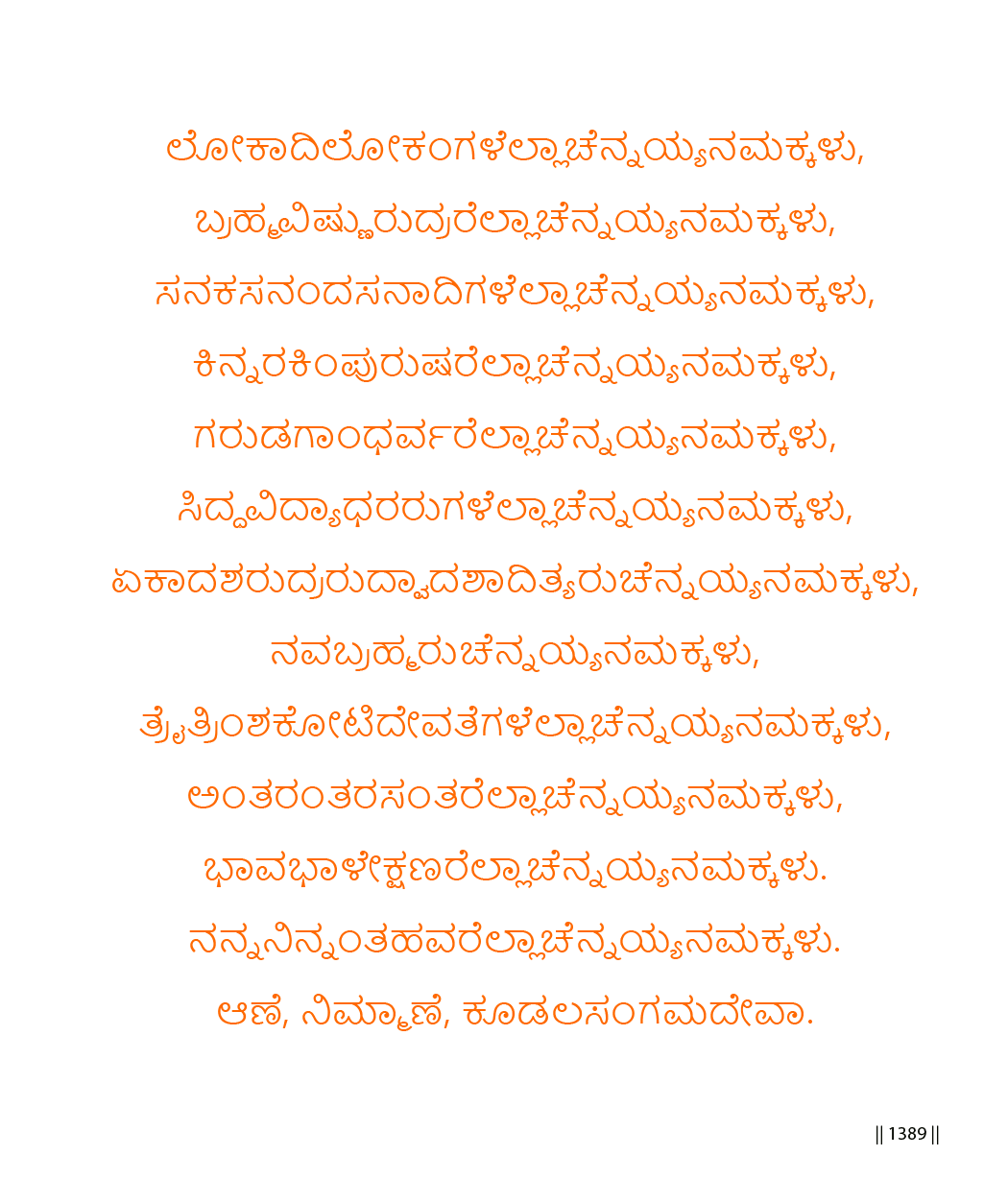
Basavanna declares that all worlds and their beings are the children of Chennayya.
Brahma, Vishnu, Rudra, ancient sages, celestial beings, perfected beings, the great orders of deities, inward beings, and beings of feeling and awareness are all placed within the same parenthood.
The list finally reaches ordinary human relation: those like “me” and those like “you” are also Chennayya’s children.
No rank of divinity, knowledge, power, birth, or status stands outside this kinship. Basavanna seals the declaration with an oath before Kudalasangama Deva.
Imagery & Symbolic Relevance
The vachana contains no material comparison. Its structure is an expansive enumeration held together by the repeated declaration:
“They are the children of Chennayya.”
All Worlds and Their Beings
Basavanna begins with the widest field: all the worlds and all who belong to them.
The declaration is not restricted to one community, place, class, or order of life. Before individual names are introduced, the whole field of existence is placed within Chennayya’s parenthood.
The movement is therefore universal from its first line.
Brahma, Vishnu, and Rudra
The creator, preserver, and destroyer are called Chennayya’s children.
Basavanna does not begin with ordinary human beings and later raise them toward the gods. He first places the highest traditional Divine figures within the same sonship.
Their powers and functions are not denied. What is removed is their use as a hierarchy by which some beings are considered naturally superior and others spiritually insignificant.
Ancient Sages and Celestial Beings
Sanaka, Sananda, and the other ancient sages are included, followed by Kinnaras and Kimpurushas.
Wisdom, antiquity, celestial nature, and extraordinary form do not create another lineage. The sages and mythical beings belong to Chennayya just as all others do.
The repeated refrain prevents knowledge or supernatural distinction from becoming a separate ground of superiority.
Garuda, Gandharvas, Siddhas, and Vidyadharas
Garuda and the Gandharvas, together with Siddhas and Vidyadharas, extend the declaration across further celestial and accomplished orders.
Garuda carries exalted sacred association. Gandharvas are linked with celestial music; Siddhas with accomplishment; Vidyadharas with knowledge and extraordinary capacity.
Yet each distinction is immediately gathered into the same statement: they are Chennayya’s children.
Attainment and knowledge therefore do not place anyone outside shared kinship.
The Great Orders of Deities
Basavanna names:
the eleven Rudras;
the twelve Adityas;
the nine Brahmas;
the thirty-three crores of deities.
The numerical expansion gathers the complete Divine order rather than isolating only a few familiar gods.
Multiplicity does not produce competing spiritual lineages. However numerous the Divine names, forms, or functions may be, all are placed under one parenthood.
Inward Beings and Beings of Feeling and Awareness
The movement then passes from named cosmic classes to inward and living orders that are not individually listed.
Those of inward condition and those marked by Bhava, feeling, perception, or awareness are also Chennayya’s children.
The declaration therefore includes not only figures recognised by mythology or scripture but every living condition that may otherwise remain unnamed.
“Those Like Me, Those Like You”
The final expansion is also the most immediate.
Basavanna moves from gods, sages, celestial beings, and vast Divine orders to those like himself and those like the person addressed.
The words “me” and “you” prevent universal kinship from remaining a distant cosmic teaching. The same parenthood must govern actual human recognition.
The ordinary person does not stand beneath the gods in spiritual lineage. Nor may the speaker claim a special position outside the family he has declared.
The Oath Before Kudalasangama Deva
Basavanna concludes with a double oath: “By my word, by Your word.”
The universal parenthood of Chennayya is not offered as speculation, praise, or poetic exaggeration. Basavanna binds his declaration before Kudalasangama Deva.
Kudalasangama Deva remains the Lord before whom the oath is made. Chennayya remains the realised Sharana whose parenthood becomes the measure of universal spiritual kinship. They must not be merged.
Lingayoga
Lingayoga must remove every inward hierarchy based upon birth, caste, learning, religious status, spiritual accomplishment, or social position.
The practitioner cannot honour Chennayya while continuing to regard some beings as naturally higher and others as spiritually inferior. To receive Chennayya’s lineage is to recognise shared belonging in actual conduct.
This includes the relation between “me” and “you.” Universal kinship becomes spiritually meaningful only when reverence, service, and dignity are no longer distributed according to inherited rank.
The fulfilled vision belongs to Aikya. Practice prepares it by correcting divided perception and learning to receive every person without caste-pride or spiritual comparison.
Editorial Commentary
Chennayya refers to Madara Chennayya, the realised Sharana whom Basavanna receives as the source of true spiritual lineage.
Makkalu means children. The word establishes kinship and shared parenthood rather than literal biological descent.
The enumerated gods, sages, celestial beings, and Divine orders retain their names and functions. The repeated parenthood removes hierarchy of lineage; it does not erase every distinction of function.
The closing oath gives the declaration its binding force before Kudalasangama Deva.
Related Vachana
Supporting Vachana
Sharana Sthala Vachana 348 — The Son of the Primal Source
In Sharana Vachana 348, Basavanna rejects caste-birth designation as the final measure of identity and repeatedly declares, “I am the son of Madara Chennayya.”
Chennayya first becomes Basavanna’s own father and realised lineage. Vachana 1348 expands that personal sonship universally: gods, sages, celestial beings, all living orders, and those called “me” and “you” are all Chennayya’s children.
What is received in Sharana Sthala as one person’s chosen lineage becomes in Aikya the kinship of all beings.
Advancing Vachana
Aikya Sthala Vachana 1398 — Beyond All Lineage and Comparison
Vachana 1348 dissolves hierarchy by gathering every named order into Chennayya’s parenthood.
Vachana 1398 carries the movement beyond genealogy itself. Even statements concerning the sons of Hara and Shakti, or comparisons between Hari and Hara, cannot contain Kudalasangama Deva, whose origin is unborn and whose greatness is incomparable.
The shared lineage of Vachana 1348 removes superiority among beings. Vachana 1398 then removes the attempt to confine the Lord Himself within lineage, relationship, or theological comparison. Universal kinship culminates in direct beholding of Kudalasangama Deva beyond every constructed genealogy.
