

Summary
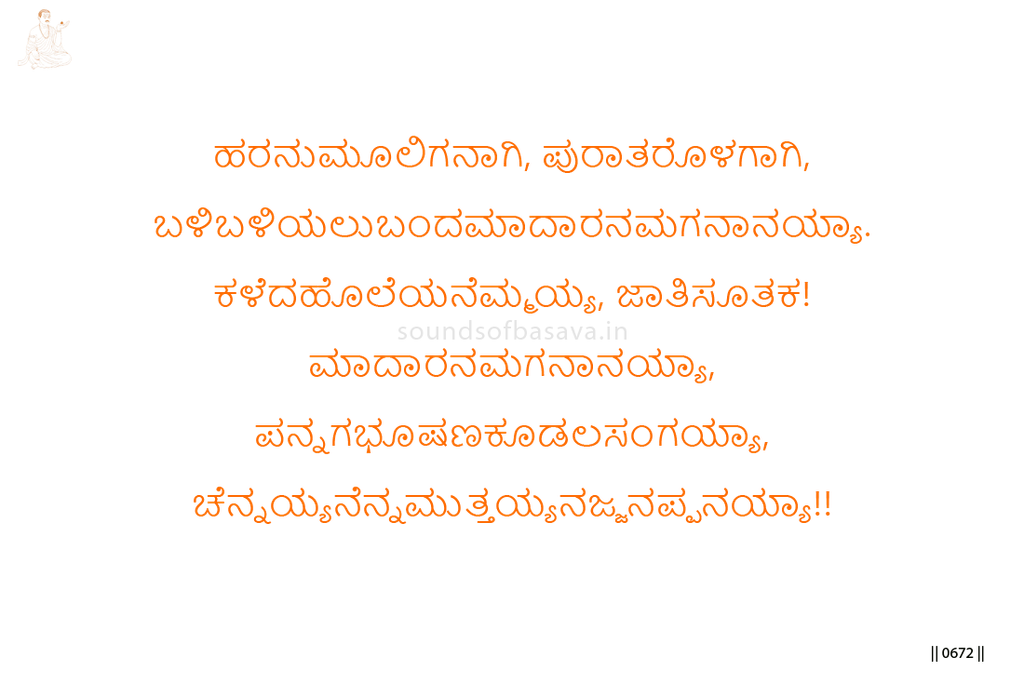
In this vachana, Basavanna says that Hara, as the primal source and ancient one, has come through line after line.
He then names himself as the son of Madara Chennayya. Even when the world speaks through caste-marking and inherited designation, he repeats the same identity: “I am Madara’s son.”
Before Kudalasangayya, he declares Chennayya to be his father. The teaching is that true lineage is not fixed by caste-sign or worldly descent, but by recognition of the realized Sharana as source.
Imagery & Symbolic Relevance
Hara as primal source is the opening image. Basavanna places the beginning of identity not in social birth, but in the ancient source.
The movement through line after line gives continuity. The source does not remain abstract; it is known through living succession.
Madara’s son is the central self-name. Basavanna deliberately receives his identity from Madara Chennayya.
Caste-marking is the opposing image. The world may identify through inherited social sign, but Basavanna refuses that as final.
The repeated declaration, “I am Madara’s son,” gives firmness to the reversal. It is not a passing honorific; it is the identity he accepts.
Chennayya as father is the final image. Fatherhood here is no longer controlled by bodily lineage or social rank. It is established through realized Sharana relation before Kudalasangama Deva.
Lingayoga
In Lingayoga, this vachana tests where the seeker locates spiritual origin.
The practice-point is direct: do not let caste-sign, birth-line, or public designation define the self. Receive identity from the realized source that stands through the Sharanas.
For Sharana Sthala, this is sonship through realized lineage.
Editorial Commentary
The word jāti-sūtaka should be kept close to caste-marking or caste-birth designation. The vachana does not merely praise Chennayya; it makes Chennayya the father through whom Basavanna names himself. The movement is from Hara as primal source, to Madara Chennayya as realized lineage, to the repeated rejection of caste-based identity.
Related Vachana
Supporting Vachana
Pranalingi Sthala Vachana 352 — The Hidden Source and the Hand’s Devotion
Pranalingi Vachana 352 supports this teaching by showing visible life sustained by hidden source, and by placing Chennayya’s humble work beside the devotion of the ancient forebears held in the seeker’s own hand. Vachana 348 gives the Sharana form of that same hidden continuity: Hara, the primal source, comes through line after line, and Basavanna recognizes that living source through Madara Chennayya as father.
Advancing Vachana
Aikya Sthala Vachana 1348 — All Are the Children of Chennayya
Aikya Vachana 1348 advances this teaching by expanding Chennayya’s parenthood to all worlds, beings, deities, sages, inner beings, and those like “me” and “you.” Vachana 348 says, “I am the son of Madara Chennayya”; Aikya Vachana 1348 carries that sonship into the Aikya vision where all beings are children of Chennayya before Kudalasangama Deva.
