

Summary
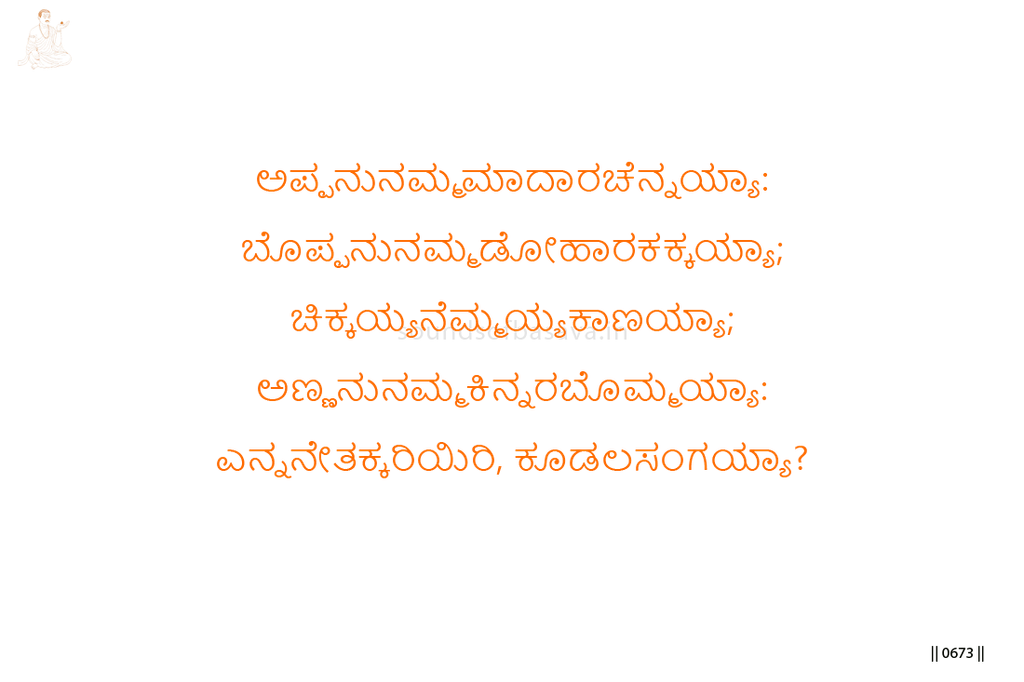
In this vachana, Basavanna names Madara Chennayya as father and Dohara Kakkayya as elder.
He then names Kannayya as his younger one and Kinnari Bommayya as brother.
Before Kudalasangayya, he asks who else should be called his kin. The teaching is that Sharana kinship has replaced birth-based belonging.
Imagery & Symbolic Relevance
Father is the first relation. By naming Madara Chennayya as father, Basavanna places spiritual origin in realized Sharana relation.
Elder is the second relation. Dohara Kakkayya is received as one who stands before him in reverence and precedence.
Kannayya as younger gives the next relation. The Sharana family is not only ancestral; it also extends into continuing companionship and care.
Kinnari Bommayya as brother completes the household-field. Brotherhood gives shared belonging, not distance.
The final question to Kudalasangayya gathers all the names together. Basavanna is not listing admired Sharanas from outside. He is naming his own people.
The force of the vachana lies in this relational replacement. Kinship is no longer secured by blood, caste, or inherited house, but by the realized fellowship of Kudalasangama’s Sharanas.
Lingayoga
In Lingayoga, this vachana tests the seeker’s sense of belonging.
The practice-point is direct: do not let birth-family, caste-family, or social inheritance be the final ground of identity. Let Sharana-sanga become true kinship when it is rooted in realized devotion.
For Sharana Sthala, this is family rebuilt through the Sharanas.
Editorial Commentary
The clarity of the vachana lies in its direct naming of relationships. Its own structure is enough: Basavanna fills the closest forms of kinship with Chennayya, Kakkayya, Kannayya, and Kinnari Bommayya, and finally turns to Kudalasangayya with a question that confirms this shift in belonging, who else remains to be called his own.
Related Vachana
Supporting Vachana
Pranalingi Sthala Vachana 742 — The Three Houses
Pranalingi Vachana 742 supports this teaching by placing Chennayya’s house as a field of humble nourishment and warning the seeker not to turn association with greatness into pride. Vachana 349 gives the Sharana form of that same movement: Chennayya is no longer only the house where life is sustained; he is father, and the Sharana household becomes Basavanna’s true family before Kudalasangama Deva.
Advancing Vachana
Aikya Sthala Vachana 1348 — All Are the Children of Chennayya
Aikya Vachana 1348 advances this teaching by expanding Chennayya’s kinship beyond Basavanna’s chosen family into a universal vision: worlds, beings, deities, sages, and all living forms are children of Chennayya. Vachana 349 names the Sharanas as Basavanna’s immediate kin; Aikya Vachana 1348 carries that kinship into complete non-hierarchical belonging before Kudalasangama Deva.
