

Summary
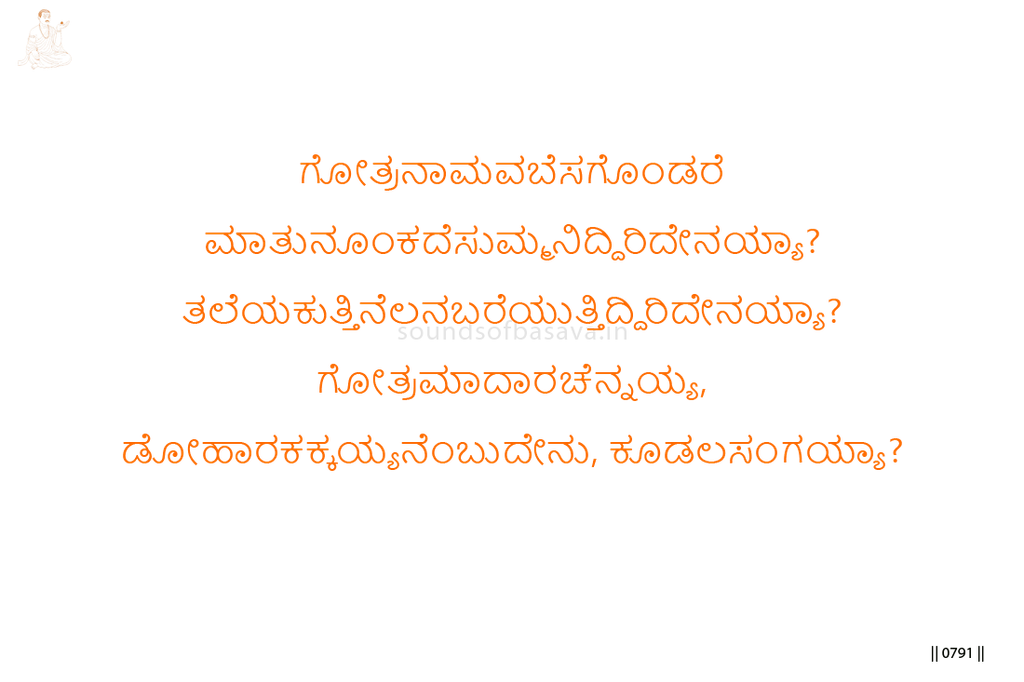
In this vachana, Basavanna challenges birth-based lineage through the question of gotra-name.
He asks: when the gotra-name is to be spoken, why sit silently without speaking? Why lower the head and write upon the ground? The gestures show unease. A lineage that must be hidden, delayed, or defended through embarrassment cannot be the true measure of spiritual worth.
Basavanna then gives the answer before Kudalasangayya. The true gotra-name is Madara Chennayya and Dohara Kakkayya. By naming them, he replaces inherited lineage with Sharana-lineage.
The reversal is direct. Gotra is no longer treated as bodily ancestry or social privilege. It becomes the lineage of those who stand as realized Sharanas before Kudalasangama Deva.
The teaching is direct: do not hide behind gotra-name or feel shame before birth-based questioning. Let Madara Chennayya and Dohara Kakkayya be the lineage one speaks without hesitation before Kudalasangama Deva.
Imagery & Symbolic Relevance
Gotra-name is the central image. It usually points to inherited descent, clan, or ritual lineage. Basavanna takes that familiar measure and brings it under examination.
Silence is the first exposed gesture. When asked to speak the gotra-name, the person sits without speaking. The silence reveals that inherited identity cannot stand firmly before truth.
Lowering the head is the second gesture. It shows hesitation, discomfort, or shame. Basavanna makes the body itself expose the weakness of birth-pride.
Writing upon the ground gives the third image. Instead of speaking clearly, the person turns downward. The movement suggests evasion, embarrassment, or uncertainty before the question of lineage.
Madara Chennayya is the first true name. Basavanna does not treat him as an outsider to be included by kindness. He places him within the very answer to gotra-name.
Dohara Kakkayya is the second true name. Together, Chennayya and Kakkayya form the lineage Basavanna is willing to speak. Their names replace the inherited markers that produce silence and hesitation.
The question to Kudalasangayya completes the reversal. Basavanna does not establish this lineage before society’s approval. He establishes it before the Lord.
The movement of the vachana is therefore from gotra-name, to silence, to lowered head and ground-writing, to Madara Chennayya and Dohara Kakkayya as the true names of lineage before Kudalasangama Deva.
Lingayoga
In Lingayoga, this vachana teaches the seeker to examine the basis of identity.
The seeker should ask: do I still depend on inherited gotra, caste, clan, or social name as spiritual support? Do I become silent or ashamed when the old measures are questioned? Can I name the Sharanas as my true lineage?
For Sharana Sthala, the practice-point is clear: let spiritual belonging be received through the Sharanas, not through birth-pride. Speak the names of Madara Chennayya and Dohara Kakkayya as lineage before Kudalasangama Deva.
Editorial Commentary
In Lingayoga, this vachana teaches the seeker to examine the basis of identity.
The seeker should ask: do I still depend on inherited gotra, caste, clan, or social name as spiritual support? Do I become silent or ashamed when the old measures are questioned? Can I name the Sharanas as my true lineage?
For Sharana Sthala, the practice-point is clear: let spiritual belonging be received through the Sharanas, not through birth-pride. Speak the names of Madara Chennayya and Dohara Kakkayya as lineage before Kudalasangama Deva.
Related Vachana
Supporting Vachana
Pranalingi Sthala Vachana 715 — The Master of the House
Pranalingi Vachana 715 supports this teaching by saying that even one called Shvapacha becomes truly Kulaja when Kudalasangama Deva dwells within. It shifts the measure of noble lineage from birth to the Lord’s living presence. This supports Vachana 745 directly. Vachana 745 rejects hesitant dependence on gotra-name and gives Madara Chennayya and Dohara Kakkayya as the true lineage; Vachana 715 gives the supporting ground: nobility belongs where Kudalasangama Deva dwells, not where social lineage claims superiority.
Advancing Vachana
Aikya Sthala Vachana 476 — One God for All
Aikya Vachana 476 advances this teaching by asking whether there is one God for one devotee and another God for Madara Chennayya, Dohara Kakkayya, and Telugu Jommayya. The question destroys the idea that the Divine can be divided by birth, work, or social identity. This is the natural advancement from Vachana 745. Vachana 745 replaces gotra-name with the names of Chennayya and Kakkayya; Aikya Vachana 476 carries that replacement into completion, showing that the same Kudalasangama Deva belongs indivisibly to all Sharanas.
