

Summary
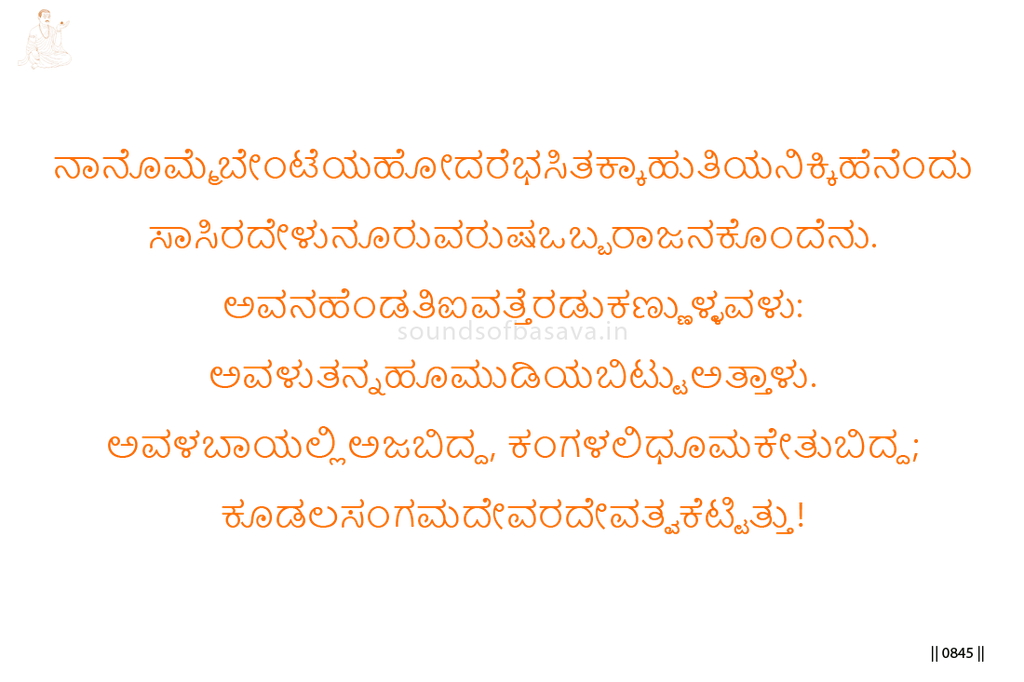
Basavanna speaks of going on a hunt in order to offer an oblation to sacred ash. In that hunt, he kills a king who had ruled for a vast span of time. The image continues the sacred-ash sequence: ash is not mild ornament, but the power before which long-standing sovereignty is ended.
The king’s queen, described with fifty-two eyes, casts away the flowers from her hair and weeps. Fire arises from her mouth, and smoke and flame arise from her eyes. The fall of the king is not quiet; everything bound to that reign is thrown into upheaval.
The final movement turns to Kudalasangama Deva. When the old kingship falls and its attendant powers burn and grieve, the divinity of Kudalasangama Deva stands revealed. The Sharana-stage teaching is clear: the sacred ash exposes and overthrows what has ruled falsely, so that the Lord’s truth may stand unobstructed.
Imagery & Symbolic Relevance
The hunt is the opening image. It is not presented as ordinary sport. It is connected directly with an oblation to sacred ash, and therefore belongs to the fierce movement of purification and offering.
The sacred ash remains the hidden altar of the vachana. The hunt is undertaken for its sake. What is slain is brought into the field of ash, where false sovereignty is reduced and transformed.
The long-ruling king is the central figure. His rule has lasted across a vast duration, showing how deeply established the old power has become. Basavanna’s image points to a dominion that has held the field for far too long.
The queen with fifty-two eyes intensifies the image. She belongs to the fallen king’s order and reacts with grief and fire. Her many eyes suggest the wide reach of that old order’s perception and attachment.
The discarded flowers from her hair show the loss of adornment and dignity. The grief is not only personal; it marks the collapse of what once appeared decorated, powerful, and secure.
Fire from the mouth and smoke and flame from the eyes make the collapse visible as burning. Speech, sight, grief, and power all erupt when the old sovereignty is struck down.
The final revelation of Kudalasangama Deva’s divinity completes the sequence. The purpose of the hunt is not destruction for its own sake. The old kingdom falls so that the Lord’s truth may be seen without obstruction.
Lingayoga
In Lingayoga, this vachana teaches that transformation may require the fall of what has ruled inwardly for a long time. The old sovereign cannot be preserved while sacred ash is made the field of offering.
For Sharana Sthala, the practice-point is surrender to the ash’s severe truth. The Sharana does not wear ash as a sign while protecting the inner king. What has ruled falsely must be brought into the fire of Kudalasangama Deva.
The queen’s grief shows that the fall of the old order is not without upheaval. Attachments, perceptions, and speech may burn when their ruler falls. Yet the burning is not the end. It becomes the clearing through which Kudalasangama Deva’s divinity is revealed.
Editorial Commentary
The mythic images should remain source-bound. The king, queen, fifty-two eyes, flowers, fire, smoke, and flame should not be over-systematized into a fixed allegory. Their function is to show the violent collapse of an old sovereignty before the sacred ash and the consequent revelation of Kudalasangama Deva.
Related Vachana
Supporting Vachana
Pranalingi Sthala Vachana 1260 — The Sacred Vibhuti Born of the Fivefold Brahman
Pranalingi Vachana 1260 supports this teaching by explaining the consecrated origin of Vibhuti. Panchagavya arises from the fivefold Brahman, is burned according to Agamic method, and becomes bhasita, the sacred ash worn by all. This prepares Vachana 933 directly. In Vachana 1260, sacred ash is understood as purified essence born through burning; in Vachana 933, that ash becomes the field of oblation where the long-ruling king is overthrown and Kudalasangama Deva’s divinity is revealed.
Advancing Vachana
Aikya Sthala Vachana 932 — The Ash That Unmade the Gods
Aikya Vachana 932 advances this teaching by carrying the power of sacred ash into fuller Aikya dissolution. There, the ash breaks Brahma’s skull, scatters Gananatha’s garlands, removes proud bodily signs, astonishes Nandi, and prepares the enthronement of Kudalasangama Deva beyond all beyond. This is the natural Aikya fulfillment of Vachana 933. In Sharana Vachana 933, sacred ash receives the overthrow of the long-ruling king and reveals the Lord’s divinity; in Aikya Vachana 932, that same ash unmakes cosmic claims and leaves Kudalasangama Deva alone enthroned.
