

Summary
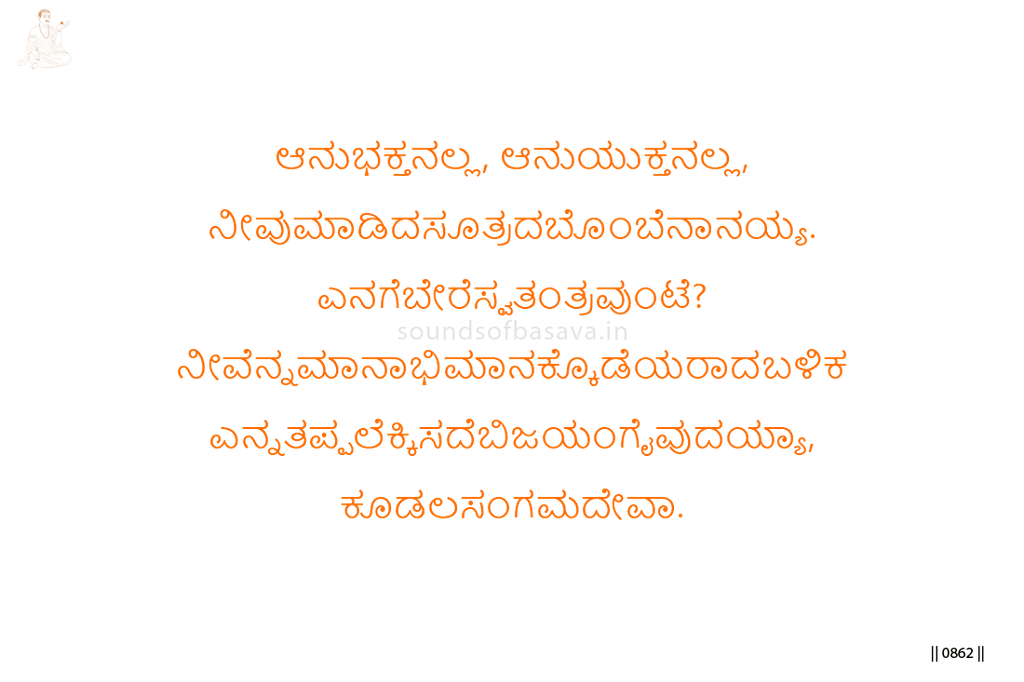
Basavanna refuses even the sacred identities of Bhakta and Yukta. He does not claim devotion as his own, nor realization as his own. He stands before Kudalasangama Deva as a puppet moved by the Lord’s thread.
The central teaching is complete dependence. The puppet does not move by independent power. Whatever devotion, understanding, action, or crossing may occur arises through the Lord’s drawing. Basavanna therefore asks, “What freedom have I apart from You?” This is not despair, but surrender of separate self-claim.
The final prayer is tender and direct. Since Kudalasangama Deva has accepted him into grace and regard, Basavanna asks that his faults not be counted. He does not claim faultlessness. He asks for compassionate completion through the One who has already taken him as His own.
Thus the vachana carries Sharana humility to a radical point. Even the identity of devotee is surrendered. Even realized status is surrendered. What remains is the prayer to be moved, forgiven, and carried across by Kudalasangama Deva.
Imagery & Symbolic Relevance
The first image is the refusal of titles. “I am not a Bhakta; I am not a Yukta.” Basavanna does not reject devotion or realization. He rejects ownership of them. A title can become another subtle form of self-claim if the seeker begins to possess it.
The second image is the puppet. A puppet has form, movement, and visible action, yet its motion comes from elsewhere. Basavanna uses this image to show that the seeker’s life does not stand by independent power. The apparent mover is being moved.
The third image is the thread. The thread is hidden, but it governs the puppet’s movement. In the vachana, the thread belongs to Kudalasangama Deva. This makes Divine grace the unseen source of action, devotion, insight, and passage.
The question of freedom deepens the image. Basavanna does not ask for freedom apart from the Lord. He asks what such freedom could even mean. Apart from the thread, the puppet has no life of its own. Apart from Kudalasangama Deva, the seeker has no independent spiritual standing.
The fourth image is the Divine account. Basavanna asks that his faults not be counted. This does not erase responsibility. It places the incomplete seeker under the Lord’s compassion. The one who has been accepted by grace depends upon grace to complete what remains unfinished.
The final image is crossing. Basavanna asks to be led safely across. The crossing is not claimed as his own achievement. It is entrusted to Kudalasangama Deva, whose thread alone moves the puppet.
Lingayoga
In Lingayoga, this vachana teaches the surrender of spiritual ownership. The seeker must not claim Bhakti, Yukti, realization, action, or purity as personal possession.
Achara becomes humility without spiritual pride. Kayaka becomes action understood as moved by Kudalasangama Deva. Dasoha becomes complete self-offering, because even the one who offers is not independently owned.
For Sharana Sthala, the practice-point is clear: do not hold even devotion as “mine.” Do not claim realization as “my state.” Remain as the puppet in the Lord’s hand, asking not for status, but for grace, forgiveness, and safe crossing.
Editorial Commentary
The puppet image should not be read as passivity or moral evasion. Basavanna is not saying that conduct does not matter. He is surrendering the claim of independent doership and asking Kudalasangama Deva not to measure him only by fault, but to complete him through grace.
Related Vachana
Supporting Vachana
Pranalingi Sthala Vachana 988 — When the Linga Returned as Living Presence
Pranalingi Vachana 988 supports this teaching by showing the movement from crisis and doubt into living Pranalinga-presence. There, Kudalasangama Deva Himself becomes the seeker’s Pranalinga and is asked to transform anxiety into freedom from anxious concern. This prepares Vachana 1050 directly. In Vachana 988, the Lord becomes the inward living presence that removes doubt and steadies the seeker; in Vachana 1050, Basavanna goes further and says that he has no independent freedom at all, but is moved by Kudalasangama Deva’s thread and asks to be carried across.
Advancing Vachana
Aikya Sthala Vachana 1344 — When Linga Is Anga and Anga Is Linga
Aikya Vachana 1344 advances this teaching by dissolving the remaining distinction between Anga and Linga, Prana and Linga. There, nothing needs to be shown as existing or sought as absent; uninterrupted Linga alone abides. This is the natural Aikya fulfillment of Vachana 1050. In Sharana Vachana 1050, Basavanna says he has no freedom apart from Kudalasangama Deva and is only the puppet of the Lord’s thread; in Aikya Vachana 1344, even the sense of separate puppet and moving thread is resolved into uninterrupted Linga alone.
