
Summary
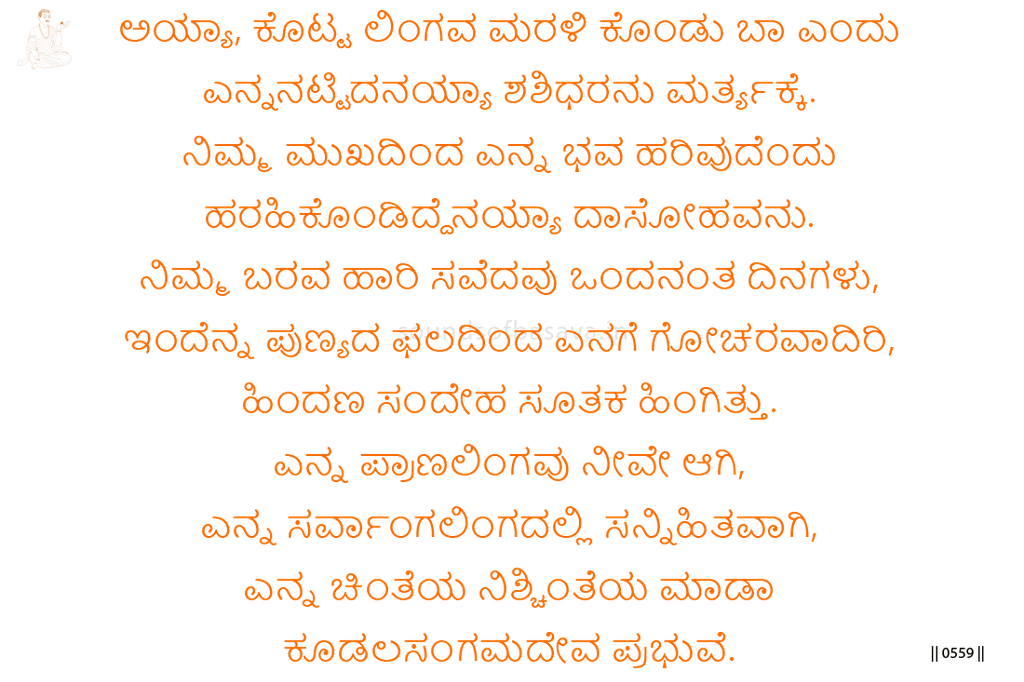
In this vachana, Basavanna speaks of Shashidhara, Shiva, the moon-crested Lord, coming back into the mortal world and calling him: “Bring back the Linga that was given.” This creates a moment of spiritual crisis, because the Linga that had been received is now being called back by its own Lord.
Basavanna says that he had remained in Dasoha, trusting that through Kudalasangama Deva’s face his bhava would be cut. Days passed in waiting. The longing did not immediately end, but he did not abandon Dasoha.
Then, through the fruit of puṇya, Kudalasangama Deva became visible to him. The earlier doubt and its trace were removed. The Lord Himself became his Pranalinga.
Basavanna then prays that Kudalasangama Deva, now present in his Sarvāṅga-Linga, should make his chinte, his anxiety and worry, into niścintā, freedom from anxious concern. The spiritual concern is therefore the movement from crisis and doubt into living Pranalinga-presence.
Imagery & Symbolic Relevance
The first image is Shashidhara coming into the mortal world. Shashidhara means Shiva, the moon-crested Lord. His coming to the mortal world gives the vachana its force: the crisis does not arise from ordinary people, but from the Divine Lord who has authority over the given Linga.
The second image is the command to bring back the given Linga. The given Linga represents the sacred relation received through grace. Being asked to return it creates the crisis of separation, accountability, and uncertainty before the Lord.
The third image is remaining in Dasoha. Basavanna does not abandon the path during uncertainty. Dasoha becomes the field of endurance, surrender, and continued offering.
The fourth image is waiting through many days. Time passes without immediate relief. The vachana shows that doubt may remain until grace becomes visible.
The fifth image is Kudalasangama Deva becoming visible through the fruit of puṇya. This is not presented as self-achievement. It comes as grace becoming manifest through accumulated spiritual fruit.
The sixth image is the removal of earlier doubt. The old uncertainty and its trace are cleared when the Lord becomes visible.
The seventh image is the Lord Himself becoming Pranalinga. This is the center of the vachana. Kudalasangama Deva is no longer only the giver or object of the Linga-relation; He becomes the seeker’s own Pranalinga, the Linga joined to life-force.
The eighth image is Sarvāṅga-Linga. The Lord becomes present in the whole body-field. Sarvāṅga means all limbs or the entire embodied being. The Linga-presence now extends through the whole of the seeker’s living body.
The final image is niścintā. Basavanna asks the Lord to make his chinte, his anxiety or worry, into niścintā, freedom from anxious concern. The fruit of Pranalinga-presence is inward rest.
Lingayoga
In Lingayoga, this vachana teaches that the received Linga must mature beyond external possession into living Pranalinga-presence. Even when the Linga seems to be called back by Shashidhara, the deeper resolution is not loss but inward realization.
For Pranalingi Sthala, the point is precise. Kudalasangama Deva Himself becomes Pranalinga. The seeker’s life-force is no longer separated from the Linga-relation, and the body becomes Sarvāṅga-Linga, the field of all-limbed presence.
The practice-point is clear: remain in Dasoha even during crisis. Let earlier doubt be removed by direct grace. Receive Kudalasangama Deva as Pranalinga and allow anxiety to settle into niścintā.
Editorial Commentary
The word Shashidhara must be kept clear. It refers to Shiva, the moon-crested Lord, coming into the mortal world. The opening is therefore not merely about a human command to return the Linga; it is a divine summons that tests the received relation itself.
The other Kannada terms should remain precise. Dasoha is the field of surrender and offering in which Basavanna remains while waiting. Puṇya-phala is the fruit of merit through which the Lord becomes visible. Pranalinga means the Lord becoming present as the Linga of life-force. Sarvāṅga-Linga means the Linga-presence extended through the entire embodied being. Niścintā means freedom from anxious concern.
Related Vachana
Supporting Vachana
Maheshwara Sthala Vachana 37 — The Dissolution of Doubt
Maheshwara Vachana 37 supports this teaching by showing that when doubt is not dissolved, even the claim of seeing the Linga becomes unstable. It asks how the path can become possible while inner affliction remains, and turns toward the Sharanas for the ending of that disturbance. Vachana 988 carries this into Pranalingi Sthala: the crisis caused by Shashidhara’s summons is resolved when earlier doubt is removed, Kudalasangama Deva becomes visible, and the Lord Himself becomes Pranalinga through the whole embodied being.
Advancing Vachana
Sharana Sthala Vachana 1236 — Beyond Purity and Impurity
Sharana Vachana 1236 advances this teaching by showing the state in which Kudalasangama Deva draws the seeker near and protects him despite impurity in conduct and speech. Because the Lord has accepted and protected him, fear no longer remains.
In Vachana 988, Basavanna waits in Dasoha until earlier doubt is removed, Kudalasangama Deva becomes visible, and the Lord Himself becomes Pranalinga within the whole embodied being. In Vachana 1236, this matures into Sharana Sthala as fearless nearness: the seeker no longer depends on his own purity, but lives protected by the grace that has drawn him close to Kudalasangama Deva.
