

Summary
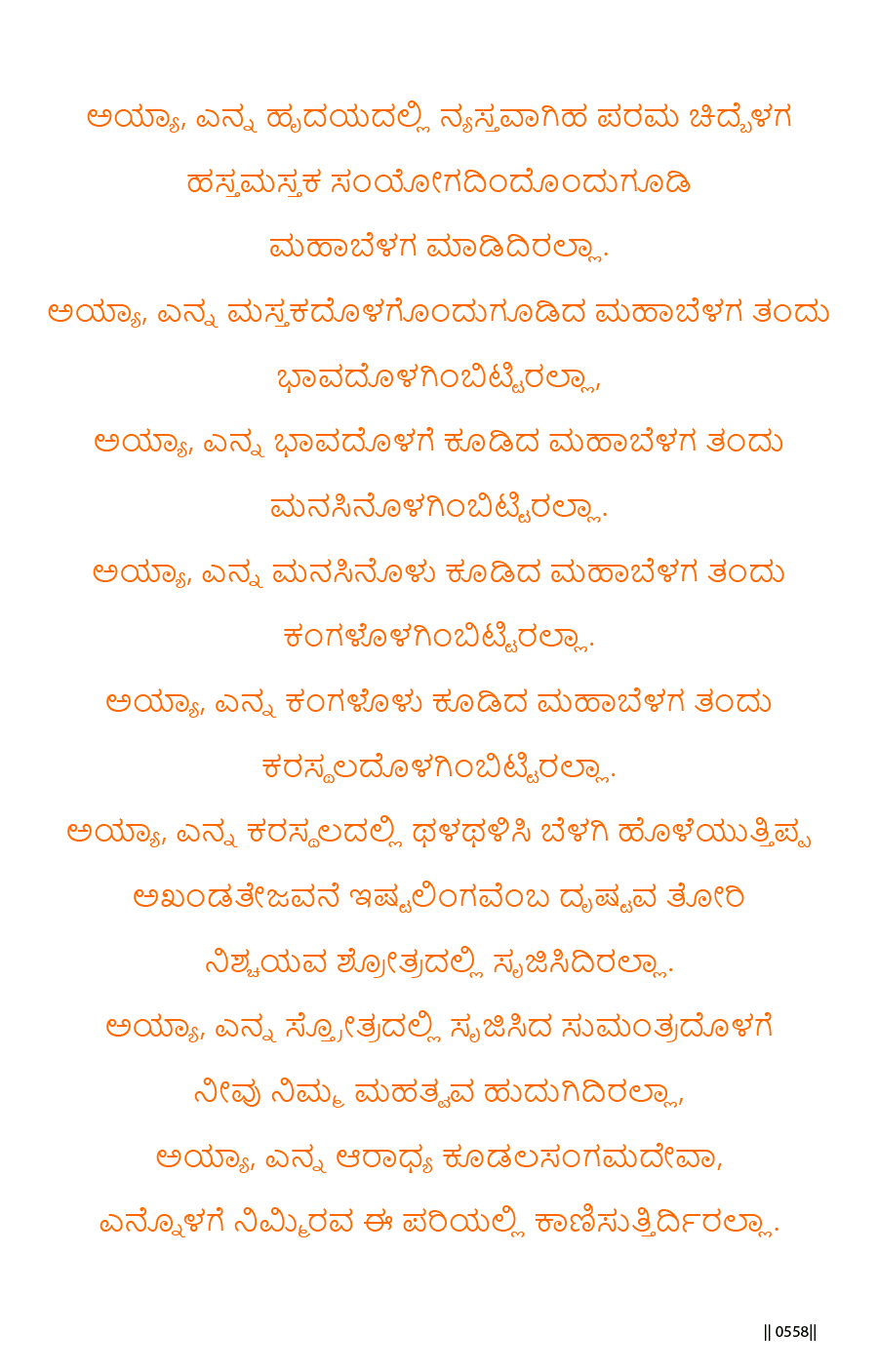
In this vachana, Basavanna speaks to Kudalasangama Deva as the One who has spread the supreme light in his heart. This light is not kept in one place; it is joined through hasta-mastaka-saṃyoga, the union of hand and head, and made into Mahābeḷagu, the Great Light.
That Great Light is then brought into bhava, the inner state of being and feeling. From there, it is brought into the mind. From the mind, it is brought into the eyes. From the eyes, it is brought into the palm.
In the palm, the light shines brilliantly and appears as the visible Ishtalinga. Kudalasangama Deva gives the dṛṣṭa, the visible sight of Ishtalinga, and creates niścaya, certainty, in the śrōtra, the inward faculty of hearing or receiving.
Within the sumantra created in that śrōtra, Kudalasangama Deva hides His greatness. The spiritual concern is therefore inward revelation: the Lord reveals Himself within the seeker through light, faculty, palm, Ishtalinga, certainty, and mantra, while His greatness remains immeasurable.
Imagery & Symbolic Relevance
The first image is the supreme light spread in the heart. The heart is the inward seat where the presence of Kudalasangama Deva first becomes luminous.
The second image is hasta-mastaka-saṃyoga. In Lingayat practice, hasta refers to the hand that receives and worships the Ishtalinga, while mastaka refers to the forehead upon which the sacred Vibhuti is worn. The union of hand and forehead signifies the inseparable connection between Linga and Vibhuti, worship and remembrance, direct experience and awakened awareness. Through this sacred joining, the devotee brings the hand-held Ishtalinga into conscious relation with the Divine presence remembered at the forehead, allowing the Lord’s grace to permeate both action and understanding.
The third image is Mahābeḷagu, the Great Light. This light is not merely visual brightness. It is the inward radiance that Kudalasangama Deva causes to move through the seeker’s whole being.
The fourth image is the Great Light entering bhava. Bhava is the inner state of being, feeling, and lived condition. The light does not remain abstract; it enters the seeker’s inward condition.
The fifth image is the Great Light entering the mind. The mind becomes illumined by what has already entered the heart and bhava.
The sixth image is the Great Light entering the eyes. Vision becomes changed by the radiance received within.
The seventh image is the Great Light entering the palm. This is important because the palm is the place where the Ishtalinga is held and worshipped.
The eighth image is the Ishtalinga as visible radiance. The light shining in the palm is shown as the visible Ishtalinga. What is inwardly luminous becomes directly seen and held.
The ninth image is niścaya in the śrōtra. Śrōtra is the faculty of hearing or inward receiving. Kudalasangama Deva establishes certainty there, so the seeker does not remain in doubt.
The final image is the sumantra in which the Lord hides His greatness. Sumantra is the auspicious or true mantra created within inward hearing. Even while Kudalasangama Deva reveals Himself, His greatness remains hidden within the mantra and cannot be exhausted.
Lingayoga
In Lingayoga, this vachana teaches the full inward sanctification of the seeker’s faculties. Heart, bhava, mind, eyes, palm, hearing, and mantra are all gathered into the radiance of Kudalasangama Deva.
For Pranalingi Sthala, the point is precise. The Linga is not merely held outwardly in the palm. The light that shines as Ishtalinga has already moved through the heart, bhava, mind, and eyes. It becomes visible in the palm after inward illumination.
The practice-point is clear: allow the Great Light to move through the whole being. Let heart, bhava, mind, eyes, palm, śrōtra, and mantra become instruments through which Kudalasangama Deva reveals Himself within.
Editorial Commentary
The Kannada sequence should remain central. The movement is not simply from outside to inside or inside to outside; it is a full circulation of radiance. Kudalasangama Deva spreads the light in the heart, joins hand and head, brings the light through bhava, mind, eyes, and palm, reveals it as Ishtalinga, establishes certainty in śrōtra, and hides His greatness in sumantra. Revelation and hiddenness remain together.
Related Vachana
Supporting Vachana
Maheshwara Sthala Vachana 42 — The Thumb-Sized Infinite
Maheshwara Vachana 42 supports this teaching by showing the paradox of the Linga held in the palm: though small in form, it points to what is immeasurable, but the mind may fail to recognize it when distorted by doubt and mis-seeing. Vachana 986 carries this into Pranalingi Sthala by showing how the Great Light moves through heart, bhava, mind, eyes, and palm until the visible Ishtalinga shines with certainty. What Maheshwara Vachana 42 presents as the overlooked Infinite in the palm becomes, here, the inner radiance revealed as Ishtalinga.
Advancing Vachana
Sharana Sthala Vachana 1233 — The Sharanas Within My Being
Sharana Vachana 1233 advances this teaching by carrying inward radiance into complete internalization. There, Basavanna breaks open the body, mind, and eyes and places the Sharanas within them, making the Sharanas of Kudalasangama the Lords of his being.
In Vachana 986, the Great Light fills the heart, bhava, mind, eyes, and palm, becomes visible as Ishtalinga, establishes certainty in inward hearing, and hides Kudalasangama Deva’s greatness within the sumantra. In Vachana 1233, this matures into Sharana Sthala as the full opening of body, mind, and vision to realized presence. The radiance revealed as Ishtalinga becomes inward habitation by the Sharanas, and devotion arises from the transformed bhava before Kudalasangama Deva.
