

Summary
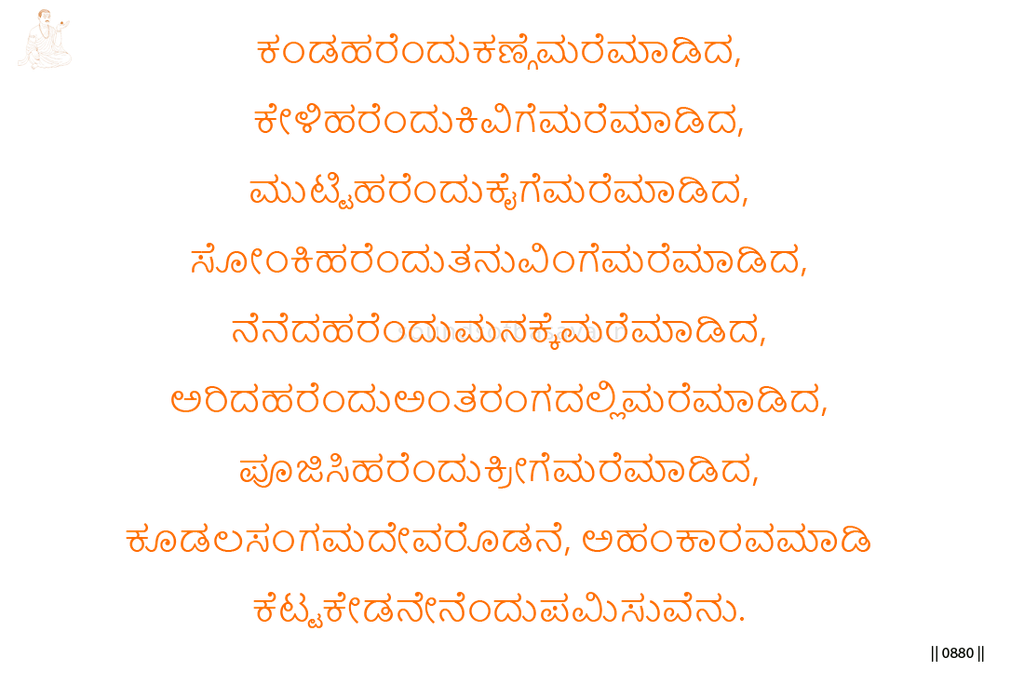
Basavanna confesses a subtle and serious failure. He has seen, heard, touched, experienced, remembered, realized, and worshipped, yet at each point he concealed what had been known. The problem is not absence of contact with the Divine. The problem is ego’s refusal to yield after contact has already occurred.
The repeated concealment gives the vachana its force. The eyes knew, the ears knew, the hand knew, the body knew, the mind knew, the inner being knew, and action itself knew through worship. Yet ego turned each of these into denial or concealment.
Basavanna therefore does not accuse the world, the senses, or the absence of grace. He turns toward himself and asks what greater ruin there can be than the ego he has made before Kudalasangama Deva.
The confession is severe, but it is also purifying. What ego hides must be brought into the Lord’s presence. By naming concealment clearly, Basavanna begins to remove the very veil that has covered direct experience.
Imagery & Symbolic Relevance
The first image is seeing and concealing from the eye. Vision has occurred, yet the eye is made to act as though it has not seen. This is not blindness, but refusal after sight.
The second image is hearing and concealing from the ear. Sacred speech, instruction, or truth has entered, yet the ear is treated as though it has heard nothing. The failure is not lack of sound, but unwillingness to receive what has been heard.
The third image is touching and concealing from the hand. Contact has been made. The hand has known the nearness of what it touched, yet the experience is hidden from the very faculty through which it came.
The fourth image is bodily contact or experience concealed from the body. The body itself has participated, but ego prevents embodied life from admitting what it has received.
The fifth image is remembrance concealed from the mind. Even after the mind remembers, ego hides the remembrance. Memory itself is prevented from becoming surrender.
The sixth image is realization concealed within the inner being. This is the deepest concealment. What is known inwardly is covered inside the very place where it should become clear.
The seventh image is worship concealed from action. Even worship can be emptied if the ego prevents action from acknowledging its own sacred meaning. Practice may occur, yet its truth can be hidden by selfhood.
The final image is ahamkara, ego, as self-made ruin. Basavanna does not treat ego as an abstract doctrine. He names it as the force that conceals what has already been seen, heard, touched, remembered, realized, and worshipped before Kudalasangama Deva.
Lingayoga
In Lingayoga, this vachana teaches honesty after experience. The seeker must not only seek vision, hearing, touch, remembrance, realization, and worship. He must also refuse to conceal their truth once they have occurred.
For Sharana Sthala, the practice-point is direct: do not pretend ignorance after contact with Kudalasangama Deva. Do not let ego hide what the senses, mind, inner being, and action have already received.
This is a discipline of transparency. The whole person must be allowed to bear witness: eye, ear, hand, body, mind, inner being, and worshipful action must not be divided from the truth they have encountered.
Editorial Commentary
The repeated “concealed” should remain central. The vachana is not saying that Basavanna lacked spiritual contact. It says something sharper: even after contact, ego concealed the truth. The ruin lies not in never having seen, but in seeing and then hiding that seeing before Kudalasangama Deva.
Related Vachana
Supporting Vachana
Pranalingi Sthala Vachana 552 — That Which Cannot Be Forgotten
Pranalingi Vachana 552 supports this teaching by testing what can truly remain when memory itself is examined. Hari, Brahma, and the thirty-three crore gods are placed before the question of forgetfulness, while Kudalasangama Deva is distinguished as the one who cannot be forgotten. This prepares Vachana 1125 directly. In Vachana 552, the Lord is recognized as the unforgettable presence; in Vachana 1125, Basavanna confesses the danger of ego concealing even what has been seen, heard, remembered, realized, and worshipped.
Advancing Vachana
Aikya Sthala Vachana 1074 — The All-Consuming Radiance
Aikya Vachana 1074 advances this teaching by showing the state in which concealment can no longer remain. There, wherever Basavanna looks, only Kudalasangama Deva’s radiance appears; in seeing, suffering, and remembering, the Lord alone is present, and darkness has no place to dwell. This is the natural Aikya fulfillment of Vachana 1125. In Sharana Vachana 1125, ego hides what has already been encountered; in Aikya Vachana 1074, the radiance of Kudalasangama Deva fills perception so completely that nothing remains available for ego to conceal.
