

Summary
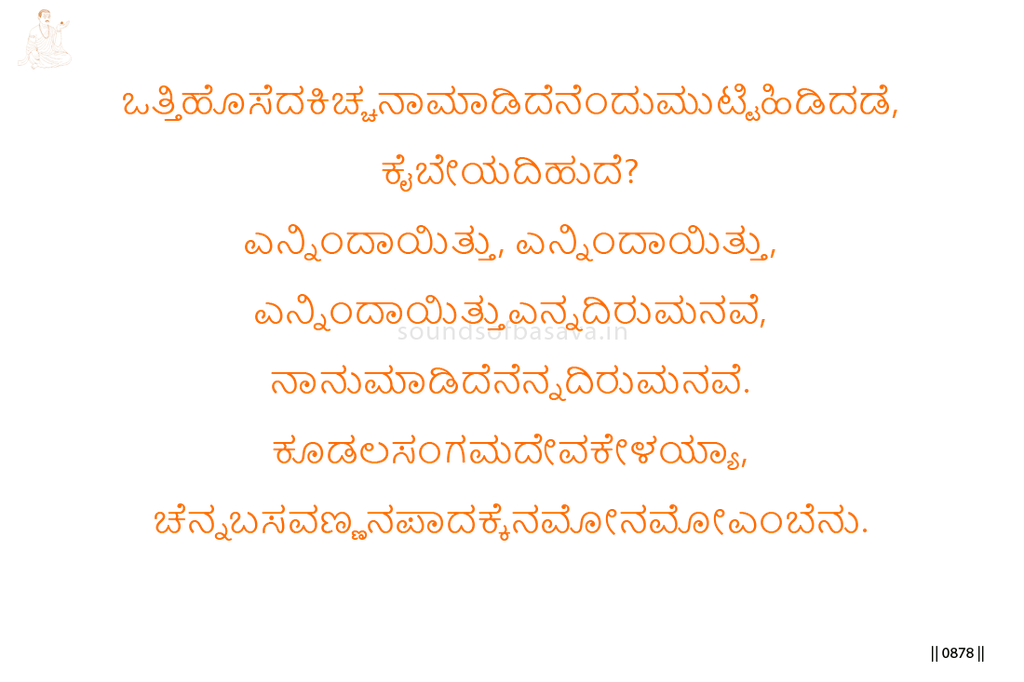
Basavanna warns the mind against the subtle poison of doership. To touch a blazing fire and claim, “I made this flame,” does not save the hand from being burned. In the same way, claiming authorship over what has arisen through grace brings spiritual harm.
The repeated phrases “It happened because of me” and “I accomplished it” expose the mind’s habit of self-claim. The ego does not only boast over worldly success. It can also claim sacred action, realization, service, or insight as its own achievement.
Basavanna therefore turns the mind away from self-congratulation. He does not say that action should cease. He says that the claim of ownership over action must cease.
The final movement is reverence. Before Kudalasangama Deva, Basavanna bows again and again at the feet of Chennabasavanna. Gratitude replaces claim. The feet of the realized Sharana become the antidote to the mind’s assertion, “I did it.”
Imagery & Symbolic Relevance
The first image is blazing fire. Fire burns by its own nature. A person may touch it and claim to have made it, but the claim does not alter the fire’s power. The hand is still burned.
This image exposes the absurdity of egoic authorship. The mind touches a power greater than itself and then says, “I made this.” Basavanna shows that such a claim is dangerous, not merely foolish.
The burned hand is the consequence of false claim. The injury is inward: pride, separation, hardening of self, and loss of humility before grace.
The repeated phrase “It happened because of me” gives the voice of ego in its restless insistence. The repetition matters. Ego does not make one claim and stop; it repeats the claim until it becomes identity.
The phrase “I accomplished it” deepens the danger. Even spiritual practice can become possessed. The seeker may serve Linga, honor Jangama, speak Vachana, or receive grace, yet secretly retain the thought: “I did this.”
The mind is directly addressed because the battlefield is inward. Basavanna is not first correcting public speech. He is correcting the private movement of self-claim before it becomes conduct.
The final image is bowing at Chennabasavanna’s feet. Bowing is the true corrective to doership. The head that wanted to stand as author is placed at the feet of the one through whom grace and realization have been received.
Lingayoga
In Lingayoga, this vachana teaches action without self-ownership. The seeker may act, serve, speak, practice, and receive insight, but must not convert any of these into the claim, “I accomplished it.”
For Sharana Sthala, the practice-point is direct: watch the mind after action. The danger often comes not before the act, but after it, when the mind begins to say, “This happened because of me.”
The corrective is remembrance and reverence. Do not let achievement become self-image. Bow inwardly to the source of grace. Basavanna places that reverence at Chennabasavanna’s feet before Kudalasangama Deva.
Editorial Commentary
The fire image should remain central. Basavanna is not rejecting effort or sacred action. He is rejecting the mind’s claim of independent authorship. The closing salutation to Chennabasavanna is therefore not ornamental; it is the vachana’s cure for doership.
Related Vachana
Supporting Vachana
Pranalingi Sthala Vachana 961 — The Descent of Linga into Prana
Pranalingi Vachana 961 supports this teaching by showing that transformation comes through Linga entering prana, through Chennabasavanna revealing the inward path, and through Prabhudeva’s living Jangama presence disciplining and protecting the seeker. Basavanna does not claim this transformation as his own achievement; he receives life through their compassion in Kudalasangama Deva. This prepares Vachana 1114 directly. In Vachana 961, the seeker is made alive through grace and does not claim the transformation; in Vachana 1114, Basavanna explicitly warns the mind not to say, “It happened because of me” or “I accomplished it,” but instead bows at Chennabasavanna’s feet.
Advancing Vachana
Aikya Sthala Vachana 1043 — The Secret of Linga and Jangama
Aikya Vachana 1043 advances this teaching by dissolving the very source of spiritual claim. There, Basavanna makes it clear that the Guru teaches the disciple, not the other way around, and that grace comes from the source, not from the seeker. Since Kudalasangama Deva alone is the source of awareness, the seeker cannot claim independent authority or achievement. This is the natural Aikya fulfillment of Vachana 1114. In Sharana Vachana 1114, the mind is warned not to say “I did it”; in Aikya Vachana 1043, the reason becomes complete: awareness itself has its source in Kudalasangama Deva, and Chennabasavanna is beheld as His very form.
