

Summary
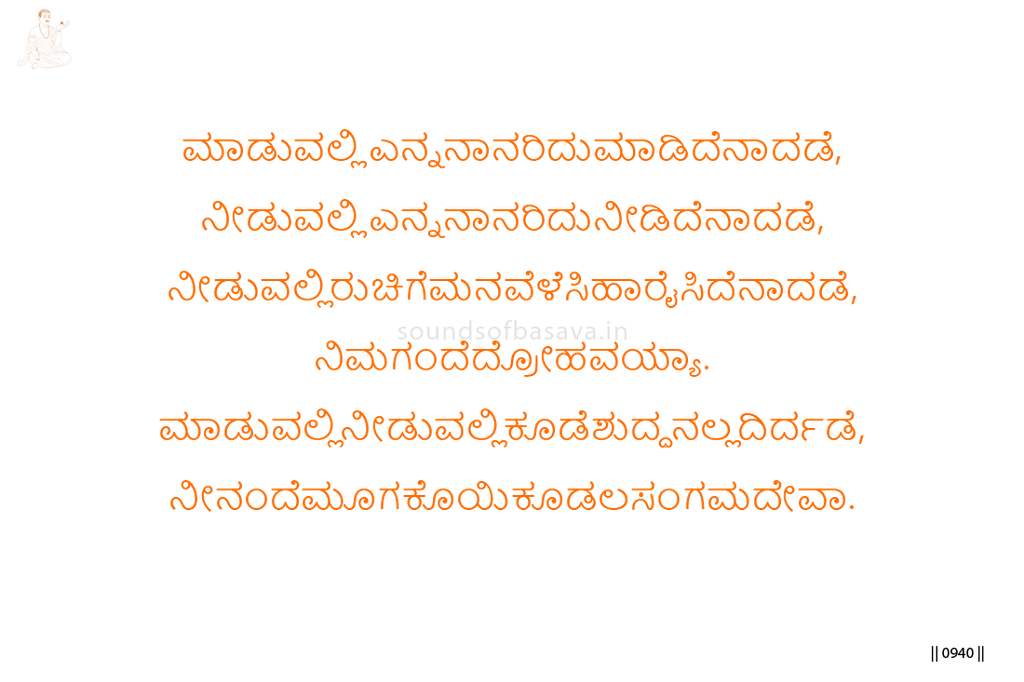
Basavanna examines the subtle impurity that can enter even good action and sacred giving. If, while doing, the thought arises, “I have done this,” or while giving, the thought arises, “I have given this,” the act becomes stained by self-claim.
The danger becomes still deeper when the mind tastes its own giving and longs for reward. Then the offering is no longer pure before Kudala Sangama Deva. Basavanna calls this betrayal, because what should have belonged to the Lord has been turned back toward the self.
The vachana ends with a severe prayer: if purity is absent in doing and giving, let the nose be cut off. Basavanna is not asking for bodily punishment, but for the destruction of false honour. Better to lose pride and reputation than to preserve an offering secretly claimed by the ego.
Imagery & Symbolic Relevance
The first image is doing with the thought, “I have done it.” Basavanna does not reject action. He rejects the self-claim that enters after action and makes the doer stand apart from the Lord.
The second image is giving with the thought, “I have given it.” Giving may appear sacred outwardly, but the moment it becomes “my giving,” the gift is taken back inwardly. The hand offers, but the ego keeps the ownership.
The third image is the mind tasting its own giving. This is subtler than open pride. The mind enjoys the flavour of its own goodness and begins to desire recognition, reward, or inner satisfaction. The offering has then become food for the self.
The fourth image is betrayal of the Lord. Basavanna uses a strong word because the impurity is hidden inside devotion itself. The act was meant for Kudala Sangama Deva, but the ego has quietly redirected it toward itself.
The fifth image is purity in doing and giving. The issue is not whether one acts or gives, but whether the act and the gift remain clean from self-claim, self-taste, and expectation.
The final image is the cutting off of the nose. The nose stands for honour, dignity, and public face. Basavanna says that if purity is absent, he deserves no honour. False reputation must be removed if it protects impurity before Kudala Sangama Deva.
Lingayoga
In Lingayoga, this vachana teaches that action and giving must be purified not only outwardly but inwardly. The danger is not merely wrong action; it is the hidden “I” that claims right action.
For Sharana Sthala, the practice-point is direct: act without saying, “I did.” Give without saying, “I gave.” Do not allow the mind to taste its own generosity. Let doing and giving remain pure before Kudala Sangama Deva.
Editorial Commentary
The image of cutting off the nose should not be softened into a minor metaphor, but neither should it be read as literal self-harm. Basavanna uses the strongest image of dishonour to expose the seriousness of spiritual pride. If purity is absent, honour itself must be surrendered.
Related Vachana
Supporting Vachana
Pranalingi Sthala Vachana 761 — Not for Wages
Pranalingi Vachana 761 supports this teaching by rejecting action done for wages, treasure, or material gain. There, Basavanna asks not for reward but for true devotion from Kudala Sangama Deva. This prepares Vachana 1316 directly. In Vachana 761, action and devotion are freed from transaction; in Vachana 1316, they are purified still further from the inward claim, “I did,” “I gave,” and “I deserve.”
Advancing Vachana
Aikya Sthala Vachana 887 — Beyond Claim, Beyond Attainment
Aikya Vachana 887 advances this teaching by carrying non-claiming to its highest refinement. There, Basavanna refuses even the claim of purity or attainment, saying that what is given is given by Kudala Sangama Deva and what comes is received as it comes. In Sharana Vachana 1316, the “I” must disappear from doing and giving. In Aikya Vachana 887, even the one who might claim purity, realization, or spiritual success has fallen silent before the Lord.
