Poetic Rendering
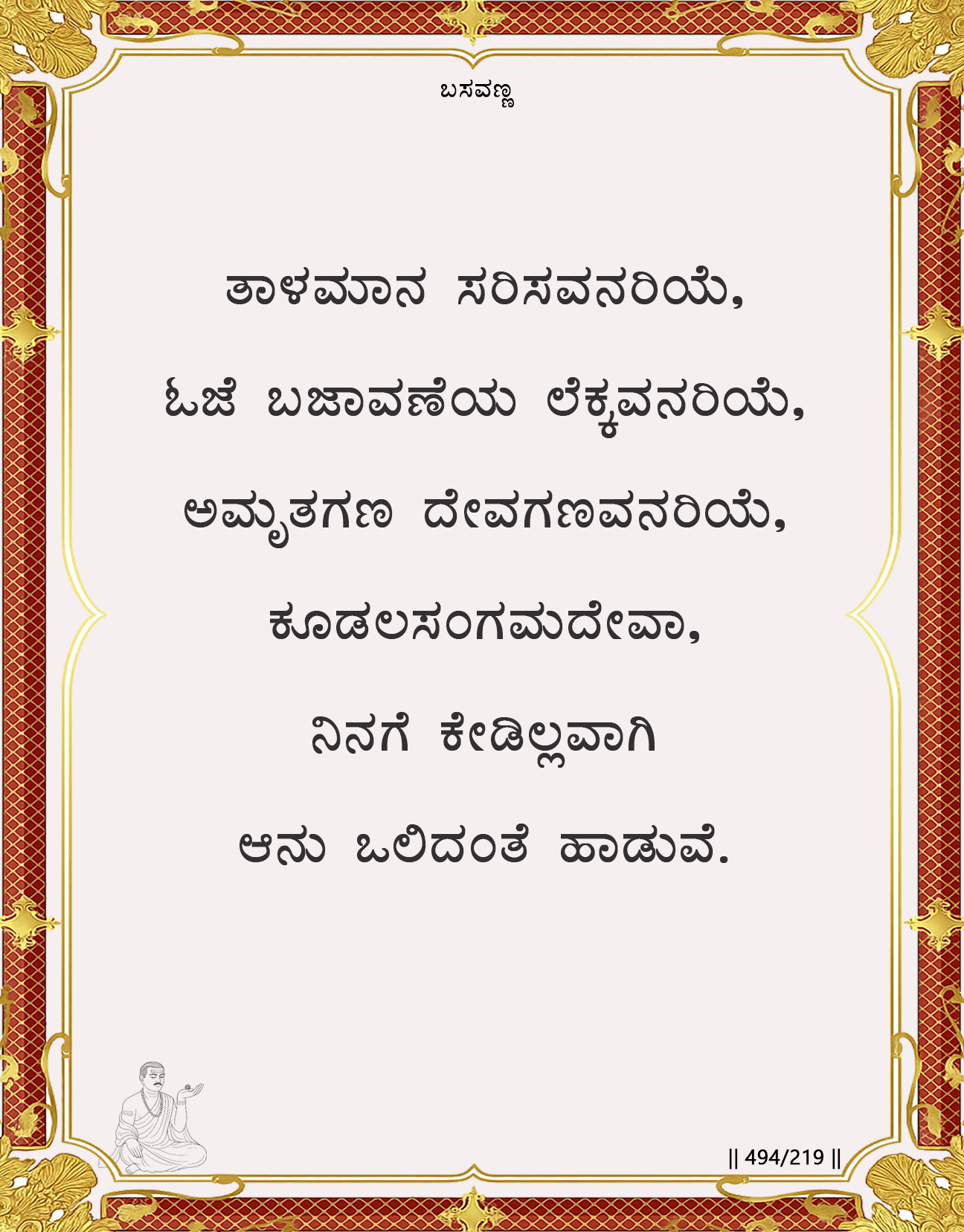
I know nothing of measure or melody,
no rhythm flows from my untutored hands.
I am unskilled in the scales of earth and sky,
a stranger to the arts that others claim with ease.
Yet, O Kudalasangamadeva,
though I lack every rule of song,
I hide nothing of my heart.
Take this raw, unshaped cry
for it is all I have,
and all of it is Yours.
Basavanna reveals that genuine devotion does not depend on learning, technique, or ritual skill. One may be untrained in music, scripture, or sacred arts, yet still stand closest to the Divine through the simple, unfiltered language of the heart. God listens not to crafted performance but to sincerity. The true offering is not the precision of the song but the purity of the emotion behind it a direct, unmediated flow of love that needs no rhythm, scale, or form to reach the Divine.
Spiritual Context
Core Spiritual Principle: The value of spiritual practice is determined by the quality of the heart’s offering (bhavana), not by the sophistication of the method. The most exalted rituals and knowledge are worthless if performed without genuine feeling, while the simplest cry from the heart is the most potent form of worship.
Cosmic Reality Perspective: In the non-dual reality, the Divine is not a separate entity to be impressed by performance, but the very source of the heart’s emotion. A raw, sincere cry is the most direct and frictionless expression of the soul (Anga) recognizing its source (Linga), without the interference of the ego’s constructions.
Historical Reality (Anubhava Mantapa Context): This vachana is a radical democratization of devotion. It empowers the common, unlettered person, assuring them that their love for God is as valid and potent as that of the most learned scholar or skilled priest. It dismantles spiritual hierarchy based on external knowledge and establishes the heart as the true seat of spiritual authority.
Interpretation
“I know nothing of measure or melody… I am unskilled in the scales…”: This is a systematic renunciation of external validation. Basavanna lists the domains of cultivated art and knowledge only to declare his freedom from their tyranny. This is not ignorance, but a chosen poverty that makes room for a richer offering.
“I hide nothing of my heart.”: This is the core of the offering. The devotee offers not a perfected performance, but a transparent self. Vulnerability and authenticity become the highest virtues. There is no mask between the soul and God.
“Take this raw, unshaped cry for it is all I have, and all of it is Yours.”: This is the ultimate surrender. The “raw, unshaped cry” is the unprocessed essence of human longing and love. By offering it “as is,” the devotee acknowledges that even the capacity to love is a gift from the Divine. The offering is simply returning the gift to its source.
Practical Implications: The path of Lingayoga is accessible to all. It does not require one to become a scholar, musician, or ritual expert. It only requires the courage to be authentically and fully present with the Divine, offering one’s current state be it joy, sorrow, confusion, or love without artifice.
The Cosmic Reality
Anga (Human Dimension): The heart in its natural, unadorned state, free from the conditioning of society and the pretensions of the ego.
Linga (Divine Principle): The beloved, the ultimate recipient of love, who values sincerity above all else. The Linga is the mirror that reflects the heart’s true image, not its decorated mask.
Jangama (Dynamic Interaction): The act of heartfelt prayer, the sigh of the soul, the tear of longing. It is the direct current of love that flows when all formal barriers and self-consciousness are dropped.
Shata Sthala
Primary Sthala: Bhakta The emotional intensity, personal relationship, and heartfelt surrender described are the defining characteristics of the Bhakta. The vachana is a love song from the devotee to the Divine.
Supporting Sthala: Prasadi The state of having “nothing” to offer but one’s raw self is the perfect vessel for grace. By claiming no merit of his own, the devotee positions himself to receive everything as a gift.
Practical Integration
Arivu (Awareness Practices): In your meditation or prayer, let go of trying to do it “correctly.” Instead, simply be present. Offer your wandering thoughts, your sleepiness, your restlessness, or your peace exactly as they are to the Linga. This is the “raw cry” of your current awareness.
Achara (Personal Discipline): Practice authenticity in your spiritual life. Do not pretend to feelings you do not have. If you feel distant, offer that distance. If you feel close, offer that closeness. Let your discipline be the commitment to truthfulness with the Divine.
Kayaka (Sacred Action): Offer your work, not as a perfected masterpiece, but as the sincere effort of your hands and heart. The clumsiness and the flaws can be part of the offering if they are given with love.
Dasoha (Communal Offering): In the community, value sincerity over eloquence. Create a space where people can share their spiritual struggles and joys without fear of judgment, where the “raw, unshaped cry” of a seeking heart is honored as the most sacred testimony.
Modern Application
We live in a culture of curated perfection, especially in spiritual and wellness circles. There is pressure to have a “perfect” meditation practice, to use the right jargon, and to exhibit constant positivity. This leads to spiritual performativity and inauthenticity, where people hide their true struggles behind a facade of attainment.
This vachana is a profound relief. It liberates us from the pressure of spiritual perfectionism. It gives us permission to come to the Divine as we are broken, confused, imperfect, but utterly real. It affirms that our authentic, stumbling, and heartfelt seeking is more precious to the Divine than any perfectly executed ritual. This is the gateway to a genuine, deeply personal, and sustainable spiritual life.
Essence
I bring no flowers of polished verse,
no incense of acquired wisdom.
I bring the storm and the silence of my own soul
and lay them, unarranged, at Your feet.
Formal systems of worship (music, ritual, scripture) are like complex, high-level coding languages. They are powerful but can create a layer of abstraction between the programmer and the machine. The “raw cry” of the heart is machine code the most fundamental, unmediated signal. In the cosmology of Lingayoga, the Divine (Linga) is the base reality that responds most directly to this fundamental signal, as it carries the pure data of the soul’s intention without the “noise” of egoic construction.
Imagine a child who cannot speak clearly trying to tell their parent they love them. The parent does not need perfect grammar or eloquent poetry; they understand the meaning directly from the child’s sincere, stumbling attempt. The parent’s heart resonates with the child’s heart, not with their vocabulary. Basavanna is that child, and his vachana is that stumbling, heartfelt attempt that God understands perfectly.
We fear that we are not good enough, skilled enough, or pure enough to approach the Divine. This vachana speaks directly to that core insecurity. It reveals that our feeling of inadequacy is not a barrier but the very key. It is the empty hands that can be filled, the broken heart that can be healed, and the sincere cry that is always heard.

Views: 3