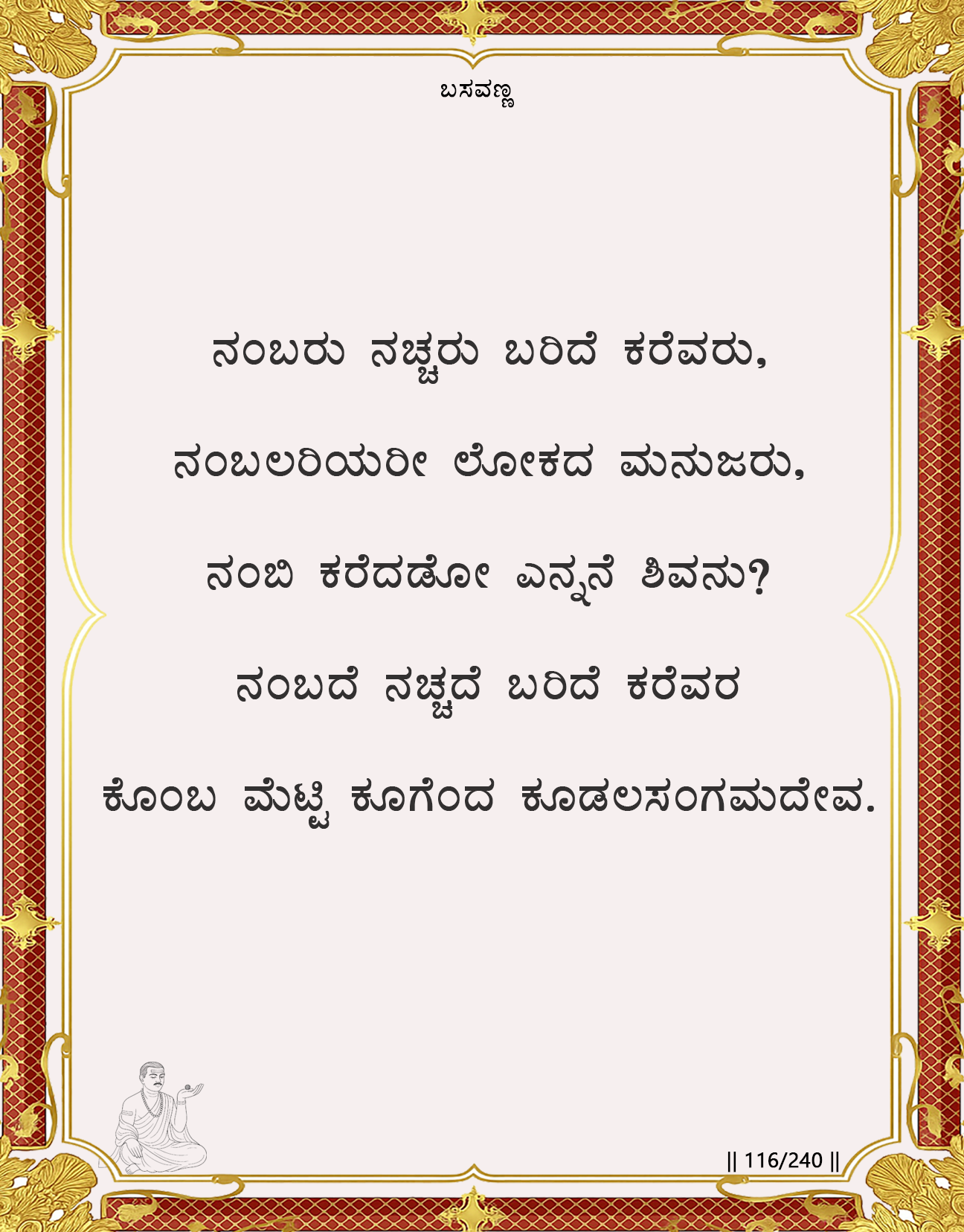
Poetic Rendering
They call with garlands,
they sing with lips,
they flatter with tongue and gesture
but the heart stands empty, untouched.
Can Shiva come to such a call,
where faith is hollow and love absent?
They offer ritual, they offer song
but not themselves.
O Koodalasangamadeva,
the heart that does not melt
cannot summon You,
for You dwell not in sound,
but in silence born of surrender.
This vachana is Basavanna’s incisive critique of performative spirituality and his profound teaching on the nature of authentic prayer. He distinguishes between the appearance of devotion elaborate rituals, melodic chanting, and eloquent praise and its essence, which is the total, heartfelt surrender of the self. The core issue is not the external action, but the internal state of the actor. An “empty heart” signifies a consciousness still occupied by the ego, which uses spiritual practice as a tool for self-glorification or as a transactional bargain with the Divine. True connection, Basavanna asserts, occurs only when the ego’s noise ceases, making space for the silent, resonant frequency of genuine surrender.
Spiritual Context
Core Spiritual Principle: The efficacy of spiritual practice is determined solely by the authenticity and depth of the practitioner’s inner surrender. God is not summoned by ritual sounds but reveals Himself in the silent space where the ego has abdicated its throne.
Cosmic Reality Perspective: In Lingayoga, the Linga is the transcendent, silent ground of being (Nada-Bindu). The cacophony of ego-driven prayer is a frequency that cannot tune into this silent ground. Only when the mind’s chatter and the heart’s pretense cease (“the heart melts”) does the individual consciousness become a silent, receptive vessel (Anga) capable of resonating with the infinite silence of the Linga.
Historical Reality (Anubhava Mantapa Context): This Vachana is a direct challenge to the Brahminical priestly class, whose authority was based on the meticulous performance of sonic rituals (Vedic mantras). Basavanna democratizes access to the Divine by asserting that a silent, surrendered heart in an outcaste is more potent than all the recited scriptures of an arrogant priest.
Interpretation
“They call with garlands, they sing with lips… but the heart stands empty…”: This contrasts the outer vehicle of devotion (body, speech) with the inner driver (the heart/mind). The vehicles are operational, but the driver the sincere, feeling, surrendering self is absent. The practice is therefore an empty shell, a spiritual automaton.
“Can Shiva come to such a call, where faith is hollow and love absent?”: This is a rhetorical question with a resounding “no.” It establishes a cosmic law: the Divine responds not to the form of the call, but to its essence which is faith (shraddha) and love (prema). Without this essence, the form is inert.
“They offer ritual, they offer song but not themselves.”: This is the core of the failure. The ultimate offering in Lingayoga is not an object, but the subject the ego, the self-sense. To offer everything except the self is to offer nothing of value.
“You dwell not in sound, but in silence born of surrender.”: This is the ultimate teaching on the locus of the Divine. God is not an entity that hears petitions; God is the consciousness that manifests when the petitioning ego dissolves into silent surrender. The Divine “dwells” in that very silence.
Practical Implications: The seeker is instructed to prioritize inner attitude over outer performance. Before any prayer or ritual, one must first “melt the heart” cultivate genuine feeling, humility, and the intent to surrender. The quality of five minutes of silent, heartfelt presence is greater than that of five hours of mechanical chanting.
The Cosmic Reality
Anga (Human Dimension): The individual who must transform from a “performer” with an empty heart to a “vessel” with a melted heart. The Anga’s task is to become authentically receptive.
Linga (Divine Principle): Koodalasangamadeva as the silent, all-pervading consciousness that can only be “found” in the internal state of surrender.
Jangama (Dynamic Interaction): The dynamic of authentic prayer is the “melting” of the heart and the resulting silent surrender. This is the true Jangama. The hollow ritual is a false, non-functional Jangama a motion that goes nowhere.
Shata Sthala
Primary Sthala: Bhakta. This Vachana serves as a crucial test for the Bhakta, distinguishing mere external devotion from the beginning of true, internal bhakti characterized by self-offering.
Supporting Sthala: Maheshwara. The process of “melting” the heart breaking down the hard shell of the ego is the purificatory work of the Maheshwara stage.
Practical Integration
Arivu (Awareness Practices): Before practicing japa or prayer, spend a few minutes in silent self-inquiry. Ask: “What is my true intention? Am I performing, or am I sincerely seeking to offer myself?” Feel for the genuine emotional quality beneath the ritual.
Achara (Personal Discipline): Simplify your spiritual practice. Choose a short, meaningful prayer and focus entirely on feeling its meaning in your heart, rather than on completing long, repetitive routines mechanically.
Kayaka (Sacred Action): Let your work be your most honest prayer. Offer the simple, unadorned effort of your labor with full presence and sincerity. This is often a more authentic offering than a forced ritual.
Dasoha (Communal Offering): In community gatherings, encourage an atmosphere of heartfelt sharing and silent communion over impressive performances of scriptural knowledge or musical skill. Value authenticity over expertise.
Modern Application
“Spiritual consumerism” and the performance of wellness on social media; going through the motions of meditation or yoga without inner transformation; the disconnect between professed values and lived action; the noise of self-help that avoids the silent core of surrender.
This Vachana is a call for spiritual authenticity in an age of curation. It liberates the seeker from the pressure to perform spirituality “correctly” and redirects them to the only thing that matters: the raw, honest, and surrendered state of their own heart. It validates simple, silent sincerity over complex, noisy piety.
Essence
The garland, song, and flattering word,
A hollow shell, absurd.
The heart that melts in silent grace,
Becomes the Divine’s dwelling place.
This Vachana describes the difference between Resonance and Forced Vibration. Hollow ritual is a forced vibration an external imposition of sound and form upon a system (the individual) that remains internally inert and disconnected from the source. The “empty heart” has a different natural frequency than the Divine. Authentic surrender, however, is the process of internal damping the “melting” of the egoic structures that create resistance. This allows the individual system to naturally fall into sympathetic resonance with the fundamental frequency of the Linga, which is silence. In this state, no external force is needed; the system simply vibrates with the source, and the distinction between caller and called dissolves.
You can shout into a cave, “Echo!” and the cave will oblige. But the cave does not care about your words; it merely reflects your sound. This is hollow ritual. But if you sit silently in the cave and listen, you may begin to hear the subtle, natural sounds of the earth the deep hum of existence itself. This is surrender. Basavanna says: stop shouting at God. Sit silently and listen. God is already speaking in the silence.
The most powerful prayer is not something you do, but something you allow to happen to you. It begins not with your voice, but with your silence; not with your strength, but with your yielding. God is not impressed by your performance, but is revealed by your authenticity. When you stop trying to reach the Divine and simply offer yourself completely, you discover the Divine was always there, waiting for you to be quiet enough to notice.

Views: 13