Poetic Rendering
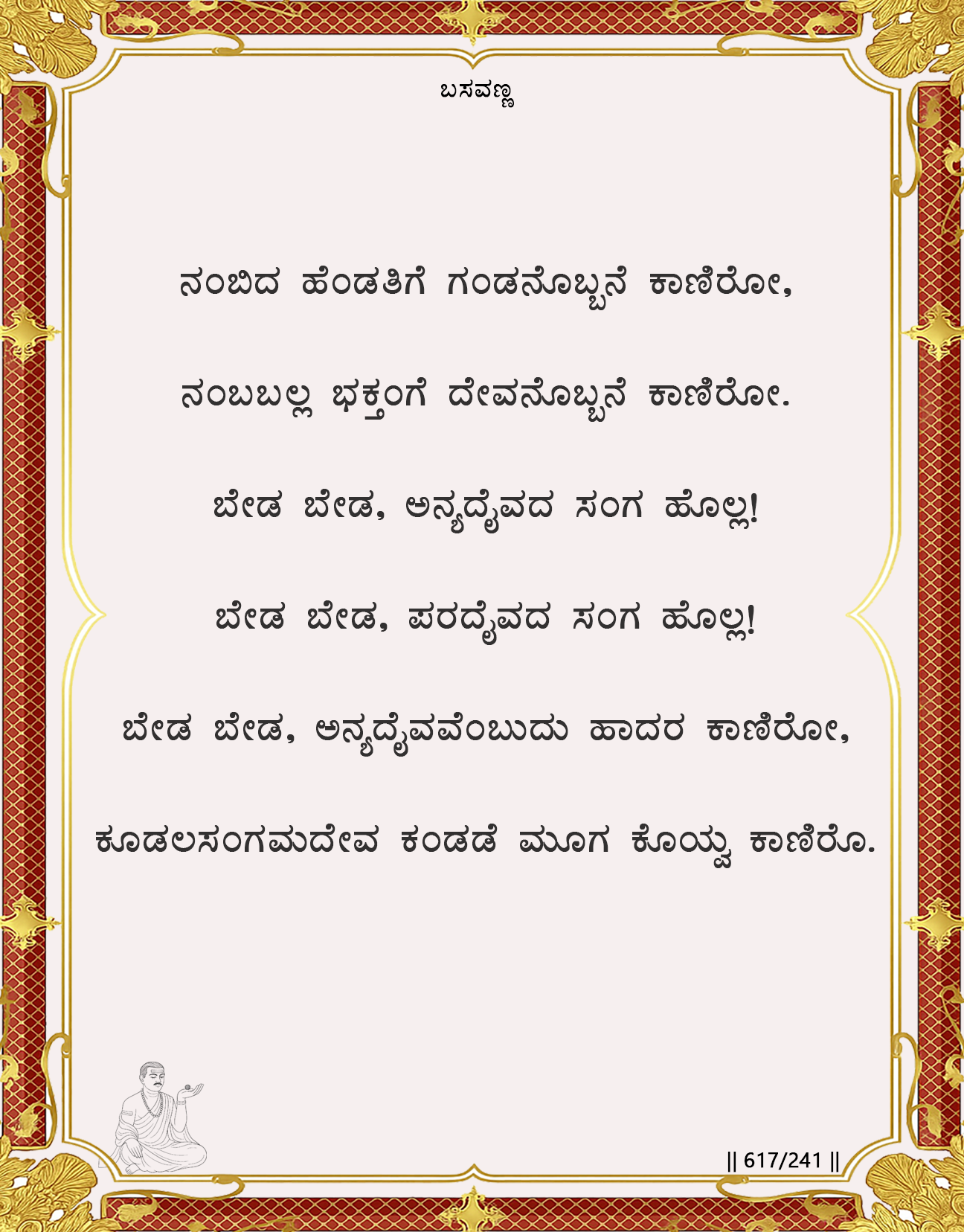
As a faithful wife cleaves to one husband,
so the awakened heart cleaves to one God.
Turn away, turn away
from the glitter of many gods
they scatter the mind
like wind scattering dry leaves.
Turn away, turn away
from wandering paths and borrowed lights;
they lead the seeker outward,
far from the sun within.
Seek only the One who dwells in your innermost breath
for running after outer deities
is to exile yourself from your own truth.
Those who do so stand stripped of devotion
before Kudalasangamadeva.
Vachana proclaims the necessity of single-pointed devotion. Just as fidelity creates harmony in human relationships, spiritual fidelity unifies the seeker’s inner world. Searching for God outside through multiple deities or external symbols distracts and fragments the mind. The true Divine resides within the heart, and those who chase outward forms lose intimacy with their own inner source. The vachana urges unwavering inward focus as the authentic path to Kudalasangamadeva.
Spiritual Context
Core Spiritual Principle: Spiritual progress requires unwavering, single-pointed focus (Aikya Bhakti). The mind, by its nature, becomes what it contemplates. Contemplating the manifold leads to fragmentation; contemplating the One leads to integration and union.
Cosmic Reality Perspective: In the non-dual framework of Lingayoga, the Linga is the singular, non-dual reality (Advaya). The “many gods” and “wandering paths” are provisional realities within the realm of duality (Dvaita). To seek them is to remain trapped in multiplicity and separation. The path to the non-dual is through exclusive devotion to the one, formless principle that manifests as the “innermost breath.”
Historical Reality (Anubhava Mantapa Context): This Vachana provides a clear, uncompromising spiritual direction for the Lingayat community, setting it apart from the polytheistic and ritualistic practices of mainstream Hinduism of the time. It simplifies the path, making it accessible to all by focusing on the essential, internal relationship with the Divine, bypassing the complex pantheon of deities and rituals.
Interpretation
“As a faithful wife cleaves to one husband…”: This analogy establishes devotion as a relationship of intimate, exclusive love and commitment (Bhava). It is not a transaction but a merging of identities. Fidelity prevents the dissipation of emotional and spiritual energy.
“Turn away from the glitter of many gods… they scatter the mind…”: “Glitter” represents the attractive but ultimately superficial diversity of forms. A scattered mind is a weak mind, incapable of the deep concentration required for Self-realization. Each external deity becomes a new object of distraction.
“Seek only the One who dwells in your innermost breath…”: This is the ultimate instruction. The “innermost breath” (Prana) is the most intimate, constant, and universal experience of life. To locate the Divine here is to find it not as a concept, but as the very substance of one’s existence. It is always present, requiring no external search.
“…running after outer deities is to exile yourself from your own truth.”: This is the profound consequence of external seeking. The very act of looking out there for what can only be found in here is a self-imposed exile from one’s true nature (Swabhava).
Practical Implications: The seeker is instructed to relentlessly prune their spiritual practice. The focus should be on one chosen form (Ishtalinga) or formless practice, rejecting all other distractions. The practice is one of constant inner orientation, using the breath or the feeling of the heart as an anchor to return to the “One.”
The Cosmic Reality
Anga (Human Dimension): The heart and mind of the seeker, which must be trained to become a single-pointed, faithful instrument focused on one goal.
Linga (Divine Principle): Koodalasangamadeva as the singular, indwelling reality the “husband” of the soul, the “sun within.”
Jangama (Dynamic Interaction): The dynamic is the continuous act of turning away from multiplicity and turning towards the inner One. This conscious, moment-to-moment choice is the Jangama that forges the union.
Shata Sthala
Primary Sthala: Bhakta. The quality of single-minded, fervent devotion is the defining characteristic of a true Bhakta. This Vachana is a guide for cultivating that quality.
Supporting Sthala: Pranalingi. The goal of this single-pointed devotion is to realize the Linga as one’s very life force (Prana), which is the state of Pranalingi.
Practical Integration
Arivu (Awareness Practices): Practice focusing your awareness on the “innermost breath.” With each inhalation and exhalation, feel it as the movement of the Divine within you. When the mind wanders to external objects, gently return it to this anchor.
Achara (Personal Discipline): Simplify your spiritual life. Choose one mantra, one form for meditation, and one path. Consciously abstain from exploring other spiritual “options” that may arise, treating them as distractions.
Kayaka (Sacred Action): Dedicate all your work to your one chosen ideal of God. Let every action be an offering to that singular reality, unifying your inner and outer life.
Dasoha (Communal Offering): Share the power of this focused approach. In a world of spiritual consumerism, help others understand the value of depth over breadth, of fidelity over exploration.
Modern Application
Spiritual consumerism; “deity collection” and mixing practices from different traditions without depth; the “shopping” mentality in spirituality; the distraction of countless spiritual teachers and methods available online, leading to a fragmented and shallow practice.
This Vachana is an antidote to the overwhelm of the modern spiritual marketplace. It offers clarity and depth. It liberates the seeker from the anxiety of missing out on other paths and empowers them to go deep into one, promising that true fulfillment is found not in the breadth of knowledge, but in the depth of a single, loving relationship with the Divine within.
Essence
One heart, one God, a single flame,
To call another’s, is to maim.
The scattered mind finds no repose,
In the One Breath, the lotus grows.
This Vachana describes the principle of Laser-Like Consciousness. Ordinary consciousness is like a flashlight beam broad, diffused, and illuminating many things superficially. Single-pointed devotion transforms consciousness into a laser beam a coherent, focused, and powerful stream of energy directed at one point. The “many gods” represent the diffused beam, which has little power to penetrate the veil of ignorance. The focused beam of devotion, aimed at the “One in the breath,” has the intensity to burn through all obstacles and reveal the underlying non-dual reality. The act of “turning away” is the process of removing the lenses that cause diffraction.
You cannot dig a well by digging one-foot holes in a hundred places. You will only find mud. To find water, you must dig deep in one single spot. The “many gods” are the hundred shallow holes. The “One in the breath” is the single, deep spot. Basavanna commands: stop digging shallow holes. Pick one spot the spot within your own being and dig relentlessly until you strike the aquifer of the Divine.
You cannot truly love many people at once with the depth of a lifelong partner. Love deepens through exclusivity and commitment. The same is true for your relationship with the Divine. A heart divided cannot know the depths of union. The greatest spiritual power is not in knowing about many paths, but in walking one path with your whole heart. Your undivided attention is the most sacred offering you can make.

Views: 7